

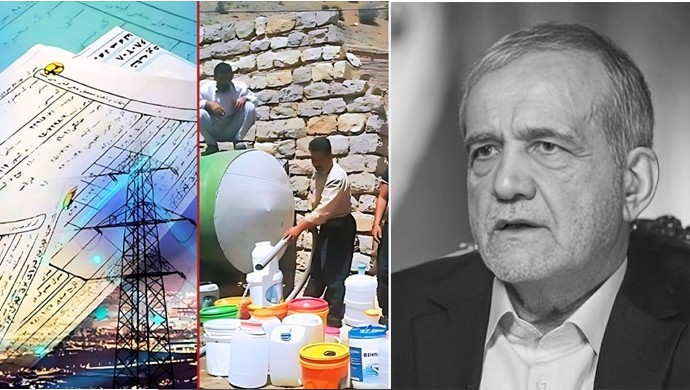

In a stunning admission of systemic failure, the Iranian regime’s president, Masoud Pezeshkian, has publicly conceded that his government has lost control over the nation’s most basic services and economic stability.
Speaking on Sunday, August 10, Pezeshkian painted a grim picture of a regime cornered by its own incompetence, stating that its actions are now dictated by “obligation,” not choice. His words are not merely a political statement but a confession that the ruling mullahs are presiding over a complete collapse, pushing Iranian society toward a social explosion.
The daily misery: Power outages and soaring prices fuel public rage
Pezeshkian’s admission reflects the daily reality for millions of Iranians. According to a report from the state-run Shahr-e Burs website on July 23, long and unplanned power outages have severely disrupted citizens’ lives, with the situation in Tabriz reaching a boiling point. The public’s anger is compounded by blatant discrimination, as government offices, banks, and state organizations continue to consume electricity without restriction while ordinary people suffer in the dark.
This injustice, reported by Shams Azerbaijan website on the same day, is a stark reminder of the regime’s corruption. Meanwhile, a member of the regime’s parliament, Mojtaba Yousefi, admitted on July 23 that there is “no justification” for the crushing price hikes that directly target people’s livelihoods. The state-run Panjereh website confirmed this dire outlook, warning that a new inflationary shock is imminent for staples like bread, rice, and oil.
This state-sanctioned misery has predictably spilled onto the streets. Across the country, citizens are transforming their economic grievances into open defiance. In cities like Rasht, large crowds have gathered to chant, “Water, electricity, life, are our undeniable rights,” while in Zabol, residents protested unbearable blackouts amid scorching 50-degree Celsius temperatures. Similar protests took place in many other cities in the past week.
The unraveling social fabric: A society on edge
The regime’s economic crisis extends far beyond daily utilities. The housing market has become what state media itself calls a “permanent nightmare.” According to Tejarat News on July 21, tenants are fleeing to city outskirts to escape soaring prices, only to find that rent hikes have followed them.
A day later, on July 22, Fararu reported that rent inflation in Tehran had surged by 30-35%, a figure completely disconnected from the incomes of most families. The psychological toll of this relentless pressure is immense.
The Eco Iran website observed on July 23 that the economic hardship has created a society defined by “explosive anger,” where even the smallest frustration can trigger a furious outburst.
This “explosive anger” is visible in the growing wave of strikes and protests. It fuels the defiance of defrauded citizens protesting state-run housing scams and animates the powerful actions of oil workers and truckers. The chant of truck drivers in Tehran—”Drivers rather die than accept humiliation”—is a testament to a populace that has reached its breaking point.
August 5—Tehran, Iran
Fourth day of protest rallies by truck owners in front of the Ministry of Industry, Mines, and Trade, demanding the release of their imported trucks, which have been blocked by regime authorities for many months.#IranProtestspic.twitter.com/G5c5sqaRdA— People's Mojahedin Organization of Iran (PMOI/MEK) (@Mojahedineng) August 5, 2025
From economic crisis to a call for revolution
The clerical regime is sitting on a social powder keg. Its own media outlets are sounding the alarm; the state-run Arman-e Emrooz newspaper warned on July 7 that “social demands are no longer limited to the elites” and that the regime’s top-down policies can no longer guarantee stability. Pezeshkian and the ruling mullahs have no solutions because they are the source of the crises.
As the regime sinks deeper into international isolation and internal strife, the Iranian people’s response has become clearer and more focused. The protests are no longer just about economic survival. The cries heard from rooftops, metro stations, and streets have transformed into an undeniable political demand, with slogans like “Death to the Dictator” openly targeting the root of their suffering.