

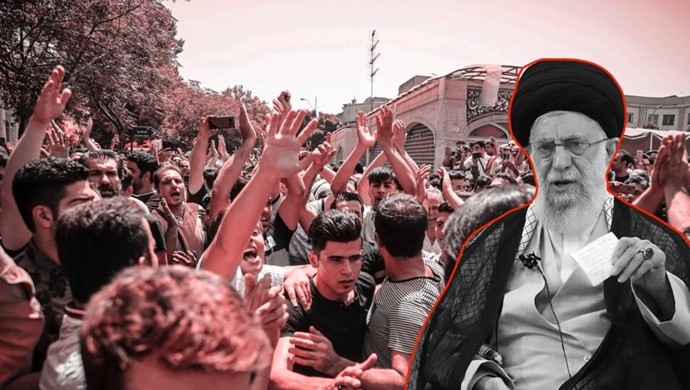

The Nowruz address of Iranian regime supreme leader Ali Khamenei’s Nowruz reveal a regime entangled in its contradictions and crises. Khamenei’s discourse, ostensibly aimed at instilling hope and faith in the future, inadvertently underscored the prevailing sense of deadlock and despair that has seized his regime from within. This analysis delves into the subtext of Khamenei’s remarks, unearthing the underlying tensions and challenges facing the Iranian leadership.
Khamenei’s speech was punctuated with references to national interests and a bright future predicated on hope and faith. He stressed the importance of maintaining hope in the hearts of the Iranian people, suggesting that progress is contingent upon a collective belief in the possibility of advancement and change. Yet, this call for optimism is the opposite of the reality on the ground, as it comes against the backdrop of widespread disillusionment and resistance by the Iranian population against the regime.
The Iranian people, far from being the intended audience of Khamenei’s exhortations, have demonstrated their unequivocal rejection of the regime’s overtures through their boycott of the sham parliamentary elections on March 1st and their relentless participation in a series of indomitable street protests throughout 2022. These acts of defiance have not only shaken the foundations of Khamenei’s rule but have also signaled the irreconcilable rift between the regime and the citizenry.
Khamenei’s speech can be interpreted as a desperate attempt to rally the remaining loyalists within the regime’s apparatus—particularly the suppressive forces that have been instrumental in maintaining his grip on power. These include the Revolutionary Guards, Basij militia, security forces, and plainclothes agents, who have historically been the regime’s bulwark against uprisings and are now being incentivized through promises of rewards, housing, and salary increases to quell the expanding dissent.
The internal strife within the regime’s power hierarchy is evident, as the anticipated consolidation of power through staged elections and the resolution of the succession dilemma have not materialized as planned. Instead, the regime finds itself embroiled in internecine conflicts, with the specter of civil unrest looming larger than ever. Moreover, the regime’s terrorist interventions in the region have failed to divert attention from its domestic failures, further exposing its strategic vulnerabilities.
Amidst these challenges, the role of the People’s Mojahedin Organization of Iran (PMOI/MEK) as a democratic alternative has been notably significant. The PMOI’s ability to galvanize widespread international support and orchestrate a series of global campaigns underscores the viability of an organized opposition capable of challenging the regime’s legitimacy and offering a vision for a democratic Iran.
In response to the escalating crisis, Khamenei’s narrative of hope appears as a thinly veiled attempt to pacify the disheartened elements within the regime, urging them to persevere in the face of mounting opposition. However, this strategy seems to be losing its efficacy, as the calls for hope and faith within the regime’s ranks are increasingly met with skepticism and resistance from the regime’s own elements.
The year 1403 (March 2024-March 2025) has been declared by the Iranian Resistance as the year of “uprising and rebellion,” reflecting a steadfast commitment to challenge the regime’s authority and advocate for a transformative change in Iran. This declaration signifies a crucial juncture in Iran’s protracted struggle for freedom and democracy, emphasizing the indomitable spirit of a nation determined to reclaim its future from the clutches of tyranny.
As Iran stands at this pivotal moment, the contradictions and challenges within the regime are laid bare, revealing a leadership grappling with existential threats from within and without. Khamenei’s attempts to cloak these vulnerabilities in a rhetoric of hope and progress cannot mask the deep-seated issues that continue to undermine the regime’s stability. The ongoing resistance movement, bolstered by the international community’s growing acknowledgment of the PMOI’s role, represents a beacon of hope for a democratic and prosperous Iran, free from the shadows of despotism and oppression.