

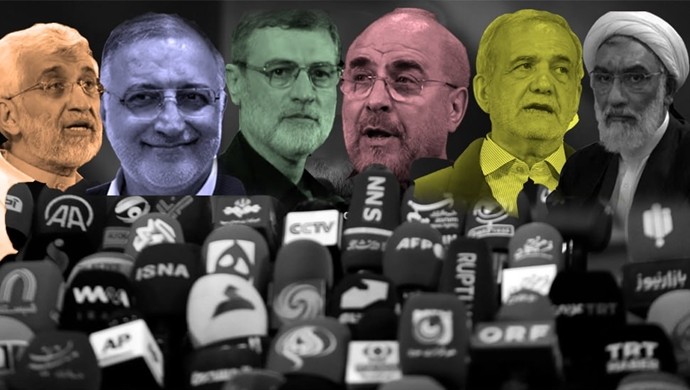

As Iran’s regime approaches its premature presidential elections following the death of Ebrahim Raisi, its own media and officials refer to the election race as a “show,” “stand-up comedy,” “modeling,” and similar terms.
Apart from the people, who have long since made their stance clear on these absurd shows, within the regime itself, there is little enthusiasm left for watching this “premature” and imposed puppet show.
On June 9, the state-run Hamdeli newspaper wrote, “It seems that we have no choice but to watch the forced show of the ‘claimants of service’ doing somersaults! Stage designers who have repeatedly donned the oversized robe of national management over the past decades and, to put it better, for reasons we all know, have draped it over their frail bodies… Uneducated ‘politicians’ who, in the name of service and of course for the sake of power, have entertained people with grand promises, leaving behind nothing but empty rhetoric and fruitless boasting in their memories.”
Despite all this, looking at the statements of the six remaining candidates on radio, television, and the regime’s media in recent days is worth the effort; especially as it not only reveals the ridiculous nature of this show but also highlights the current state of the regime.
The main and amusing feature of this drama is that all six actors play the same role and say the same thing with minor differences. They not only declare their allegiance to regime supreme leader Ali Khamenei, but also outdo each other in their commitment to continue Raisi’s path and program.
The Majlis (Parliament) Speaker, Mohammad Bagher Ghalibaf, who in his television interview had been talking about “new governance” for a long time, said: “One of the necessities I felt to come here and set aside comfort-seeking is to implement Raisi’s program.”
In his promotional program, Alireza Zakani, the current mayor of Tehran, emphasized that “we all have heavy duties to continue the path of Martyr Raisi.”
Amir-Hossein Ghazizadeh Hashemi, another candidate for regime’s presidential election, said: “I consider myself responsible for continuing the path of martyr Raisi. Ayatollah Raisi’s government had unfinished tasks… Raisi had changed the path and approaches… Raisi’s ideals should not be left unfulfilled.”
In declaring his allegiance to the Khamenei and Raisi’s path and program, Massoud Pezeshkian spoke more clearly than the other competitors and said: “We are not supposed to write new programs, we are not supposed to implement new policies in the country, but the general policies issued by the Supreme Leader are clear and development plans exist. Every incoming government must implement the existing programs.” With this straightforwardness, he clarified not only his stance but also the roadmap for the other five actors in this show.
Former chief nuclear negotiator Saeed Jalili played a higher card than his competitors and said that he and his “shadow government” have been running Raisi’s government for the past three years. He said that in this “shadow government” there were “dozens of specialized working groups… and managers and experts whose number exceeds one thousand. Along with activating this agile and low-cost but hardworking headquarters, I traveled to various parts of the country over 140 times.”
Undoubtedly, if the “continuation of the path” of Raisi is intended, Mostafa Pourmohammadi, a notorious executioner who is responsible for the death of thousands of political prisoners, protesters, and other Iranians who want to live in freedom and decency, has no rival.
On June 11, Mehr news agency reported that Pourmohammadi appeared with an “artistic pose” in his promotional film. The closer the regime gets to its elections, the more evident it becomes that it is stuck in continuing its failed policies, which will eventually lead to more confrontations with the people.