

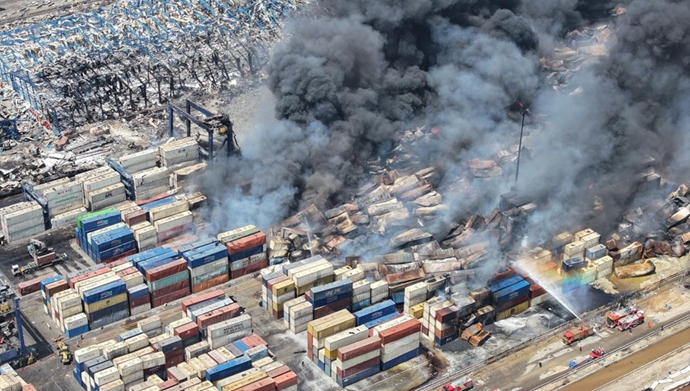

The massive explosion in Bandar Abbas, which regime outlets stated reached temperatures of “up to 1400 degrees Celsius” and The Washington Post estimated its power as equivalent to the detonation of 50 tons of TNT, not only claimed the lives of hundreds of Iranians but also further exposed the anti-people nature of the mullahs’ regime ruling Iran.
This explosion demonstrated that Iranian regime supreme leader Ali Khamenei, in order to continue his sinister policy of “warmongering”—essential for the regime’s survival—not only wastes the nation’s resources on missiles and nuclear programs but also turns various parts of Iran into killing fields by stockpiling explosive materials and missile fuel.
Now, after the explosion, Khamenei, terrified of public anger fueled by the exposure of this reality, shamelessly dismissed the catastrophe as “an incident that happens everywhere” and tried to downplay its scale by urging people to “be patient.” However, this cover-up is futile against the stark reality and the nation’s fury.
Following Khamenei’s shameless remarks and his adding insult to injury by telling people to “be patient,” the regime’s prosecutor’s office in Hormozgan province, in a scandalous attempt at a cover-up, reduced its own repeatedly minimized death toll from 70 to 46, claiming only 11 people were missing. Yet, at the same time, state media, like the Entekhab website, reported that in just one instance, “30 to 40 people whose family members went missing after the explosion incident at Rajaee Port gathered at the entrance gate of the port.”
The official figure of 46 deaths, widely ridiculed by the public, stands in stark contrast to witness accounts provided to Simaye Azadi (the satellite TV channel of the Iranian Resistance):
“Easily over 300 to 400 bodies were incinerated on the docks, leaving no trace.”
“I personally knew 15-16 people who vanished without a trace.”
“Many Baluchi people who worked there, entering without documentation through the back gates, were all burned.”
“I can confidently say the death toll is 400, 500, or 600, possibly higher, but absolutely not lower.”
Regarding the injured, eyewitnesses describe the intensity of the blast, stating that for many, even their “eyes were blown out of their sockets.”
What directed the immense public anger more sharply towards the IRGC and Khamenei after this catastrophe was their role in the presence of missile fuel, which, according to international news agencies like the Associated Press, was stockpiled in the port under the supervision of the IRGC and sanctioned companies linked to Khamenei’s office.
These are the facts that have deeply frightened Khamenei. He now seeks to hide the reality through rhetoric and tricks. But the cover-up is useless; the people’s anger, exceeding tolerance for these crimes, is about to explode. His role and that of the IRGC in the Bandar Abbas disaster are clear to the people, especially the suffering and grieving residents of Bandar Abbas.
As widely seen in recent popular protests and on social media, the Iranian people increasingly emphasize that as long as anti-people regimes like the Shah’s monarchy and the current clerical rule are in power, such disasters will continue. Therefore, only by uprooting them and establishing a democratic republic based on the people’s vote can an end be put to these calamities.