

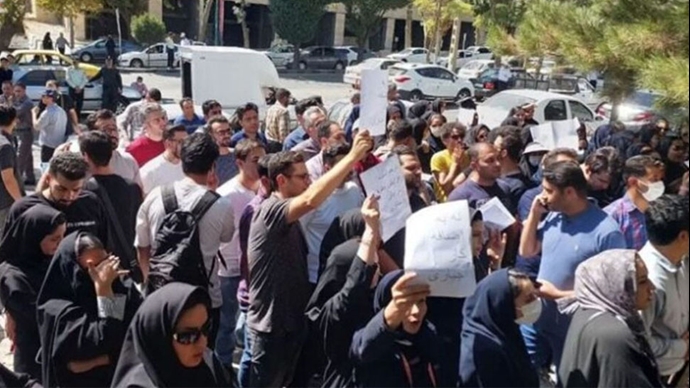

“The recent strikes and protests have featured slogans such as ‘Justice for nurses’ and ‘Stop the exploitation of nursing staff,’ which reflect an increased awareness among this group regarding their rights. Iranian nurses have clearly realized that only through unity and widespread protests can they achieve their goals. The support from some public groups and even segments of the medical community for these protests indicates that the issue of nurses has evolved into a broader social concern.”
More footage of the protest by nurses in Isfahan.
Protesters chanting:
"Incompetent officials, resign!"
"Overtime work at 20k tomans, shame on you!"#IranProtestspic.twitter.com/2ginhj8ygf— People's Mojahedin Organization of Iran (PMOI/MEK) (@Mojahedineng) September 7, 2024
The above sentences were reported by state-run Eghtesad 24 news website, on August 30. Although the author has admitted to some aspects of the truth, it is better to first take a broader look at the recent public protests to gain a deeper understanding of the demands of various groups including nurses, and the essence of the conflict between the people and the regime. Only then can one judge whether the demands of the Iranian people remain limited to professional, economic, and “social” issues or have taken on a “political” tone.
Recent protests
The protests by nurses continued, with emergency personnel and nurses from Isfahan University of Medical Sciences persisting in their protests that had begun weeks earlier.
Also, there were protests by applicants for National Housing in front of the Ilam Governor’s Office for the umpteenth time, protests by Shaskam Telecom workers in Tabriz, protests by South Pars Gas Refinery workers in Asaluyeh, protests by residents of Dehmord village in front of the Bakhtegan County Governor’s Office against the lack of a local council and mayor and against mining operations near residential buildings, protests by oil workers from the Bahrgan region in Bushehr, and protests by spinal muscular atrophy (SMA) patients and their families in front of the Ministry of Health against the scarcity and extreme cost of essential medicines for these patients.
One of the distressing scenes on this day was the protest action by dairy farmers in Yazd, who poured out their produced milk on the ground in protest their living conditions and government-set prices. They stated that despite the rising cost of animal feed compared to last year, the purchase price of milk had not changed.
On September 1, the protests intensified. The main group of protesters were retirees who had spent their lives serving their fellow citizens and are now deprived of even minimum pension benefits. Retirees from the Social Security and Civil Service sectors in the cities of Tehran, Isfahan, Ahvaz, Rasht, and Shush, as well as retirees of the steel industry in Isfahan, and retirees from Social Security, Civil Service, and Telecommunications in Kermanshah, held rallies to protest the corrupt and plundering policies of the regime. In Behbahan, the nurses’ protest in front of the city governor’s office continued. In Tehran, university entrance exam candidates protested in front of the Presidential Office against the definitive impact of high school grades on the entrance exam results.
September—Isfahan, central Iran
Retirees of the steel industry hold protest rally, demanding higher pensions and other basic rights.#IranProtestspic.twitter.com/k0Wlbhb4Oe— People's Mojahedin Organization of Iran (PMOI/MEK) (@Mojahedineng) September 1, 2024
Other protests on this day included electric taxi drivers protesting in front of the Taxi Organization and a group of military personnel in Tehran protesting in front of the General Staff of the Armed Forces against the non-delivery of pre-purchased homes.
On this day, security forces attacked protesting workers of the Wagon Pars factory in Arak, beating them. Several workers were arrested, and some were injured and taken to the hospital. The workers have been on strike for over a month, protesting unpaid wages and the actions of the factory’s regime-appointed manager. They are also demanding the reinstatement of their dismissed colleagues.
September—Iran
Workers of the Wagon Pars train and locomotive manufacturer in Arak intend to go to Tehran to continue their protests in front of the presidential palace despite threats and arrests by security forces. pic.twitter.com/WcBQdY9oal— People's Mojahedin Organization of Iran (PMOI/MEK) (@Mojahedineng) September 1, 2024
On September 2, demonstrations and protests by various professions and social groups continued. Emergency personnel and nurses at Isfahan University of Medical Sciences once again took to the streets, chanting slogans such as “Inflation is in dollars, our salaries on in rials.”
The people of Mirjaveh city protested the allocation of their ancestral lands to non-locals by the head of the Chamber of Commerce, which ignored the rights of the local population and Baluch citizens.
Additionally, residents of the Balvan-Abad area, part of Dehgolan County, held a protest for the third day, blocking roads in protest poor road conditions. They demanded the release of those arrested the previous day during clashes between local people and special forces.
A common thread in protests
The socio-economic protests of the oppressed classes are becoming more radical by the day due to the regime’s lack of responsiveness. In many of these gatherings, the regime’s repressive forces, fearing that the protests could ignite an uprising, intervened and arrest protesters through beatings. Currently, several activists from labor and nursing protests have been arrested and are in prison.
Therefore, it is completely natural in the progression of the Iranian people’s freedom movement that various professions and groups conclude that the only way to achieve their rights is through “unity” for a major political change.
This conclusion was most clearly expressed during the retirees’ gathering in Kermanshah, where one of them said in a speech, “The only way to achieve our rights is through unity and organization.”
The enlightened retirees of Kermanshah demonstrated this unity in practice on the streets with slogans like “Nurses’ livelihood, patients’ health” and “Nurses, we support you,” showing that the root of the problems faced by nurses, retirees, and other social groups is the same.
With the slogan “Warmongering is enough, our tables are empty,” they exposed the entire deceitful apparatus of the mullahs for regional warmongering and most vocally protested the theft of their livelihood to fuel regional crises.
The angry retirees, with the slogan “Bodies will hurt, lives will be destroyed, but freedom can’t be destroyed,” reminded all social classes of the goal of their protests, which is “freedom.”
With the slogan “United and in agreement, against the death penalty,” they shattered the regime’s atmosphere of fear and terror created by the expansion of executions aimed at preventing further protests, and they called for unity and alliance against executions and executioners.
The mullahs’ regime wanted to stop gatherings and protests through executions, but now the people are chanting against executions during their protests.
Therefore, the demands of the Iranian people have transcended “justice,” “elimination of discrimination,” and their professional rights, reaching the political realm and the realization of “freedoms” and the rejection of “warmongering” and “executions. ”
These nationwide protests, along with the expansion of the Resistance Units’ activities, indicate the revolutionary situation of society for a deep-rooted political change with the participation of all oppressed masses.