

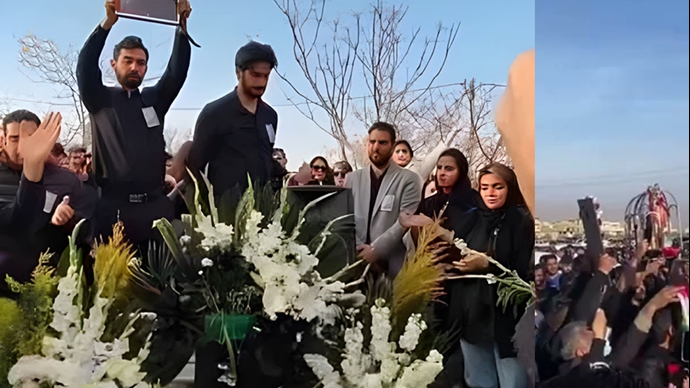

The uprising that erupted across Iran on December 28, 2025, has undergone a profound transformation. What began with shopkeepers shuttering their stores over the collapsing rial has evolved into a nationwide political movement challenging the very foundations of the clerical regime. Now, 40 days after the regime’s crackdown left thousnads dead, the traditional end of mourning has become the beginning of a new offensive.
In Iranian culture, the 40th day after a death—known as Chehelom—traditionally marks the end of mourning. Families usually remove their black garments, and life returns to normal. However, for the martyrs of the January 2026 uprising, this tradition has been inverted. The 40th-day memorials have not been a time for silence or closure, but a strategic launchpad for renewed protests. In cities across the country, tears have turned into flames, and graves have turned into trenches.
Cemeteries turned into bastions of defiance
In Nurabad Mamasani, Kazerun, and Kuhchenar, crowds gathered not to weep, but to pledge allegiance to the fallen. At the graves of martyrs like Reza Shahrivar and Arian Kashkouli, the atmosphere was electric with revolutionary fervor. The mourners, holding the names of the dead like flags, chanted slogans that targeted the highest levels of the regime: “Death to Khamenei” and “I will kill he who killed my brother.”
February 16—Karaj, northern Iran
People mark the 40th day of the martyrdom of Reza Habibi and Sajjad Darab, two protesters murdered by the regime during the nationwide uprising. Mourners chanted, "We swear on the blood of our comrades that will stand till the end" and "Down with… pic.twitter.com/OLQPsqWCPc— People's Mojahedin Organization of Iran (PMOI/MEK) (@Mojahedineng) February 17, 2026
This spirit of defiance was mirrored in Rostamkola, Behshahr, where a woman read verses from the Shahnameh—Iran’s epic book of kings and heroes—over the grave of martyr Houman Sabbagh, linking the current struggle to Iran’s historical fight against tyranny. Similarly, in Hamedan and Malayer, crowds honoring martyrs Nima Najafi and Mojtaba Roustaei vowed to stand until the end.
The regime’s admission of a “lose-lose” game
The persistence of the unrest has caused visible fissures within the regime. Mohammad Reza Aref, the First Vice President of the regime, admitted in a rare moment of candor that the January uprising was a “lose-lose game” for the regime. Aref expressed frustration that the youth were mobilized to oppose the “principle of the system” and target government buildings. His comments reveal a deep-seated fear that the crackdown has failed to restore stability and that the “wall of fear” has collapsed.
The regime’s response remains brutal, yet ineffective. On the evening of February 16, 2026, in Abdanan (Ilam province), during the 40th-day memorial for martyr Alireza Seidi, authorities cut off internet access and opened fire on protesters. Despite the presence of high-ranking military commanders and heavy suppression, the people took to the streets chanting “Death to Khamenei.”
February 16—Abdanan, western Iran
People of Abdanan held anti-regime rallies, chanting, "Down with Khamenei!" It is worth noting that during the January 2026 uprising, the people of this city took control of the city from the regime's security forces.#IranProtests pic.twitter.com/ktmL29OnHq— People's Mojahedin Organization of Iran (PMOI/MEK) (@Mojahedineng) February 17, 2026
Simultaneously, the resistance remains strong within Iran’s universities. On February 14, students at Tehran University of Medical Sciences staged a sit-in to honor martyr Aida Heidari. Refusing to attend exam sessions, they held signs declaring, “The bloodied shirt of martyrs is our shroud,” rejecting the regime’s attempts to normalize the situation on campuses.
The 40th-day ceremonies have proven that the blood of the martyrs has become the fuel for the uprising. As the crowds in Nurabad chanted, “We didn’t give martyrs to compromise, to praise the murderous leader,” they signaled that the path forward is not negotiation, but the overthrow of the religious dictatorship.
February 14—Tehran, Iran
Students at Tehran University of Medical Sciences held a protest rally, holding photos of students murdered by the regime's security forces during the January uprising and demanding the release of medical staff imprisoned for treating wounded protesters.… pic.twitter.com/ZsXbVuF1xr— People's Mojahedin Organization of Iran (PMOI/MEK) (@Mojahedineng) February 15, 2026