

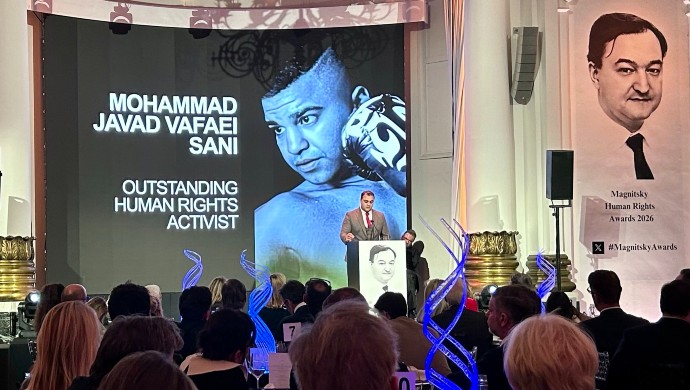

On November 12, 2026, Iranian political prisoner Mohammad Javad Vafaei Sani, a boxing champion and supporter of the People’s Mojahedin Organization of Iran (PMOI/MEK) who faces execution, received the prestigious 2026 Magnitsky Award for Outstanding Human Rights Activist at a ceremony in London.
The award was presented in absentia, as Vafaei Sani remains imprisoned in Vakilabad Prison in Mashhad, northeastern Iran, where he has been held under the threat of execution following years of torture, solitary confinement, and repeated death sentences.
The ceremony brought together prominent political figures, human rights defenders, journalists, and legal experts, including Geoffrey Robertson, Bianca Jagger, Antonio Stango, Emanuelis Zingeris, and Mark Ellis.
British MP Bob Blackman presented the award, which was accepted by Mohammad Namdari on behalf of Vafaei Sani and his family.
A message sent by Vafaei Sani from prison was read to the gathering, conveying his determination to continue resisting repression despite the death sentence hanging over him.
Bob Blackman calls for the annulment of Vafaei Sani’s death sentence
Presenting the award, Bob Blackman, chair of the British Committee for Iran Freedom, highlighted Vafaei Sani’s ordeal since his arrest following the November 2019 nationwide protests.
Blackman recalled that the Iranian boxing champion had been imprisoned for more than six years because of his participation in the protests and support for the PMOI. He described the torture, prolonged solitary confinement, and repeated death sentences imposed on him.
He stressed that Britain and the international community could not maintain normal relations with a regime that uses executions as an instrument of political repression.
Blackman also recalled the December 2024 emergency appeal by more than 150 international personalities, including Nobel laureates, calling on UN Special Rapporteur Mai Sato to intervene to save political prisoners facing execution.
Vafaei Sani dedicates the award to Iran’s political prisoners
In a message transmitted from the high-security Vakilabad Prison under difficult circumstances, Vafaei Sani thanked the award organizers and participants for their solidarity with Iran’s political prisoners.
“Getting this message to you from behind the prison walls is extremely difficult,” he wrote. “I am glad that the voice of your solidarity passes through the prison walls and reaches us.”
He emphasized that he did not consider the award a personal achievement but a recognition of the broader struggle for freedom in Iran.
“I accept this Magnitsky award in the name of all those who, for the ‘crime’ of aspiring to a free Iran, have been imprisoned, tortured, threatened, or sentenced to death; in the name of my comrades in the Resistance Units and the generation that is paying the price of freedom with their lives.”
Mohammad Namdari, accepting the award on his behalf, similarly stressed that the recognition was not limited to one individual but also drew attention to all political prisoners facing execution in Iran.
“We will never surrender”: A message of defiance from death row
In one of the most powerful passages of his message, Vafaei Sani recalled the 1988 massacre of political prisoners in Iran, when approximately 30,000 prisoners, predominantly PMOI members and supporters, were executed for refusing to abandon their convictions.
“Today, I too have been sentenced to death for the same ‘crime’, because I refuse to renounce my dignity,” he wrote.
“The regime demands repentance, televised confessions and surrender from us. But our answer is clear: ‘We will never surrender; we will never submit to humiliation.'”
Vafaei Sani’s message underscored his refusal to renounce his convictions despite the possibility of execution.
“I remain steadfast in my pledge, and I will not bow before oppression until the people of Iran are free,” he declared.
Rejecting monarchy and religious dictatorship: A vision for a democratic Iran
Vafaei Sani also used his message to outline his vision for Iran’s future, explicitly rejecting both the former monarchy and the current religious dictatorship.
He opposed foreign military intervention, emphasizing that democratic change must come through the Iranian people, organized resistance, and a nationwide uprising.
“We want a free and democratic Iran; an Iran in which neither the Shah nor the Mullah rules, where the people vote freely, women and men are equal, there is no discrimination on the basis of ethnicity, religion or belief, and no one is imprisoned or executed for political opposition,” he wrote.
He expressed support for the Ten-Point Plan of Maryam Rajavi, the president-elect of the National Council of Resistance of Iran (NCRI), which calls for free elections, separation of religion and state, gender equality, an end to discrimination, and abolition of the death penalty.
A boxing champion facing execution
Vafaei Sani, a boxing champion and coach from Mashhad, was arrested in 2020 following the November 2019 uprising. Accused of supporting the PMOI, he was charged with corruption on earth and subjected to severe physical and psychological torture.
His death sentence was overturned twice, but he was sentenced to death for a third time in September 2024. On October 4, 2025, the Iranian regime’s Supreme Court upheld the sentence despite serious legal objections.
His case has drawn international condemnation and appeals from prominent athletes, human rights defenders, and legal experts.
The Magnitsky Award, established in 2015 to recognize courageous defenders of human rights, brings renewed attention to his plight.
While Vafaei Sani remains imprisoned under the threat of execution, his message to the London ceremony ended with an expression of hope:
“I hope that, in the near future, you will be able to visit a free Iran.”
Full text of Mohammad Javad Vafaei Sani’s message to the 2026 Magnitsky Human Rights Awards ceremony
Dear friends, from the high-security Vakilabad Prison in Mashhad, in north-eastern Iran, I send my greetings to all of you gathered at the conference in London, and I thank you from the bottom of my heart.
Getting this message to you from behind the prison walls is extremely difficult. With great effort and the help of my friends, I am sending it to you in the hope that it reaches you. I am glad that the voice of your solidarity passes through the prison walls and reaches us.
I am grateful to all of you for presenting me with the “Outstanding Human Rights Activist Award 2026”, which is a great honour for me. I do not regard this award as belonging to me alone. I am but a small part of this resistance, which has resisted the fundamentalist Islamic regime for years so that the people of Iran may achieve freedom.
I accept this Magnitsky award in the name of all those who, for the “crime” of aspiring to a free Iran, have been imprisoned, tortured, threatened, or sentenced to death; in the name of my comrades in the Resistance Units and the generation that is paying the price of freedom with their lives.
Dictatorship fears those who stand firm. In the summer of 1988, around 30,000 political prisoners, the majority of whom were supporters of the People’s Mojahedin Organisation of Iran (PMOI), were massacred for remaining steadfast in their ideals. Today, I too have been sentenced to death for the same “crime”, because I refuse to renounce my dignity.
The regime demands repentance, televised confessions and surrender from us. But our answer is clear: “We will never surrender; we will never submit to humiliation.”
Inside the country, this regime represses young people and women, while abroad it seeks to discredit the Resistance by spreading lies against it. The regime is not concerned about the restoration of the monarchy, because they have no base inside Iran and rely on foreign powers. But we oppose foreign war and believe that change can only be brought about by the Iranian people themselves, through organised resistance and a nationwide uprising.
We want a free and democratic Iran; an Iran in which neither the Shah nor the Mullah rules, where the people vote freely, women and men are equal, there is no discrimination on the basis of ethnicity, religion or belief, and no one is imprisoned or executed for political opposition.
These aspirations are set out in Mrs. Maryam Rajavi’s Ten-Point Plan, which includes free elections, the separation of religion and state, equality between women and men, the abolition of the death penalty, and the establishment of a democratic republic.
I remain steadfast in my pledge, and I will not bow before oppression until the people of Iran are free.
As the leader of the Resistance has said: “We resist, therefore we are.”
I thank you from the bottom of my heart for holding this ceremony, for presenting me with this award and, above all, for ensuring that Iran’s political prisoners are not forgotten. I hope that, in the near future, you will be able to visit a free Iran.
Political prisoner and supporter of the PMOI
Mohammad Javad Vafaei-Sani