

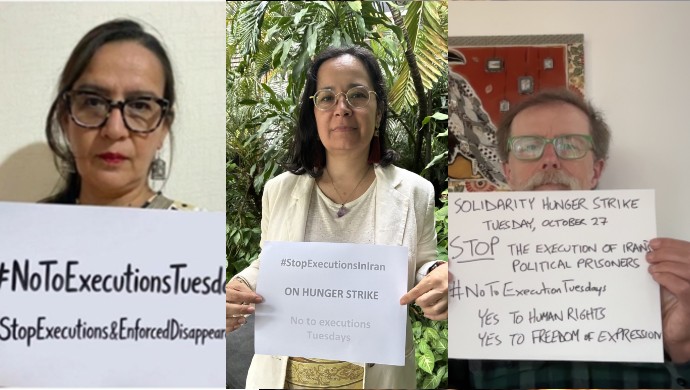

The resistance of prisoners in Iran is finding an expanding international echo, with three human rights figures announcing solidarity with the “No to Executions Tuesdays” campaign.
Andrea Bolaños Vargas, the UN Special Rapporteur on the situation of human rights defenders, and David R. Boyd, a former UN Special Rapporteur, announced solidarity hunger strikes. Ana Lorena Delgadillo, a member of the UN Working Group on Enforced or Involuntary Disappearances, announced plans to join the following week.
Their actions come as prisoners across 66 Iranian prisons marked the campaign’s 144th consecutive week on October 27, 2026.
Human rights figures stand with the prisoners
On October 27, Bolaños Vargas announced that she was joining the solidarity hunger strike for human rights defenders imprisoned and threatened with death for their work. She called for executions to end and those detained to be released.
Her participation brings particular significance: the prisoners’ struggle has prompted the UN expert responsible for defending human rights defenders to adopt their form of protest.
I am joining a solidarity action with political prisoners in Iran participating in #NoToExecutionTuesdays. On Tuesday October 27, I'm going to start a 24-hour hunger strike.#hungerstrike #Iran #stopexecutions #abolishdeathpenalty
#NoToExecutionTuesdays@CanadaUN@drmaisato pic.twitter.com/c4Vvz04LpH— Dr. David R. Boyd (@EnvirOptimist) October 26, 2026
Boyd, the former UN Special Rapporteur on human rights and the environment, announced on October 26 that he would begin a 24-hour hunger strike the following day. He linked his action to solidarity with Iran’s political prisoners and opposition to the death penalty.
Delgadillo’s announced participation the following week adds another voice to this growing response. Together, these commitments demonstrate how a protest sustained inside Iranian prisons is inspiring concrete acts of solidarity abroad.
A movement sustained behind prison walls
The campaign began at Ghezel Hesar Prison on January 30, 2024, when prisoners launched weekly Tuesday hunger strikes against executions. Their appeal defended all prisoners facing death sentences, regardless of their charges, and called for public support to protect their lives.
🇮🇷 #Iran [ESP abajo]
💪 I join #NoToExecutionTuesdays in the solidarity hunger strike for the human rights defenders that are being jailed and threatened with death for their work. At least 46 political prisoners and protesters have been executed in Iran since March 2026. More… pic.twitter.com/mNSMFQHJGx
— Andrea Bolaños Vargas (@AndreaBV_SR_HRD) October 27, 2026
Other prisoners joined, extending the campaign across Iran. By October 27, 2026, participants in 66 prisons were continuing the weekly protest.
That persistence is central to the international response. Through repeated collective action, prisoners have kept the demand for an end to executions before the world and provided a rallying point for supporters beyond Iran.
Solidarity amid continuing executions
The latest campaign statement underscored the urgency of that demand, reporting at least 87 executions over a 20-day period in October. It also warned of new or upheld death sentences against political prisoners, including Manouchehr Fallah and Reza Zanganeh.
The prisoners have appealed to human rights activists and the international community to break their silence and expand solidarity.
The announced hunger strikes answer that appeal through direct participation. They bring renewed attention to prisoners whose lives remain threatened and reinforce the demand that the regime’s executions must stop.
The international echo of prisoners’ resistance
The significance of these developments lies in the connection between resistance inside Iran and action abroad. Prisoners have sustained their campaign through 144 consecutive weeks; human rights figures are now joining their protest through solidarity hunger strikes.
Their participation illustrates the growing reach of the prisoners’ demands. From behind prison walls, those resisting executions are drawing others into a shared defense of the right to life. Their continued defiance is reverberating beyond Iran’s borders.