

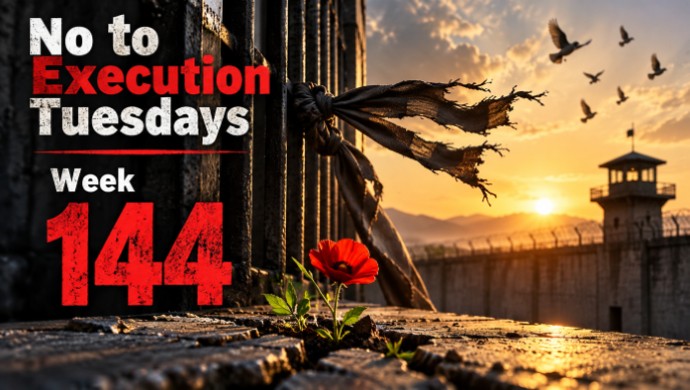

On Tuesday, October 27, 2026, inmates across 66 prisons in Iran held hunger strikes to mark the 144th consecutive week of the “No to Executions Tuesdays” campaign. The prisoners continued their organized protest against the systematic issuance and execution of death sentences, demonstrating the resilience of a movement that has persisted for nearly three years despite severe restrictions.
The campaign’s latest statement detailed the regime’s continuous weaponization of the death penalty to crush dissent. The striking prisoners pointed to the recent confirmation and issuance of death sentences against several individuals, warning that the continuous presence of hundreds and thousands of prisoners on death row is a “warning bell” that demands attention.
Recent capital sentences include those issued or upheld for political prisoner Manouchehr Fallah in Rasht’s Lakan Prison, protesting Arab citizen Ilia Bin Rashid in Isfahan, political prisoner Reza Zanganeh in Karaj Central Prison, and Hassan Golshan-Nejad, who faces security-related charges in Mashhad Prison.
Condemning these rulings, the prisoners wrote: “Execution in Iran is not merely ending a person’s life; rather, it is a deep wound on the body of society, a tool for eternal mourning of families, and a means to spread fear and silence the people’s voice of protest.”
The execution rate in Iran has reached alarming levels. According to the prisoners’ statement, at least 87 people were executed in just a 20-day span between late September and mid-October 2026 (during the Persian month of Mehr). Among those hanged were seven political prisoners and two women.
Despite these figures and severe state repression—including security pressures, threats, restricted contact with the outside world, and punitive measures against participating inmates over the past few weeks—the prisoners remain steadfast in their strike.
“History has shown that no hangman’s noose can pull the desire for freedom and equality from human hearts, and no repression is capable of silencing the voice of justice-seeking forever,” the statement read.
The striking prisoners welcomed the recent stance taken by UN Special Rapporteur on human rights in Iran, Mai Sato, against the executions and state repression, emphasizing that defending the right to life, freedom of expression, and the right to protest is a universal human responsibility that “should not stop at political borders.”
The statement concluded with an urgent appeal for global solidarity to dismantle the regime’s execution machine: “Today, all prisoners condemned to death need our voices. We must not allow their names to be lost in silence and apathy… We ask all freedom-loving people, justice-seeking families, human rights activists, political and trade union activists, and awakened consciences to not remain silent in the face of the wave of executions; be the voice of prisoners condemned to death, condemn these verdicts, and expand your solidarity to stop the executions and abolish this inhumane punishment.”