

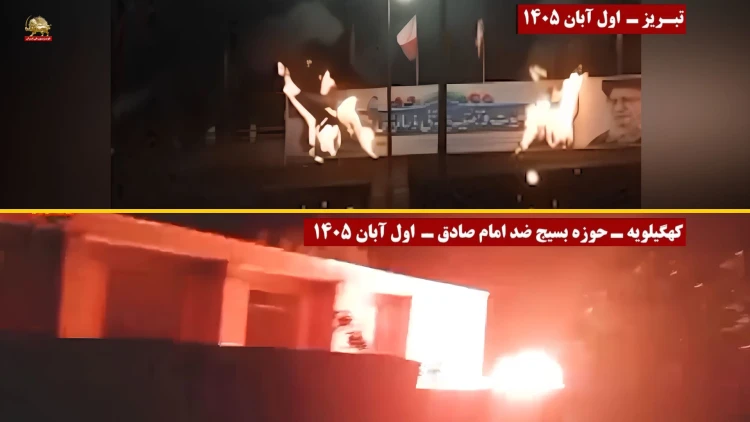

On October 23, 2026, Resistance Units affiliated with the People’s Mojahedin Organization of Iran (PMOI/MEK) carried out 10 operations across eight locations in Iran in response to the demolition of cafés belonging to ordinary citizens in Khorramshahr, southwest Iran.
The operations targeted facilities and signs associated with the Islamic Revolutionary Guard Corps (IRGC) and its Basij paramilitary force, as well as regime propaganda symbols.
October 23—Iran
PMOI/MEK Resistance Units carry out 10 daring operations against regime targets in response to the destruction of coffee shops of ordinary citizens in Khorramshahr. pic.twitter.com/Qgh1MR8PwA— People's Mojahedin Organization of Iran (PMOI/MEK) (@Mojahedineng) October 26, 2026
The actions were a response to the destruction of small businesses that provided livelihoods for local residents, conveying a message that the regime’s mistreatment of vulnerable citizens would not go unanswered.
The destruction of livelihoods in Khorramshahr
On October 18, videos circulated on social media showing the demolition of several cafés along Khorramshahr’s coastal boulevard, on the banks of the Karun River.
The footage showed the destruction of at least three establishments. The demolitions reportedly took place under municipal orders, depriving local business owners of establishments they had created to support themselves and their families.
For young entrepreneurs trying to make a living in difficult economic conditions, the loss of their businesses represented another blow to their financial security. Instead of supporting employment and local enterprise, the authorities had destroyed establishments that provided income for residents.
Resistance Units target IRGC Basij facilities and regime propaganda
The October 23 operations extended across several regions of Iran, targeting facilities associated with the regime’s security apparatus and symbols of its political authority.
In Kohgiluyeh, Resistance Units targeted the Imam Sadeq Basij center. In Khash, southeast Iran, they carried out an operation against an IRGC Basij base.
Khash
Resistance Units set fire to entrance of IRGC Basij base pic.twitter.com/Oa58CiwvCt— People's Mojahedin Organization of Iran (PMOI/MEK) (@Mojahedineng) October 26, 2026
In Shahriar, west of Tehran, Resistance Units carried out two separate operations targeting signs associated with IRGC Basij bases. In Kermanshah, they set fire to the entrance of another Basij facility.
Additional operations took place in Rask and Chabahar, both in Sistan and Baluchestan province. In Rask, Resistance Units set fire to a signpost associated with an IRGC base, while in Chabahar, they targeted a signpost belonging to an IRGC Basij facility.
Other operations focused on symbols of the regime’s leadership. In Tabriz, Resistance Units set fire to a large billboard featuring former regime supreme leader Ali Khamenei. A separate operation in the same city targeted another poster depicting him.
Shahriar
Resistance Units set fire to signpost of IRGC Basij base pic.twitter.com/XhrQ6HuMtd— People's Mojahedin Organization of Iran (PMOI/MEK) (@Mojahedineng) October 26, 2026
In Eslamshahr, near Tehran, Resistance Units burned a propaganda poster promoting the intelligence-gathering apparatus of the IRGC, an organization associated with monitoring citizens and suppressing dissent.
Standing up for ordinary Iranians against repression
The operations carried a broader political message beyond their immediate targets. The demolition of cafés in Khorramshahr illustrated how vulnerable ordinary citizens can be when authorities exercise power against their livelihoods.
The café owners were attempting to support themselves through small businesses. Yet the destruction of their establishments left them facing the consequences of decisions imposed by authorities with far greater power and resources.
By responding with operations against regime-affiliated targets, the Resistance Units showed that these grievances would not be ignored.
Their actions connected the economic hardships of ordinary citizens to the broader confrontation with the regime’s repressive institutions, challenging the notion that the authorities could destroy people’s livelihoods without encountering opposition.
Through their operations, the Resistance Units conveyed a message of solidarity with citizens facing repression and economic hardship: the regime’s actions against vulnerable Iranians would not pass without a response.