

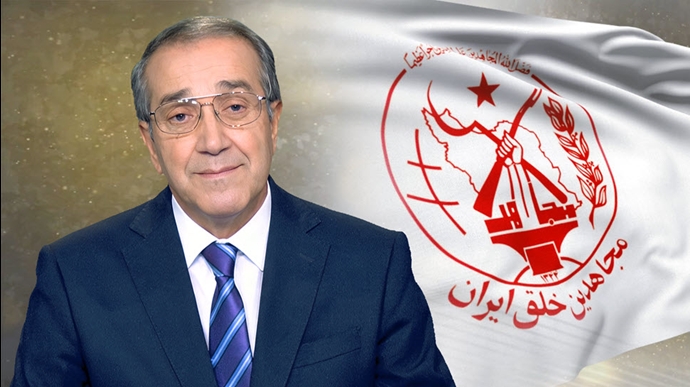

It is with heavy hearts that we announce the passing of PMOI member Jalal Farkhondi in Albania due to illness, following 50 years of relentless struggle against two dictatorships in the ranks of the PMOI and the National Liberation Army of Iran (NLA).
Jalal Farkhondi was born in 1960 in Tabriz, northwestern Iran. In 1976, while studying in Tehran, he became acquainted with the ideals and struggles of the PMOI by reading the biographies of its martyrs and the defense statements of PMOI members before the Shah’s military courts.
Together with a group of students and friends from his neighborhood, he began distributing leaflets and engaging in activities in support of the PMOI. As a result, he was arrested by the Gendarmerie in Amol in June 1976 and was detained and interrogated for several days.
In 1979, during the anti-monarchical revolution, Jalal Farkhondi participated in organizing demonstrations and protest marches. Following the September 8, 1978 massacre, carried out on the orders of the treacherous Shah, he intensified his activities, spreading the slogans “The only path to liberation is armed struggle” and “Freedom for political prisoners” among young people.
On February 11, 1979, he and his comrades fought against the Shah’s repressive forces in the streets and participated in seizing military barracks.
Following the establishment of Mojahedin’s National Movement, they all joined it. Jalal was active in various neighborhood associations, including the Fourth of Khordad Association, the Movahed Association, and the Misaq Association, as well as the Muslim Students Association at the University of Tehran.
During the early years of the revolution, he was arrested and imprisoned three times for selling the PMOI’s newspaper in Tehran. However, each time he was released from detention, he resumed his struggle with even greater enthusiasm.
In the autumn of 1980, Jalal was transferred to the organizational section responsible for Mojahed, the PMOI’s official publication, where he continued working until its final issue in June 1981.
He subsequently assumed responsibility for protecting one of the PMOI’s clandestine bases in Tehran. In July 1982, he joined the PMOI’s combat units along the Iran–Iraq border. That same year, he took command of an ambush unit in the Piranshahr region of northwestern Iran.
In 1987, with the formation of the National Liberation Army of Iran (NLA), Jalal Farkhondi joined the ranks of the NLA. He fought courageously in various military operations, including Operation Aftab, Operation Chelcheragh, and Operation Forough Javidan (Eternal Light). He sustained shrapnel wounds to his hands and legs during these operations.
During Operation Morvarid (Pearl), he commanded a group of National Liberation Army fighters.
Following the invasion of Iraq in 2003, during 14 years of confinement and resistance at Camp Ashraf and Camp Liberty in Iraq, including the attacks of July 28–29, 2009, and April 8, 2011, as well as a series of missile attacks from 2012 to 2016 under the direction of the executioner Qasem Soleimani, commander of the Iranian regime’s Quds Force, he, like his fellow PMOI brothers and sisters, was repeatedly exposed to brutal and deadly assaults by the regime’s thugs. Nevertheless, he courageously resisted and stood firm.
According to his comrades, Jalal Farkhondi was exceptionally serious and self-sacrificing in fulfilling his responsibilities. Even during periods of illness, including after undergoing open-heart surgery, he pursued his commitments with extraordinary dedication and determination.
Jalal Farkhondi, a son of Tabriz, continued the tradition of great freedom fighters like Sattar Khan, Mohammad Hanifnejad, and Mousa Khiabani. We salute his five decades of passionate and unwavering struggle and his commitment to his pledge to the people until his final breath.
His relentless struggle—from the demonstrations and anti-monarchical uprising and the PMOI’s awareness-raising activities against Khomeini’s reactionary forces, to the battles following June 20, 1981; and from the series of operations conducted by the National Liberation Army of Iran to 14 years of steadfast resistance under the harshest conditions at Ashraf and Liberty—represents a path and tradition that now shines before the courageous sons and daughters of the Iranian people in the Resistance Units, illuminating and opening the path to freedom.