

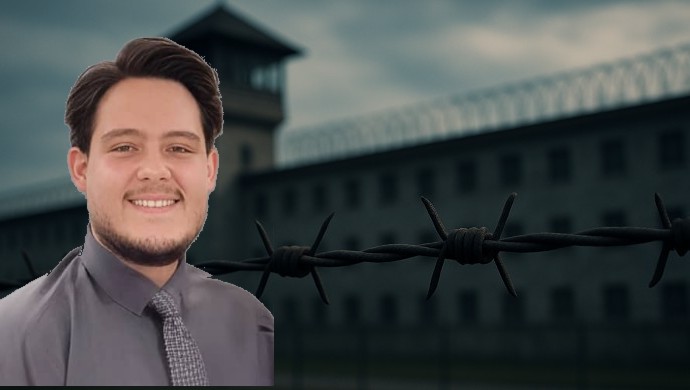

On October 11, 2026, the Iranian regime’s Supreme Court upheld the death sentence of Amirhassan Akbari Monfared, a 23-year-old accounting student at Karaj Azad University held in Evin Prison. Branch 41 confirmed his conviction for baghi (rebellion) through membership in the People’s Mojahedin Organization of Iran (PMOI/MEK), placing him at imminent risk of execution.
The decision was delivered by a deputy from Evin Prison accompanied by two people, including a masked Ministry of Intelligence representative. Authorities simultaneously presented Amirhassan with a pardon application and a document demanding repentance and disavowal of the PMOI. He refused to read the papers and referred the matter to his lawyer.
Arrest, torture, and the Abdar-chi case
Amirhassan was arrested on January 19, 2025, when heavily armed agents wearing bulletproof vests raided his paternal home in Karaj. The arrest came one day after the elimination of the regime’s criminal judges Ali Razini and Mohammad Moghiseh in the “Abdar-chi” (“tea boy”) incident. Amirhassan had no involvement in or knowledge of the incident.
Transferred to Ward 209 of Evin Prison, he subsequently endured five months of torture in Ward 241. Regime authorities physically assaulted him during his arrest and tortured him to extract forced confessions. After the bombing of Evin, he was transferred to Fashafouyeh Prison before returning to Evin.
Two days after Amirhassan’s arrest, agents also detained his father, Mohammad Akbari Monfared, a political prisoner from the 1980s and the 2022 uprising. Interrogators threatened the family while demanding information about PMOI connections.
A family persecuted across generations
Amirhassan’s original death sentence was announced in July 2026. Judge Abolqasem Salavati of Branch 15 of Tehran’s Revolutionary Court imposed it on charges of baghi through membership in the PMOI. His prosecution was linked to his family relationship with the late PMOI member Farshid Asadi in connection with the Abdar-chi case.
The Akbari Monfared family has endured decades of persecution. Four relatives—Alireza, Gholamreza, Abdolreza, and Roghayeh Akbari Monfared—were executed by the regime in the 1980s. Abdolreza and Roghayeh were among the victims of the 1988 massacre of political prisoners.
The arrest of Amirhassan and his father, followed by pressure to disavow the PMOI, demonstrates how the regime continues targeting a family already devastated by executions.
A wider crackdown on PMOI supporters and political dissidents
Amirhassan’s case is part of a wider crackdown on PMOI supporters and their relatives. On October 11, the Iranian Resistance disclosed details of 12 people arrested across Iran, including former political prisoners, workers, and relatives of executed dissidents.
The danger is underscored by recent executions. Between March 19 and October 6, 2026, at least 46 political prisoners were executed, including nine PMOI members and 37 people arrested during uprisings and protests. Six PMOI members were executed at Ghezel Hesar Prison between March 30 and April 4, and three at Karaj Central Prison between April and July.
Political defendants face charges including baghi, moharebeh (“enmity against God”), and efsad-e fel-arz (“corruption on Earth”), amid torture, coerced confessions, restricted legal representation, and accelerated proceedings.
Urgent international action needed
The Iranian Resistance has called for urgent United Nations intervention to stop Amirhassan’s execution and save other political prisoners facing the death penalty. It has also urged the UN High Commissioner for Human Rights and the Special Rapporteur on Iran to determine detainees’ conditions and secure access to their prisons.
With Branch 41 confirming his death sentence, Amirhassan faces an immediate threat. The authorities have already subjected him to prolonged detention and torture.
His case reflects the broader danger facing PMOI supporters in the regime’s prisons. But it also demands an urgent response in its own right: a 23-year-old student in Evin Prison now faces execution unless effective action is taken to save his life.