

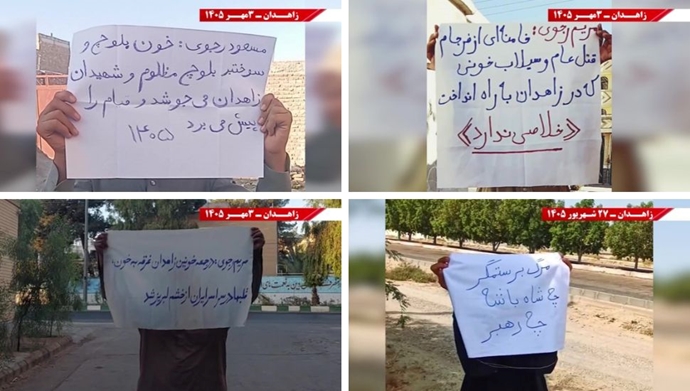

On September 25, 2026, PMOI/MEK Resistance Units in Zahedan, southeast Iran, marked two key anniversaries: the September 30, 2022, “Bloody Friday” crackdown in Zahedan and the September 27, 1981, confrontation between PMOI fighters and the clerical regime in Tehran.
As part of their weekly anti-regime activities, Resistance Units displayed placards in public places despite the presence of security forces and measures aimed at suppressing opposition activities. Their messages combined remembrance of those killed in Zahedan with tributes to PMOI members killed in September 1981.
One placard declared, “Despite the highest number of martyrs, the oppressed warriors and brave Baluch people roar: From Zahedan to Tehran, my life for Iran!” Another read, “Salute to the martyrs and the oppressed people of Sistan and Baluchestan.”
Keeping the memory of Bloody Friday alive
Zahedan’s Bloody Friday took place on September 30, 2022, during the nationwide uprising that had begun earlier that month. After Friday prayers, security forces opened fire on protesters and civilians in Zahedan. More than 100 people, including children, with hundreds more wounded.
September 25—Zahedan, southeast Iran
In their weekly anti-regime activities, PMOI/MEK Resistance Units commemorate the victims of Zahedan's "Bloody Friday" and mark the anniversary of the September 27, 1981, where PMOI fighters in Tehran put up a historic resistance against the… pic.twitter.com/q3J4QA334A— People's Mojahedin Organization of Iran (PMOI/MEK) (@Mojahedineng) September 26, 2026
Four years later, remembrance and demands for justice figured prominently in the Resistance Units’ September 25 messages.
“The outcry for justice for the women, children, and youth gunned down in cold blood in Zahedan echoes across all of Iran,” one placard stated. Another declared, “As Zahedan ran red on Bloody Friday, hearts across all of Iran overflowed with revolutionary rage.”
Several messages sought to connect the events in Baluchestan with opposition activity across the country. “Rise up Baluchistan, stand tall Iran, the fire of uprising must be spread everywhere,” one read. Another addressed regime supreme leader Mojtaba Khamenei while emphasizing solidarity among different communities in Iran: “We are men and women united in battle, and we will fight back.”
Remembering September 27, 1981
The September 25 activities also commemorated the events of September 27, 1981, in Tehran. The confrontation came amid the severe repression that followed the regime’s crackdown on PMOI supporters beginning in June 1981.
September 27 was a landmark because its supporters brought the slogan “Death to Khomeini” into Tehran’s streets, directly challenging the authority that Ruhollah Khomeini had consolidated after the 1979 revolution. More than 1,100 young people were killed that day and hundreds more were executed in prisons that night.
"While Iran’s heart bleeds for the hundreds of Baluch martyrs and wounded, the nation overflows with pride at the indomitable courage of Baluchestan's brave sons and daughters." pic.twitter.com/jpt9Nr3iGe
— People's Mojahedin Organization of Iran (PMOI/MEK) (@Mojahedineng) September 26, 2026
The Resistance Units’ placards explicitly invoked that history.
“The PMOI paid the heaviest bloody price on September 27, 1981, by bringing the slogan ‘Death to Khomeini’ into the public sphere,” one message read.
Another stated: “Salute to the fallen heroes of the PMOI who shed their blood across Iran on September 27, 1981, in the noble pursuit of freedom.”
From remembrance to continued resistance
Another recurring theme in the September 25 campaign was rejection of both the former monarchy and the current clerical system. One placard declared, “The people and history of Iran curse the bloodthirsty mullahs and shah.” Another stated more directly: “We want neither the shah nor the mullahs, dictators be damned.”
The same theme was incorporated into the commemoration of Zahedan, with Resistance Units declaring that “Zahedan’s Bloody Friday and a century of atrocities under both monarchical autocracy and religious dictatorship in Baluchistan will never be forgotten.”
Similar slogans appeared during Resistance Unit commemorations in Zahedan in September 2025, when banners also rejected both monarchical and clerical rule.
"Through Zahedan’s Bloody Friday, the people's resolve for revolution and regime change has been forged into steel" pic.twitter.com/sFJLoxGvJN
— People's Mojahedin Organization of Iran (PMOI/MEK) (@Mojahedineng) September 26, 2026
By bringing these messages into public spaces, the September 25 campaign sought to transform remembrance into a continuing political message. The victims of Bloody Friday and those killed during the confrontation of September 27, 1981, were presented not simply as figures from the past but as symbols for present-day resistance.
Through these recurring activities, the Resistance Units are keeping alive the memory of those who lost their lives in earlier struggles and connecting their sacrifices to the continuing struggle for freedom in Iran.