

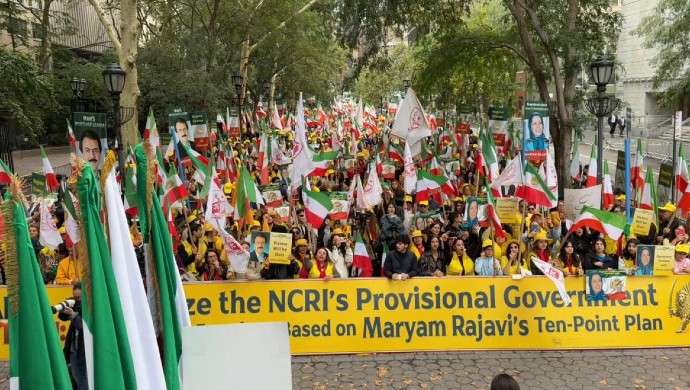

As world leaders gathered at the United Nations General Assembly, thousands of Iranians and supporters of the Iranian Resistance assembled nearby on September 22 with a message directed both at the international community and at people inside Iran: the country’s political future, speakers said, must be determined by the Iranian people themselves.
The rally brought together supporters of the National Council of Resistance of Iran (NCRI), former senior U.S. officials and military commanders, Iranian youth, religious leaders, and human rights advocates. Across their speeches, several themes repeatedly surfaced: executions and the treatment of political prisoners; the bloodshed during Iran’s recent uprisings; opposition to both monarchical and clerical dictatorship; support for the People’s Mojahedin Organization of Iran (PMOI/MEK) and its Resistance Units; and the NCRI’s proposal for a democratic, secular republic.
Thousands will rally outside the UN on September 22 in support of a democratic republic in Iran based on Maryam Rajavi’s Ten-Point Plan, while calling for an end to executions. #StopExecutionsInIran #FreeIran2026NYRally #NCRIAlternativehttps://t.co/M6T2ciQQPQ
— People's Mojahedin Organization of Iran (PMOI/MEK) (@Mojahedineng) September 21, 2026
The event unfolded against the backdrop of the UN General Assembly, giving particular prominence to demands for international accountability. Speakers repeatedly contrasted the presence of Iranian government representatives at the United Nations with reports of executions, imprisonment, torture, and repression inside Iran.
But the rally’s message was not confined to condemnation. Much of the program focused on the alternative: change driven from inside the country by the Iranian people and their organized Resistance, followed by a transition based on free elections and the political principles contained in Maryam Rajavi’s Ten-Point Plan.
As moderator Anahita Sami put it, while world leaders were meeting inside the United Nations, “when it comes to Iran, the Iranian people are now speaking for themselves.”
Maryam Rajavi: “The solution is democratic change by the people of Iran”
In remarks broadcast to the rally, NCRI President-elect Maryam Rajavi framed the demonstration as a protest against both repression inside Iran and decades of international disregard for the Iranian people and their Resistance.
“The time has come to listen to the voice of the Iranian people,” she said. “A people who seek neither war nor dictatorship; a people who seek freedom and a democratic republic.”
Mrs. Rajavi placed executions and political prisoners at the center of her speech. She cited more than 1,100 executions since the beginning of 2026 and “dozens of political prisoners executed in recent months alone.” She also raised awareness about protesters killed during the January 2026 uprising and earlier uprisings, as well as the 1988 massacre of political prisoners.
Her message from those still imprisoned was equally direct. Citing death-row prisoner Arghavan Fallahi, Mrs. Rajavi quoted: “We belong to Generation Z. We stand against dictatorship and dependence, against both the Shah and the Mullahs.”
Message to the rally of freedom-loving Iranians outside the United Nations in New York
“Iran's seat belongs to the people of Iran and to their legitimate resistance for peace, freedom, and a democratic republic”#FreeIran2026NYRally#UNGApic.twitter.com/toXKTcV6AT— Maryam Rajavi (@Maryam_Rajavi) September 22, 2026
Mrs. Rajavi also rejected the premise that Iran’s political crisis could be resolved through an external war.
“The solution to the Iranian crisis is neither war nor foreign intervention,” she said. “Rather, it is the people of Iran and their organized Resistance who possess the ability and the legitimacy to bring about great change in Iran.”
Mrs. Rajavi called for international criminal accountability for human rights violations and urged governments to recognize what she described as the Iranian people’s right to overthrow the clerical system.
Her central political message was concise: “The solution is democratic change by the people of Iran and their organized Resistance.”
Executions and Political Prisoners Move to the Center of the Rally
The most immediate issue raised throughout the event was the accelerating use of executions and the fate of political prisoners.
Mrs. Rajavi described Iran as “a regime of executions and massacres,” pointing to executions carried out in 2025 and 2026 and to successive episodes of lethal repression. She told the gathering that international institutions had repeatedly documented human rights violations in Iran and argued that the “policy of turning a blind eye to this regime’s crimes must not continue.”
Other speakers returned to the same issue from different perspectives.
Former U.S. Ambassador Carla Sands spoke of political prisoners enduring “torture, solitary confinement, and the threat of execution.” She said prisoners had sent messages from inside Iran expressing support for the opposition movement despite the dangers attached to doing so.
.@CarlaHSands: The democratic world must recognize the Iranian people's right to fight tyranny. Their vision is @Maryam_Rajavi's 10-point plan for a democratic, secular, non-nuclear republic at peace with the world. #NCRIAlternative #StopExecutionsInIran https://t.co/qqSZ0YrILM
— NCRI-FAC (@iran_policy) September 22, 2026
The two Episcopal priests addressing the gathering placed the same issue in explicitly human terms. Rev. Adrian Dannhauser referred to killings, torture, sexual violence and arbitrary imprisonment documented in connection with earlier protests.
“Together, we say no to executions, no to dictatorship,” she said, before recalling “all political prisoners, for those facing torture and death sentences, and for the families who wait in fear of news of their loved ones.”
Rev. Dr. Chloe Breyer similarly closed her remarks by remembering prisoners currently held across Iran and “family members of those whose futures of their loved ones are uncertain.”
The subject also crossed national boundaries at the rally. Venezuelan human rights activist Jonathan Acosta joined the crowd in chanting: “Free Iran, no more executions!”
The speakers differed in background and political vocabulary, but the repeated references to prisoners, death sentences and families awaiting news gave the rally one of its clearest points of focus.
From the Uprisings to the Resistance Units: Who Brings About Change?
While the speeches devoted considerable attention to international policy, their argument over how political change would actually occur inside Iran was strikingly consistent.
Former NATO Supreme Allied Commander Gen. Wesley Clark told the crowd that outsiders could not deliver freedom on Iran’s behalf.
“We can’t do it for you,” Clark said. “Only the people of Iran can give freedom and power in Iran.”
Gen. Keith Kellogg made essentially the same point. “A free Iran is dependent upon you and who you are,” he told participants. Referring to military action and sanctions, he added: “It will not lead to change. That change is dependent upon the people of Iran.”
.@GeneralClark: For decades, under @Maryam_Rajavi's leadership, the @Mojahedineng has resisted the tyranny of the ayatollahs: resisted by the power of ideas, resisted where possible and necessary.
It's this organization that is the greatest enemy of the ayatollahs, the most…— NCRI-FAC (@iran_policy) September 22, 2026
Ambassador Sands likewise argued that external military pressure and internal political transformation were not the same thing. “Military action certainly weakens the regime,” she said, “but only the indigenous force on the ground can deliver lasting change and peace.”
For the speakers, that indigenous force included organized opposition networks operating inside Iran.
Kellogg referred to Resistance Units in all 31 provinces and described them as “the engine of change.” An Iranian youth speaker, Parya Garmroudi, said the units continued “to grow and organize under the most dangerous conditions” and argued that acts of defiance challenged an atmosphere of fear.
Mrs. Rajavi presented the same concept in broader terms. “Their message is this: they will overthrow the religious fascism ruling Iran, no matter the price,” she said. “This is the message of the Resistance Units.”
The emphasis throughout was the decisive political actor would have to emerge from Iranian society itself.
Rejecting a Choice Between the Shah and the Mullahs
A second political theme ran through speeches by Iranian participants in particular: rejection of the idea that Iran must choose between restoration of monarchy and continuation of the present theocracy.
Mrs. Rajavi placed the slogan within the Resistance’s longer history, saying the Iranian people “have rejected every form of dictatorship, whether religious or monarchical.”
Iranian human rights activist Zahra Amanpour described the country’s modern political history through what she called “two Irans”: one built around concentrated authority and another around popular sovereignty.
Zahra Amanpour: Under the Shah, opposition was suppressed, political prisoners were tortured, and SAVAK became a symbol of fear. Replacing one dictatorship with another will never be enough—we stand for a democratic republic! #FreeIran2026 https://t.co/svBZlyMn1Q
— NCRI-FAC (@iran_policy) September 22, 2026
“Under the monarchy, sovereignty ultimately rested with the Shah,” she said. “Under the Islamic Republic, ultimate authority rests with the Supreme Leader and institutions the Iranian people cannot freely choose or remove.”
For Amanpour, the question was not simply which faction or personality should replace the present rulers, but where political sovereignty should reside.
“One says power belongs to the Shah or a Supreme Leader,” she said. “The other says sovereignty belongs to the Iranian people.”
Her conclusion was equally explicit: “Iranians did not struggle against monarchy to create religious tyranny, and the answer to religious tyranny is not to recreate monarchy.”
Parya Garmroudi, speaking for the Iranian youth delegation, delivered the same idea in sharper language.
“We will not exchange a turban for a crown or one dictator’s son for another,” she said. “Iran is not a family inheritance; Iran belongs to its people.”
Rev. Dannhauser broadened the principle beyond Iran’s specific political history. “Whether exercised in the name of religion, monarchy, or any other ideology,” she said, dictatorship produces repression and discrimination.
The alternative repeatedly presented from the stage was not another unelected ruler but a democratic republic in which political authority derives from elections.
The NCRI Platform: Elections, Secular Government and Equal Rights
Speakers repeatedly linked their calls for political change to the NCRI’s proposed framework for a post-clerical Iran, particularly Maryam Rajavi’s Ten-Point Plan.
Gen. Clark praised the plan for “freedom of speech, association, democratic elections, separation of church and state” and an end to nuclear-weapons and regional domination policies.
Amb. Sands outlined a similar list: “A democratic and secular republic based on free elections, the separation of religion and state, equality between women and men, respect for ethnic and religious minorities,” along with a non-nuclear Iran.
Parya Garmroudi added an independent judiciary and abolition of the death penalty to the principles she highlighted.
Women’s political equality was given particular prominence.
Amanpour contrasted the restrictions imposed on women by the clerical system with the role women have assumed within the MEK. She pointed to Mahnaz Meimanat’s recent election as the organization’s tenth successive female secretary general.
.@GeneralClark: For decades, under @Maryam_Rajavi's leadership, the @Mojahedineng has resisted the tyranny of the ayatollahs: resisted by the power of ideas, resisted where possible and necessary.
It's this organization that is the greatest enemy of the ayatollahs, the most…— NCRI-FAC (@iran_policy) September 22, 2026
“Think about that contrast,” Amanpour said: “a regime that has devoted enormous power to restricting women confronted by a resistance movement in which women have spent decades exercising political and organizational authority.”
Maryam Hosseini, another member of the youth delegation, described women’s leadership as “a central part of the movement’s identity and direction.” She cited successive generations of women involved in protest and resistance, arguing that younger Iranian women were continuing a struggle extending across decades.
Sands made much the same point, noting the succession of female secretaries general since 1989 and describing women’s leadership as evidence of organizational continuity.
Together, the speakers presented the Ten-Point Plan not only as a declaration of opposition to the current system but as a proposed set of rules for what should follow it: electoral government, secular institutions, equality before the law, minority rights, abolition of the death penalty and a non-nuclear state.
A Call for International Accountability, Without Substituting for Iranians
With the United Nations only steps away, many of the speeches ended by turning back to the role of the international community.
Mrs. Rajavi called for an international criminal justice mechanism addressing crimes against humanity in Iran, referral of human rights violations to the International Criminal Court, and prosecution of Iranian officials under universal jurisdiction.
Garmroudi appealed to leaders at the UN to “hold those responsible for repression accountable, defend political prisoners, and recognize the Iranian people’s right to determine their own future.”
https://twitter.com/NCRIUS/status/2102460609061417233
Clark argued that governments outside Iran should place greater confidence in the Iranian people rather than fear political change. Sands said Iranians were “not asking foreign armies to fight on their behalf” but wanted democratic governments to recognize their right to determine their own future.
That distinction formed a thread connecting several of the day’s speeches: an appeal for international action on executions, political prisoners and accountability, coupled with an insistence that the political transformation itself must come from within Iran.
It was Mrs. Rajavi who stated the formulation most directly: “The solution to the Iranian crisis is neither war nor foreign intervention.”
Kellogg, coming from a military and national-security background, arrived at a similar conclusion: external pressure “will not lead to change. That change is dependent upon the people of Iran.”
As the General Assembly continued nearby, the rally therefore put forward two parallel demands—one directed outward and one inward. To governments and international institutions, speakers called for action on executions, prisoners and accountability. To Iranians, they presented the Resistance Units, the organized opposition and a democratic republic as the instruments of political change.
The day’s speeches ultimately converged on a proposition heard repeatedly from the platform: whatever role international policy plays, Iran’s next political order should be decided not through foreign intervention or the restoration of an earlier dictatorship, but by the Iranian people themselves.