

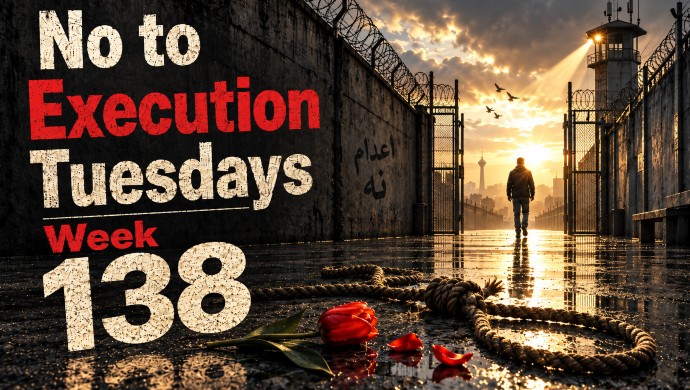

On Tuesday, September 15, 2026, prisoners across 62 facilities in Iran held the 138th consecutive week of the “No to Executions Tuesdays” campaign, initiating hunger strikes to protest the regime’s widespread use of the death penalty. The organized defiance inside the regime’s prisons continues to expand despite participating inmates facing severe security pressures, threats, punitive measures, and restricted communication with the outside world.
Bridging the uprisings: Commemorating 2022 and 2026
In their weekly statement, the striking prisoners marked the fourth anniversary of the 2022 nationwide protests, which were sparked by the death of Jina (Mahsa) Amini. The inmates honored the women who played a leading role in the movement and the nearly 700 protesters killed by the regime’s security forces. The prisoners explicitly linked the resistance of 2022 to the recent massive nationwide uprisings of December 2025–January 2026, framing their ongoing strike as part of the broader, unbroken Iranian movement for a democratic republic.
“We send our greetings to the compatriots who, exhausted by the oppression and tyranny of the rulers, took to the streets to demand their rights and cry out for freedom,” the prisoners wrote in their statement. “These protests did not fade away despite the brutal suppression, but rather flared up like fire under the ashes in [December 2025–January 2026] and still continue until the day they reach their final destination, which is freedom, equality, democracy, and the establishment of a popular government.”
The regime’s wave of retaliatory executions
The statement detailed a sharp increase in executions and death sentences aimed at crushing dissent following the recent revolution attempts. Since late August 2026, the regime has executed at least 61 individuals.
The campaign highlighted several specific cases of protesters currently facing imminent execution. Alireza Sepahi, a young man arrested during the December 2025–January 2026 uprisings and sentenced to death in the Alikhani Square case, has been transferred to solitary confinement.
Death sentences have also been issued for two other protesters from the same winter uprising: Marzieh (Soda) Ebrahimi in Bandar Abbas and Hossein Rasoulinejad in Mashhad. Furthermore, the appeal for retrial by political prisoner Arghavan Fallahi, who is currently on death row, was rejected in Evin Prison.
To incite fear ahead of the new academic year in late September, the regime has also charged university student Mohammad-Parsa Golchin with “Baghy” (armed rebellion), placing him at severe risk of receiving a death sentence. The prisoners noted that the regime issues these sentences to “stifle the voice of the university, the stronghold of freedom, equality, and resistance.”
Global solidarity and a call to the United Nations
The prisoners’ statement noted the growing solidarity from the Iranian diaspora, with rallies held in Paris, Cologne, and London to commemorate the 2022 uprising and support the campaign against executions. A concurrent rally is scheduled to take place outside the United Nations headquarters in Vienna. Domestically, calls for a general strike in Kurdistan were met with threats from the regime against shopkeepers in cities like Saqqez.
The campaign welcomed support from Javaid Rehman, the former UN Special Rapporteur on the situation of human rights in Iran, while demanding concrete action from the current international bodies.
The campaign called on the UN Third Committee, UN Special Rapporteur Mai Sato, and other UN members to “condemn the widespread human rights violations, the suppression of the Iranian people, and the widespread executions by the Iranian government, and provide a practical solution to stop the executions and the suppression of the Iranian people by the fascist government.”
The prisoners marked the 138th week of the “No to Executions Tuesdays” hunger strike in 62 prisons across Iran.