

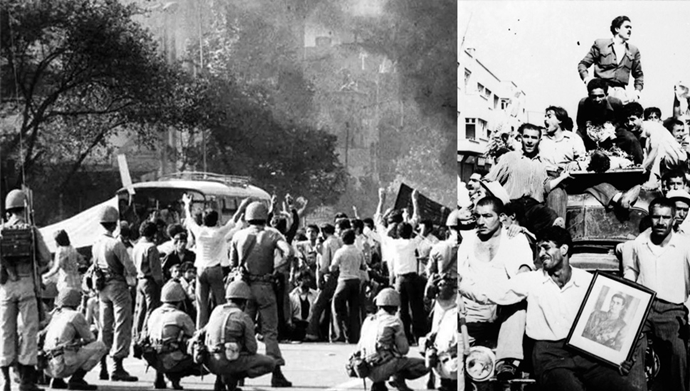

August 19, 2026, marks 73 years since the disastrous 1953 coup that overthrew Dr. Mohammad Mossadegh. This date is not merely a historical anniversary; Mossadegh has transformed from a political figure into an enduring “phenomenon,” a “thought,” and a recurring benchmark in Iran’s continuous struggle for freedom.
Mossadegh’s government was the only national, independent, and democratically willed government to emerge in Iran following the Constitutional Revolution. Today, understanding this bitter event in the context of Iran’s ongoing political and social developments is the master key to understanding why dictatorship has persisted in Iran for so long, and why Iran will not go back from one dictatorship to another.
The unholy triangle: The court, the clerics, and colonialism
The shah regime tried to frame the foreign-backed coup as a domestic uprising. But in reality, it was carried out by an unholy convergence of three anti-democratic forces: the royal court, religious reactionaries, and foreign colonial interests.
Western powers engineered the plot because Iran’s oil nationalization and political independence severely threatened their geopolitical and financial interests. London and Washington’s think tanks subsequently designed the overthrow of Mossadegh’s legal government.
Simultaneously, the Shah and his military commanders executed the coup in the streets using organized thugs and repressive military forces, as they saw their absolute power and class interests fundamentally threatened by democracy. In a telling historical betrayal, senior clerics like Abol-Ghasem Kashani and Mohammad Behbahani stabbed the national movement in the back, paving the way for the Shah’s tyranny.
This proved that at historical crossroads, whenever democratic movements threaten the clerics’ monopoly on power, their interests will inevitably align with traditional tyranny and foreign exploitation.
International admissions vs. royalist revisions
Despite royalists and monarchists brazenly attempting to rewrite history by calling this shameful coup a “national uprising” or “revolution,” decades of declassified documents and public confessions by Western leaders have vindicated the Iranian people’s historical grievances and exposed these revisionist lies.
In 2000, former U.S. Secretary of State Madeleine Albright officially acknowledged the U.S.’s “significant role” in the overthrow of Mossadegh, noting that “the coup was clearly a setback for Iran’s political development.”
In 2009, former U.S. President Barack Obama acknowledged that “In the middle of the Cold War, the United States played a role in the overthrow of a democratically elected Iranian government.”
Furthermore, in 2023, former UK Foreign Secretary David Owen stressed that Britain must accept responsibility for damaging Iran’s democratic process. “There are good reasons for acknowledging the UK’s role with the US in 1953 in overthrowing democratic developments,” Owen said. “By admitting that we were wrong to do so and damaged the steps that were developing towards a democratic Iran, we make reforms now a little more likely.”
Finally, in October 2023, an internal CIA audio document confirmed the entirely undemocratic nature of the operation, revealing that a significant portion of the 1960s documents related to the coup had been deliberately destroyed.
The evolution of the democratic struggle: From Amir Kabir to Mossadegh
Historically, figures like Amir Kabir attempted to bring scientific, cultural, and political progress to Iran by working within the royal court and utilizing the Shah. However, Mossadegh took a massive evolutionary step forward in Iranian political thought.
He did not tie his hopes to the persona of the Shah. Instead, for the first time in Iran’s history, he attempted to bind the monarchy to the constitution, stripping the royal court of its absolute, unchecked political power and subjecting it to democracy, freedom, and the rule of law.
This unprecedented disruption of the traditional, inherited alliance between the shah and mullahs is the exact reason why monarchists and religious reactionaries still harbor deep-seated hatred for Mossadegh and the historical spectrum aligned with his ideals today. His government became a powerful lever for practicing democracy in Iran.
Bitter lessons and the missing link of organization
The aftermath of 1953 provided deep historical lessons for both the oppressors and the oppressed. For the ruling dictator, the Shah learned that to maintain power, he had to increase domestic suppression systematically and rely entirely on foreign powers, leading to the creation of the dreaded SAVAK secret police.
In parallel, Ruhollah Khomeini and his dark-minded clerics learned to hide in the shadows of the Shah’s tyranny. Because the Shah heavily suppressed democratic forces, the clerics were perfectly positioned to hijack the revolution and monopolize power during a national crisis.
For the pioneers of the Iranian resistance, including the PMOI and Fada’i, the primary lesson of 1953 was undeniably clear: spontaneous movements lacking revolutionary organization will always be crushed by the collusion of tyranny and colonialism.
They realized that achieving and safeguarding freedom requires an organized and dedicated movement. Mossadegh’s movement lacked this vital science of structural organization, which was its main historical shortcoming. Mossadegh himself recognized this in his final years, pointing to the organized Algerian independence fighters in 1961 as a model and historical directive for the future.
Rejecting the dictatorships of the past and present
Today, the legacy of August 19 acts as a definitive dividing line between two fronts: the front of freedom and the front of tryranny—those who worship the deposed monarchy and those who worship the Velayat-e Faqih. Clarifying the history of 1953 is absolutely essential for cleansing Iran’s political landscape and ensuring the final overthrow of the ruling clerics without returning to a royal dictatorship.
Just as the Shah’s SAVAK and martial law could not prevent the collapse of the monarchy, the regime’s execution machine and massacres cannot guarantee the survival of the absolute clerical rule today.
From the start of the resistance on June 20, 1981, to the nationwide uprisings of December 2017, November 2019, 2022, and 2025-2026, Iranian society has consistently targeted the simultaneous negation of both religious fascism and royal neo-fascism. This revolutionary awareness loudly declares that the Iranian people are not looking to return to a despotic past.
After seven decades, the wound of 1953 has now transformed into the driving engine of a nationwide movement for justice. Armed with the bitter lessons of 1953, the Iranian people are proving their absolute resilience. Through the emergence of a National Liberation Army and a democratic alternative, Iran is on the verge of dismantling tyranny once and for all, establishing a secular, democratic republic, and finally realizing the historic dream of the pioneer of Iran’s national movement, Dr. Mohammad Mossadegh.