

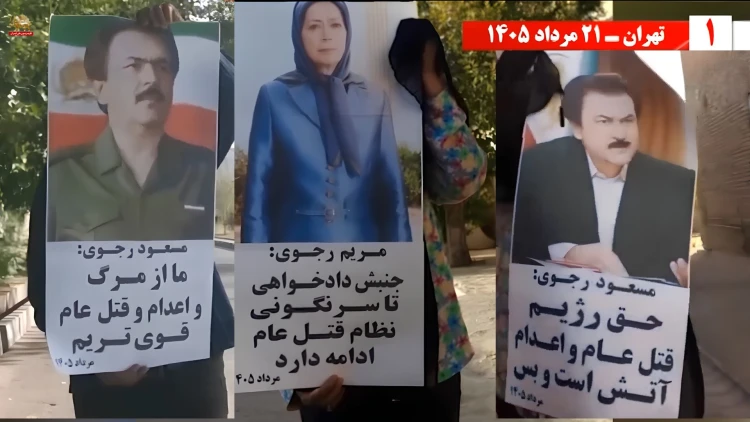

In commemoration of the 38th anniversary of the summer 1988 massacre, where over 30,000 political prisoners were executed by the ruling regime, Iran’s rebellious youth and PMOI Resistance Units launched a bold nationwide campaign. Comprising 30 revolutionary acts, these activities send a clear message to the regime: the fight for freedom in Iran is more alive than ever, and the movement seeking justice for the martyrs will not rest until the system responsible for these atrocities is overthrown.
Through coordinated photocalls, graffiti, and the distribution of posters, the Resistance Units emphasized the continuation of the justice movement across the nation.
August 12—Iran
PMOI/MEK Resistance Units mark the anniversary of the 1988 massacre of political prisoners with activities across Iran, honoring the 30,000 political prisoners who laid down their lives and pledging to continue their path. pic.twitter.com/m7TnYAwwrV— People's Mojahedin Organization of Iran (PMOI/MEK) (@Mojahedineng) August 13, 2026
The commemorative campaign spanned multiple major cities across Iran, demonstrating the vast reach and undeniable courage of the Resistance Units in Tehran, Kerman, Tabriz, Sonqor, Mashhad, and Kermanshah.
In Tehran, activists reclaimed public spaces by plastering walls, columns, doors, and cars with photos of the 1988 martyrs, including Ashraf Ahmadi, Monireh Rajavi, Majid Khademi, Seyed Hamid Khezri, Massoud Dalvand, and Farahnaz Ahmadi. By prominently displaying these faces, the youth ensured the regime cannot erase them from the public memory.
The youth also bravely held photocalls with messages of defiance, declaring, “We are stronger than death, execution, and massacre,” and asserting that “fire” is the only thing the regime of massacre and execution deserves.
Tehran
"The massacre of political prisoners in 1988 was carried out under the direct order of Khomeini" pic.twitter.com/yzGxfvI5Et— People's Mojahedin Organization of Iran (PMOI/MEK) (@Mojahedineng) August 13, 2026
Posters of Maryam Rajavi were widely displayed in Tehran, Kerman, Tabriz, and Sonqor, highlighting that seeking justice for the 1988 martyrs is a “national obligation.” Her printed quotes emphasized that the massacred heroes are the “inspiration for the creators of uprisings in rebellious cities” and that the justice movement will continue until the regime’s downfall.
In Mashhad and Kermanshah, resistance took the form of striking graffiti. Activists wrote messages emphasizing the “boiling blood of the 1988 massacre” and declaring, “We swear by the blood of our comrades, we are armed in the field.”
The heroism of today’s Resistance Units is deeply rooted in the summer of 1988. At that time, then-regime supreme leader Ruhollah Khomeini issued a religious fatwa explicitly ordering the purge of all political prisoners who supported the People’s Mojahedin Organization of Iran (PMOI/MEK). As a result of this ruthless decree, more than 30,000 prisoners were hanged in the span of just a few months.
Tehran
Photos of the martyrs of the 1988 massacre pic.twitter.com/qLV1Ucxuws— People's Mojahedin Organization of Iran (PMOI/MEK) (@Mojahedineng) August 13, 2026
These mass executions were carried out following sham courts lasting only minutes, completely denying the prisoners any legal right to a defense or a lawyer. During these minutes-long trials, prisoners were given a stark choice: either disown their pledge to the PMOI and their fight for freedom, or go to the gallows. Defying the regime, 30,000 political prisoners heroically embraced death rather than surrender to tyranny, creating one of the greatest epics of Iranian history.
Following the massacre, the regime went to unprecedented lengths to hide and deny its crimes. Officials marked the massacre as highly classified, victims were secretly buried in tightly guarded, mass unmarked graves, and families were severely intimidated and explicitly forbidden from holding funerals.
Tehran
Photos of the martyrs of the 1988 massacre pic.twitter.com/6jijoRhVBu— People's Mojahedin Organization of Iran (PMOI/MEK) (@Mojahedineng) August 13, 2026
The clerical regime fundamentally miscalculated the resilience of the Iranian resistance. Dictators throughout history repeatedly fail to understand a fundamental truth: the blood of those seeking freedom and justice never dies. It does not simply vanish into the earth; rather, it multiplies, flows, and flourishes. The regime falsely believed that by wiping out a generation of dissidents, they could secure their totalitarian rule indefinitely.
For 38 years, the battle between the 1988 martyrs and the regime’s executioners has not stopped for a single day. This historical confrontation has continuously echoed through the eight major uprisings that have rocked the nation since. Today, nearly four decades later, the fearless and ongoing activities of the Resistance Units across the country prove that the martyrs of 1988 remain timeless sparks whose truth lives on in the national collective memory, continuing to drive the movement for a free Iran.