


Four months after the death of Ali Khamenei, the Iranian regime orchestrated a massive, state-sponsored funeral procession designed to project an image of power, unity, and stability to both domestic and international audiences. The regime desperately needed a political and security maneuver to mask its profound vulnerabilities following the massive nationwide uprisings earlier in the year.
However, this prolonged spectacle proved to be nothing but an empty facade. The moment the state-mandated mourning ended, the true face of Iran re-emerged on the streets. The immediate resurgence of nationwide protests—driven by severe economic grievances and explicit political demands—proves that the regime’s expensive propaganda and coercive measures have failed to solve any underlying crises.
A failed maneuver to mask weakness
The prolonged funeral ceremonies were never about mourning; they were a desperate attempt to intimidate the public and force the illegitimate, hereditary succession of Khamenei’s son, Mojtaba. The so-called massive crowds showcased by state media were largely manufactured through coercion. Security institutions threatened Kurdish state employees with dismissal if they did not board buses to Tehran and Qom, while families dependent on the State Welfare Organization and the Relief Committee faced threats that their financial aid would be permanently cut off if they refused to participate.
Far from projecting unity, the ceremonies highlighted the regime’s deep fractures and intensifying factional infighting. Former regime presidents were notably excluded or marginalized from the main events and clashes erupted between supporters of different regime factions.
The facade crumbles: The streets reclaim their voice
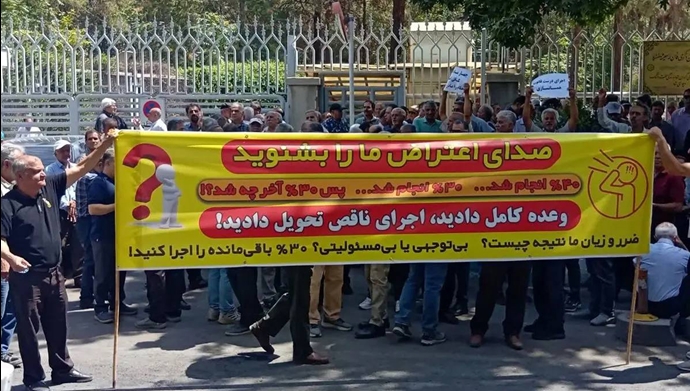
As the Iranian Resistance explicitly warned, the state-staged ceremonies could not eliminate the existential crises between the regime and the Iranian people. The moment the funeral concluded, the streets were reclaimed by the public. By the weekend of July 11 and 12, widespread protests and strikes erupted across multiple cities, including Tehran, Kermanshah, Ahvaz, Shiraz, Isfahan, Damghan, and Shush.
Protesters spanned various sectors of society, demonstrating the universal nature of the public’s grievances. Demonstrators included Social Security retirees, telecommunications and steel fund pensioners, defrauded automotive customers of Saipa, coal miners in Damghan, university students in Shiraz protesting poor living conditions, and bakers in Alborz province. People protested in grueling conditions, such as the retirees in Shush who marched in temperatures exceeding 50°C to demand their basic rights and protest systemic discrimination.
Beyond economics: The political demands of the protesters
While the protests are fueled by severe economic deprivation, inflation, and corruption, the people’s slogans make it clear that their demands are highly political and directly target the regime’s foundational policies. Protesters directly linked their empty tables to the regime’s destructive foreign policy and proxy wars, chanting: “Enough warmongering, our tables are empty” and “Inflation, high prices, no to war and destruction.”
Demonstrators also boldly challenged the regime’s coercive apparatus and human rights abuses, explicitly chanting “No to execution” and demanding the release of imprisoned workers and teachers. Protesters highlighted the irrelevance of the regime’s political factions, chanting that neither the government nor the parliament cares about the nation, and insisting that rights can only be achieved “on the streets.”
The events of the past few weeks offer a clear lesson: no amount of state-sponsored pageantry, security mobilization, or forced crowds can legitimize a hollowed-out dictatorship or pave the way for a hereditary transition of power to Mojtaba Khamenei. The immediate return of diverse sectors of Iranian society to the streets—demanding an end to corruption, executions, and warmongering—demonstrates that the people are not intimidated.
Highlighting this defiance, Mrs. Maryam Rajavi, President-elect of the National Council of Resistance of Iran (NCRI), praised the demonstrators. On July 12, she wrote on X: “Salutes to the brave retirees who took to the streets today in Kermanshah, Shush, Ahwaz, Dezfoul, Tehran, Rasht and other cities of Iran. Braving oppressive heat, they demanded their basic rights with powerful slogans: ‘Our rights are only won on the streets!’ ‘Stop the warmongering, our tables are empty!’ ‘Inflation and high prices—No to war and destruction!’ ‘Free imprisoned workers and teachers!’”
Salutes to the brave retirees who took to the streets today in Kermanshah, Shush, Ahwaz, Dezfoul, Tehran, Rasht and other cities of Iran.
Braving oppressive heat, they demanded their basic rights with powerful slogans:
"Our rights are only won on the streets!"
"Stop the… pic.twitter.com/ecIaQ27g5o— Maryam Rajavi (@Maryam_Rajavi) July 12, 2026
Mrs. Rajavi emphasized that the protesters “made it clear: the root of the crisis is the warmongering dictatorship robbing the people of their sovereignty. The only path forward is through protest and uprising.”
The underlying crises of poverty, repression, and isolation cannot be solved by the very regime that created them. The relentless persistence of the Iranian people proves that the only solution to Iran’s multifaceted disasters is the total dismantling of the clerical dictatorship and the establishment of a democratic republic.