

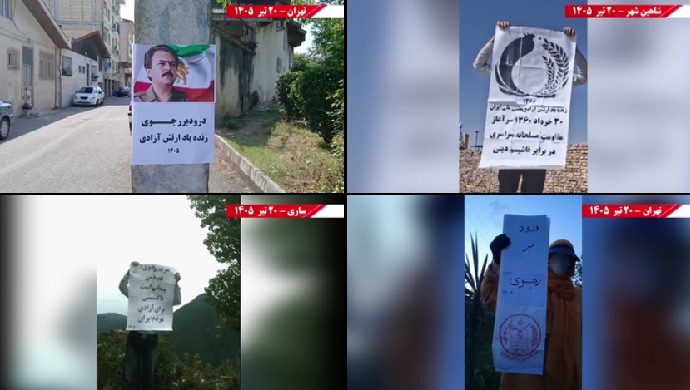

On July 10, in direct defiance of the heavily militarized, state-sponsored funeral ceremonies for the eliminated supreme leader Ali Khamenei, PMOI/MEK Resistance Units carried out 40 anti-regime activities across Iran. These courageous acts shattered the regime’s desperate attempts to project stability, echoing the Iranian people’s true desires for regime change and reiterating their commitment to the struggle for a free, democratic republic.
July 10—Iran
In response to lavish state-sponsored funeral ceremonies for eliminated regime supreme leader Ali Khamenei, PMOI/MEK Resistance Units across Iran carried out 40 anti-regime activities, echoing the desires of the Iranian people for regime change and reiterating their… pic.twitter.com/bFlEceIYgu— People's Mojahedin Organization of Iran (PMOI/MEK) (@Mojahedineng) July 12, 2026
Undeterred by the suffocating security atmosphere, Resistance Units mobilized in major cities across the country, including Tehran, Mashhad, Isfahan, Zahedan, Kermanshah, and Rasht. Through placards, posters, and graffiti, they delivered a resounding message to the clerical dictatorship. In Mashhad, units wrote “Khamenei is dead. The nation awakens” in six public locations. In Tehran, members held placards reading “Salute to Rajavi” and installed posters declaring “Long live the National Liberation Army.” In Zahedan, protesters displayed messages stating “Down with Khomeini and Khamenei.”
Furthermore, the Resistance Units clearly laid out the Iranian people’s vision for the future. In Arak, units installed a placard in a public place with the message: “No to monarchy, no to the mullahs’ rule. Yes to a democratic republic.”
Tehran
"Salute to Rajavi" pic.twitter.com/fK4aJep7aQ— People's Mojahedin Organization of Iran (PMOI/MEK) (@Mojahedineng) July 12, 2026
The bravery of these young men and women stands in stark contrast to a regime reeling from massive nationwide uprisings at the beginning of the year. The funeral ceremonies were essentially a week-long military scenario managed by the Islamic Revolutionary Guard Corps (IRGC). Terrified of a restive public, the regime coerced over 70 percent of the attendees to participate through extortion. On July 6, it was reported that government employees in Kurdistan were forced onto buses under threat of termination, while vulnerable families were threatened with the loss of their state welfare aid if they did not attend.
The regime’s sheer panic was glaringly exposed on the fourth day of the ceremonies in Tehran. Unable to secure the streets and terrified of the crowds, the IRGC was forced to abruptly cancel the pre-planned procession route on live television, resorting instead to flying Khamenei’s coffins out of the area by helicopter. Ironically, the newly installed supreme leader, Mojtaba Khamenei, was entirely absent, reportedly hiding in a secret location out of fear.
Gorgan
"Salute to Rajavi" pic.twitter.com/7wc74EFRve— People's Mojahedin Organization of Iran (PMOI/MEK) (@Mojahedineng) July 12, 2026
At this critical juncture, the ruling theocracy is weaker and more desperate than ever before. Politically, the regime has reached a dead end. In contrast, the Resistance Units have ignited the engines of resistance, proving to be the most important organized force within the uprisings.
This new generation draws inspiration from thousands of PMOI members who laid down their lives for freedom and democracy. As the Resistance Units brave the streets today, writing “Down with the oppressor, be it the shah or the supreme leader” in Kermanshah, they demonstrate that there is no place for power to pass back and forth between the Shah and the mullahs. The only solution to Iran’s crisis is regime change, achieved through the organized resistance of the Iranian people.