


The headlines appearing across Iran’s own state-controlled newspapers increasingly tell a story the authorities can no longer conceal. Even when reported separately, they reveal interconnected crises that have merged into a single national emergency.
On one day alone, July 1, state-affiliated newspapers highlighted a series of alarming developments:
- Sazandegi: “Scientific Ranking in Free Fall”
- Sazandegi: “Women Missing from the Labor Market”
- Arman Melli: “Bread Trapped Between Reality and Government Orders”
- Siasat-e Rooz: “Inflation Pushes the Middle Class Toward Poverty”
- Kayhan: “200 University and Seminary Professors Call for Halting Negotiations Until the U.S. Fulfills Its Commitments”
Each headline reflects a different dimension of the regime’s failures. Together, they expose a country caught in overlapping political, social, and economic crises. Yet among these, one crisis has become the center of gravity: the accelerating collapse of Iran’s economy.
Economic catastrophe, however, did not emerge in isolation. It is the direct consequence of decades of political dysfunction. Corruption, deception, ideological priorities, institutionalized theft, and empty promises have produced an economic system incapable of meeting even the most basic needs of the Iranian people.
The latest figures illustrate this reality with brutal clarity.
According to the state-affiliated newspaper Tose’e Irani, Iran’s official minimum monthly wage for 2026 was set at approximately 166 million rials. Yet the regime’s own Supreme Labor Council estimated that the minimum cost of living for a worker’s family exceeds 450 million rials. In other words, the legal minimum wage covers only about 37 percent of a family’s basic living expenses.
The report also acknowledged that many working-class families now survive primarily on bread, cheese, eggs, and tomatoes—a diet that already reflected extreme economic hardship. Even this last nutritional safety net is now disappearing.
The same report revealed that bread prices recorded inflation exceeding 140 percent, the highest increase among all essential food products.
These statistics represent far more than declining purchasing power.
They signal the erosion of food security itself.
When a household begins every month unable to cover nearly two-thirds of its essential expenses, survival becomes an exercise in eliminating necessities rather than discretionary spending. Healthcare is postponed. Education becomes unaffordable. Nutrition deteriorates. Savings disappear. Debt accumulates. Poverty becomes permanent rather than temporary.
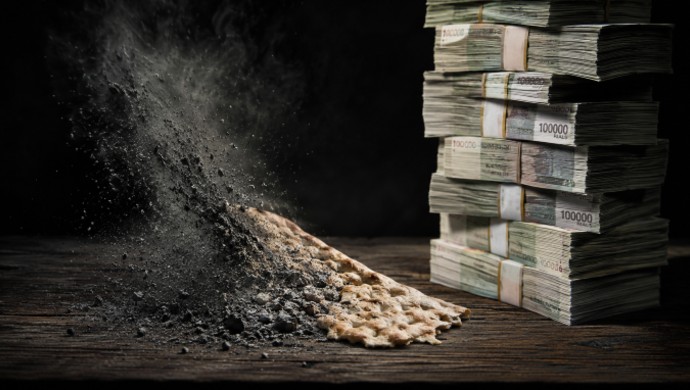
Bread occupies a unique place in Iranian society. For generations, it has served as the final guarantee against hunger for millions of low-income families. When meat, dairy, and fresh produce became unaffordable, bread remained the one staple that prevented complete food insecurity.
Today, even bread is slipping beyond reach.
A 140 percent increase in the price of the country’s most basic food item is not merely another inflation statistic. It represents the collapse of the final line of defense protecting millions of families from hunger.
The regime has attempted to offset public anger through periodic wage increases, but these adjustments are largely symbolic. Raising salaries while allowing essential food prices to rise at more than twice the rate simply masks the continued destruction of purchasing power. Workers may receive larger paychecks, but they can afford less with every passing month.
This widening gap between official rhetoric and daily reality exposes the structural nature of Iran’s economic crisis. Inflation is not simply the product of sanctions or temporary market disruptions, as regime officials routinely claim. It is the predictable outcome of decades of systemic corruption, economic mismanagement, massive spending on repression and regional proxy networks, and policies that consistently prioritize the survival of the ruling establishment over the welfare of the Iranian people.
History demonstrates that bread has never been merely an economic commodity.
When societies can no longer guarantee access to basic food, economic crises inevitably evolve into political crises. Rising bread prices have repeatedly served as catalysts for popular unrest because they affect every household regardless of class or geography.
Even voices within institutions traditionally aligned with the regime have begun issuing warnings. The Executive Secretary of the East Tehran Workers’ House cautioned that if families are forced to reduce even their daily bread consumption, the consequences will extend far beyond household budgets and could undermine social stability itself.
Such warnings acknowledge an uncomfortable truth.
A society deprived of its most basic necessities cannot remain politically stable indefinitely.
For years, the regime has attempted to manage each crisis individually—through subsidies, temporary wage adjustments, propaganda campaigns, or heightened repression. Yet these measures fail because they address symptoms rather than causes. Economic collapse is rooted in a political system built on corruption, lack of accountability, ideological absolutism, and the systematic exclusion of the Iranian people from meaningful participation in determining their country’s future.
The bread crisis therefore represents far more than inflation. It symbolizes the exhaustion of a governing model that has steadily consumed the nation’s economic resources while impoverishing its citizens.
Iran today is confronting not simply an affordability crisis but a crisis of governance. As living standards continue to deteriorate and even the most basic staples become inaccessible, the regime faces an increasingly stark reality: repression cannot substitute for economic competence, and propaganda cannot feed hungry families.
The choice facing Iran is no longer between economic reform and continued decline. The structural nature of the country’s overlapping crises suggests that meaningful recovery requires political transformation. Without fundamental change that places accountability, democratic governance, and the interests of the Iranian people above the preservation of the ruling establishment, today’s bread crisis is unlikely to remain confined to the marketplace. It will increasingly become a catalyst for broader demands for political change.
When a government can no longer guarantee its people’s daily bread, it also begins to lose its claim to govern.