

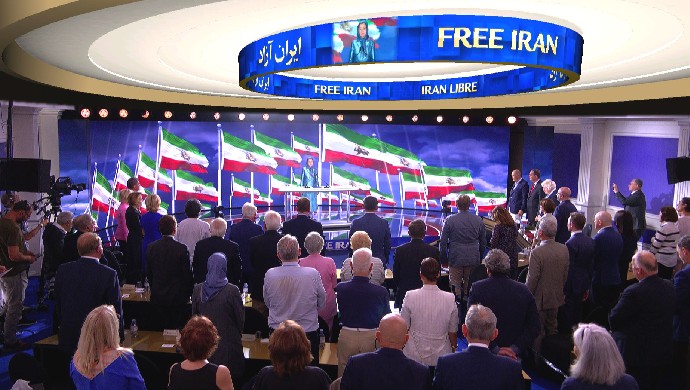

On June 20, 2026, thousands of Iranians gathered in Paris for the Free Iran World Summit, an event carrying profound historical and contemporary significance. Held on the 45th anniversary of June 20, 1981—the Day of Martyrs and Political Prisoners and the anniversary of the founding of the National Liberation Army of Iran—the summit took place against a deeply turbulent geopolitical backdrop.
Iran remains in the throes of political upheaval. The regime is still reeling from the massive nationwide uprising of December 2025 and January 2026, which began in the Tehran bazaar and quickly morphed into sweeping calls for regime change, resulting in thousands of protesters killed by security forces.
Furthermore, following the death of Ali Khamenei, the ascension of Mojtaba Khamenei to the position of Supreme Leader has laid bare the deep schisms within the clerical establishment. A ceasefire extended in June has momentarily paused hostilities, yet inside the country, the regime under President Masoud Pezeshkian has resorted to an unprecedented wave of executions to terrorize a restive population.
Free Iran 2026
Onward to a Democratic Republic#100KFreeIranRally #OurChoiceMaryamRajavihttps://t.co/fjp1x9p6zQ— People's Mojahedin Organization of Iran (PMOI/MEK) (@Mojahedineng) June 20, 2026
The Paris summit was intended to coincide with a colossal demonstration of over 100,000 people to condemn this execution spree. However, in a stark manifestation of the West’s ongoing policy of appeasement, French police banned the rally at the eleventh hour, sparking widespread outrage among international dignitaries and parliamentarians who attended the summit. The facts presented by the array of global leaders in Paris painted a clear picture: the Iranian regime is at its most vulnerable, and the path to a free Iran runs neither through foreign wars nor a return to past dictatorships, but through the Iranian people and their organized Resistance.
Maryam Rajavi’s Vision for a Democratic Republic
In her keynote address, Maryam Rajavi, the President-elect of the National Council of Resistance of Iran (NCRI), laid out a definitive roadmap for the country’s future, characterizing the current era as the religious dictatorship’s “final stop.” Mrs. Rajavi noted that Khamenei’s son, Mojtaba, has inherited a “crumbling edifice” and that his public opposition to the recently signed ceasefire exposes a “deadly schism at the helm of the regime, showing just how unstable and precarious it is.”
The path to Iran's freedom is not a foreign war. Nor is it waiting for the regime to collapse.
The real force for change is on the ground, rising from a people whose devoted and enlightened sons & daughters say No to both the Shah and the mullahs.https://t.co/Jlc8ia7lvi— Maryam Rajavi (@Maryam_Rajavi) June 20, 2026
Addressing the sudden ban on the Paris rally, Mrs. Rajavi pointed out that it reflected the mullahs’ terror in the face of an organized opposition. She noted the irony that the Paris Administrative Court cited intelligence reports suggesting a risk of attacks by “the Iranian regime or Iranian monarchists,” highlighting how “remnants of the Shah’s regime are accomplices and instruments of the religious dictatorship.”
Mrs. Rajavi firmly rejected the notion that the current geopolitical military dynamics would bring about Iranian liberation. “The path to Iran’s freedom is not a foreign war. Nor is it waiting for the regime to collapse of its own accord,” she stated. Instead, she emphasized that the “real force for change is on the ground,” citing the 630 operations carried out by PMOI Resistance Units during the January uprising, and a daring February 23 strike by 250 PMOI freedom fighters against Khamenei’s headquarters in Tehran.
Drawing attention to the NCRI’s announcement of a Provisional Government aimed at transferring sovereignty through free elections within six months, Mrs. Rajavi concluded with a powerful pledge to the martyrs: “My commitment is an unbreakable covenant to secure freedom for all the people of Iran—regardless of their ethnicity, political conviction, beliefs, religion, or creed.”
Condemnation of the Policy of Appeasement and the Paris Ban
The last-minute cancellation of the massive Paris rally became a focal point of intense criticism during the summit, with dignitaries denouncing the decision as a capitulation to Tehran. Rather than ensuring public safety, the ban was broadly interpreted as a diplomatic concession to a regime that routinely uses hostage-taking and terrorism to manipulate Western democracies.
.@ChArrighi: France will have to look at things differently and must bow to the resistance at work. Because tomorrow, or the day after, it is you who will be in power. In reality, I believe it is already today. #NCRIAlternative #100KFreeIranRally https://t.co/xWcCsMEA10
— NCRI-FAC (@iran_policy) June 20, 2026
French MP Christine Arrighi expressed deep sorrow for her country’s decision, calling it a betrayal of France’s foundational values of Liberty, Equality, and Fraternity. Arrighi pointed out the suspicious timing of the ban, noting that it occurred shortly after a phone call between the French and Iranian Ministers of Foreign Affairs. “You did not request it because it was the Iranians who requested it, it was the mullahs who requested it; but you, you decided it,” Arrighi stated, addressing the French government directly. She called the ban “diplomatically irresponsible.”
Dominique Attias, President of the Administrative Council of the European Lawyers Foundation, delivered a searing indictment of the ban. “We do not silence human rights defenders to protect the peace. We silence them so as not to displease tyrants,” she argued. Pointing to the hypocrisy of citing “public order” against a peaceful assembly, Attias stated, “When the exception becomes the instrument of diplomatic surrender, it is no longer law: it is cowardice dressed up as legality… Every demonstration banned in Paris is one more rope tightened in Tehran.”
Former UK Prime Minister @BorisJohnson: It was a tragic mistake for French authorities to cancel this rally. By doing so, they have cravenly capitulated to a regime in Tehran that tortures and kills its opponents on an industrial scale and promotes terror across the Middle East.…
— NCRI-FAC (@iran_policy) June 20, 2026
Former UK Prime Minister Boris Johnson ridiculed the shifting excuses provided by authorities, from weather concerns to the threat of counter-demonstrations. “We know why we’ve been prevented from having a proper rally,” Johnson remarked. “The French government… has bowed cravenly and capitulated to a regime in Tehran that tortures and kills its opponents on an industrial scale.”
John Bercow, Former Speaker of the UK House of Commons, echoed this sentiment, describing the cancellation as a “pathetic, abject, pitiful, craven, feeble, submissive surrender” that only played into the hands of the mullahs. He invoked Winston Churchill’s condemnation of appeasement to underscore the failure of such policies today.
John Bercow: You can murder hundreds of thousands of people, but the one thing you cannot do is murder an idea. The idea of freedom has lived in human hearts from the inception of civilization, and it will always flourish in the breasts of those who want liberty. #NCRIAlternative…
— NCRI-FAC (@iran_policy) June 20, 2026
Baroness O’Loan from the UK House of Lords highlighted the absurdity of the ban given the PMOI’s track record. “There is no history of the NCRI causing trouble on the streets of any capital city,” she noted, adding that disturbances only occur when agents of the IRGC or the Shah’s former secret police, SAVAK, attempt to disrupt the events. Carsten Müller, a member of the German Bundestag, took the criticism a step further, warning European nations: “Do not make yourselves accomplices to the murderous mullahs’ regime… by banning demonstrations of freedom-loving Iranians.”
Alejo Vidal-Quadras, former Vice-President of the European Parliament, who survived an assassination attempt orchestrated by the Iranian regime, summarized the futility of engaging with Tehran. “If you engage with evil, if you make deals with evil, if you cooperate with evil, if you sit at the same table with evil, you become part of evil,” he declared. He observed that four decades of “constructive dialogue” had only emboldened the regime, proving that appeasement definitively fails.
An Execution Spree and Severe Human Rights Abuses
The summit cast a glaring spotlight on the domestic terror campaign currently being waged by the regime. The recent executions of eight PMOI members and more than 20 young dissidents from the December-January uprising are part of a broader, systemic effort to suppress dissent through mass murder.
Charles Michel, former President of the European Council, provided stark statistics to contextualize the bloodshed. Relying on Amnesty International data, Michel noted that in 2025, there were 2,159 executions by hanging in Iran—double the previous year, equating to six hangings per day. “Denouncing and naming things is our primary responsibility, because otherwise, silence becomes a license to kill,” Michel urged.
.@CharlesMichel: There is an alternative. The organized, democratic resistance is determined to secure emancipation. When a people rises, united by suffering and a shared project, nothing can stop them. I stand with the organized Iranian opposition and refuse indifference.…
— NCRI-FAC (@iran_policy) June 20, 2026
Alejo Vidal-Quadras updated these grim figures for the current year, stating that since the beginning of 2026, 853 people had been executed. He specifically noted the execution of 33 political prisoners since March 19 alone, including the eight PMOI members, while pointing out that many more, charged with supporting the MEK, remain on death row. “This is not moderation. It is pure and hard state terror,” Vidal-Quadras affirmed.
Canadian MP Judy Sgro brought a human face to these statistics by highlighting the case of Zahra Tabari, an electrical engineer with a master’s degree from a Swedish university. Tabari’s death sentence was recently upheld solely for her political beliefs and support for the PMOI. Sgro noted that Tabari’s case “symbolizes the regime’s fear of organized opposition and the systemic use of executions as a tool of repression.”
Judy Sgro: I leave here even more confident of what is coming is freedom for the Iranian people. So, it's a great privilege to join you in support of the Iranian people's struggle for #freedom, democracy, and human rights.#NCRIAlternative https://t.co/rR08mfb2BJ
— NCRI-FAC (@iran_policy) June 20, 2026
Former U.S. Senator Robert Torricelli addressed the staggering human cost of the recent uprising, pointing out that 40,000 innocent people lost their lives during the protests. He emphasized the regime’s profound miscalculation in using such brutal force. “They took those 40,000 martyrs’ lives, but every one of them was a father, a sister, a brother, a cousin, or an aunt. And in the wake of that 40,000 passing, a million will rise to bring down this tyranny.”
Carsten Müller similarly highlighted the brutality of the January crackdown, stating that the regime “brutally slaughtered over 40 mostly young people and women.” He argued that this extreme violence is not an indicator of a stable government but rather “a sign of contempt for humanity, disgust, and profound weakness.”
The Rejection of Dictatorships: Neither Shah Nor Mullahs
A prominent theme woven throughout the summit was the Iranian people’s unequivocal rejection of both the current clerical dictatorship and the deposed monarchial dictatorship. Speakers systematically dismantled the regime’s disinformation campaign, which seeks to falsely present a return to the Shah’s era as the only alternative to the current theocracy.
John Bercow delivered a blistering critique of Reza Pahlavi, referring to him as a “prince over the water” who possesses a “rather vacuous CV” and has lived off the “largesse acquired hither and yon.” Bercow condemned Pahlavi’s recent remarks wherein the former royal claimed to be proud of his family’s history and “everything that they have done.” Bercow argued, “The idea that you can aspire to public office in a democracy whilst being proud of everything your egregious, tyrannical father did as a despot over the people of Iran is utterly beyond the pale.”
.@Baird: There is only one way the Iranian people will achieve their dreams for freedom, and that is to rise up and to overthrow this brutal regime. The #NCRIAlternative, under the capable leadership of my friend, Madame @Maryam_Rajavi, has the on-the-ground organization and has…
— NCRI-FAC (@iran_policy) June 20, 2026
Former Canadian Foreign Minister John Baird reinforced this perspective, stating that the international community must reject the false binary choice between two forms of tyranny. “The Iranian people have made it very clear that they reject all forms of dictatorship, whether it’s the religious fascists and the mullahs, or whether it’s the return of the monarchy and the disgraced regime of the Shah,” Baird said. He noted that true political legitimacy belongs to the organized resistance on the streets, not to “any mullah or any relative of the last dictator.”
Robert Torricelli pointed out that the actions of SAVAK remnants during the summit itself—creating security threats that the French government used as a pretext to cancel the rally—proved that the monarchist faction is entirely unfit to lead. “Pahlavi has learned nothing and is discredited as any force in any future Iran,” Torricelli stated bluntly.
.@BobTorricelli: Here's what the regime does not know. They took those 40,000 martyrs' lives, but every one of them was a father or a sister or a brother or a sister, a cousin or an aunt. And in the wake of that 40,000 passing, a million will rise to bring down this tyranny. A…
— NCRI-FAC (@iran_policy) June 20, 2026
The consensus among the dignitaries was that the true alternative is a forward-looking, pluralistic movement. Bercow contrasted the monarchist faction with the NCRI, noting that within the Resistance, one sees a “young, secular, modern, pluralist Iran personified,” fundamentally opposed to an “atavistic, autocratic, feudalist past whereby office is determined by heredity.”
The Force for Change: The People and Resistance Units
With the Middle East embroiled in conflict and following the recent military strikes that killed Ali Khamenei, the summit provided crucial clarity on how regime change in Iran will actually materialize. The speakers uniformly stressed that while foreign interventions and ceasefires alter the geopolitical landscape, the true engine of liberation is the Iranian populace and the organized Resistance Units operating within the country.
Boris Johnson emphasized this reality, stating that recent months have proven that “Tomahawks alone cannot secure freedom for the people of Iran. We’ve proved that it can’t be delivered by the Pentagon. Change must come from within, and it will come from within.” He likened the impending fall of the regime to the collapse of apartheid in South Africa and the fall of the Soviet bloc—events driven by people who could no longer tolerate oppression.
Former U.S. Senator Robert Torricelli echoed this sentiment vividly. Acknowledging the devastation of the regime’s military infrastructure, he nonetheless cautioned against relying on foreign powers for liberation. “Countries are not liberated by foreign air forces,” Torricelli observed. “It wasn’t going to get won from Washington… It’s going to get won on the streets of Tehran because soldiers lay down their weapons, shopkeepers close their doors, agents of the regime refuse to go to work, people take to the streets, and they decide that tyranny must come to an end.”
Charles Michel similarly dismissed the efficacy of foreign military solutions, warning that interventions carried out without clear objectives or European consultation only offer temporary respite. The recent ceasefire, he argued, does not address the root causes of the Iranian tragedy. “The strategy of appeasement was abused… to buy time,” Michel noted, identifying the true alternative as the “organized, democratic, determined resistance.” He added, “When a people rises, united by suffering, united by executions… nothing can stop a people that rises.”
.@DmytroKuleba: In 2014, when we stood on the Maidan, no one believed we would prevail against the machine of repression backed by Moscow. Four months later, the revolution prevailed because nothing can stop freedom. #NCRIAlternative https://t.co/RZXc41trbj
— NCRI-FAC (@iran_policy) June 20, 2026
Dmytro Kuleba, Former Minister of Foreign Affairs of Ukraine, drew powerful parallels between his country’s struggle for survival and the Iranian Resistance. Noting that Iranian drones have been routinely used by Russia to attack Ukrainian cities, Kuleba identified the mullahs’ regime as a shared enemy of global freedom. He recalled the 2014 revolution in Kyiv, where unarmed citizens faced down the machinery of a Moscow-backed regime and ultimately prevailed.
“Nowhere in history, in the entire history of humanity, have these regimes outlived the people who opposed them,” Kuleba stated. He advised the Iranian Resistance to “Believe, remain committed, and resolve,” assuring them that “once you start winning, you will see the invitation from the authorities to hold a rally—the same authorities who banned the rally before.”
Petre Roman: Drawing on my experience during the #Romanian Revolution, I know that when a dictator resorts to mass murder to cling to power, the end is near. Just as our dictatorship collapsed in hours after a massacre, I am convinced the collapse of the mullah regime is very…
— NCRI-FAC (@iran_policy) June 20, 2026
Petre Roman, former Prime Minister of Romania, shared his personal experience of the 1989 revolution against Nicolae Ceaușescu. Roman recounted how the Romanian dictator ordered security forces to fire on protesters—a massacre that seemed to signal total defeat but instead precipitated the regime’s collapse a mere 12 hours later. Pointing to the recent slaughter of protesters in Iran, Roman concluded, “The collapse of the mullahs’ regime in Iran is very near.”
A Democratic Alternative: The Ten-Point Plan
The summit underscored that the imminent collapse of the clerical regime will not lead to a political vacuum, thanks to the decades of groundwork laid by the NCRI. Central to this democratic alternative is Maryam Rajavi’s Ten-Point Plan, which has garnered unprecedented support from lawmakers and political leaders worldwide.
Charles Michel provided a detailed breakdown of the Ten-Point Plan, urging skeptical European politicians to read the document. He emphasized its commitments to free and transparent elections, an independent judiciary, the abolition of the death penalty, gender equality, freedom of expression, and a non-nuclear, peaceful Iran.
Drawing a profound historical parallel, Michel stated, “When I read this Ten-Point Plan, I see in it a powerful resonance… equal to the promises made by the founding fathers of the European Union to European citizens after the tragedies of two world wars and the Holocaust: democracy, peace, freedom, prosperity. That is what the Ten-Point Plan is.”
.@VidalQuadras: The answer to this failed appeasement is neither endless negotiations nor military intervention, but the Iranian people and their organized resistance, the NCRI, under @Maryam_Rajavi's leadership. #OurChoiceMaryamRajavi https://t.co/EgNOPquEDA
— NCRI-FAC (@iran_policy) June 20, 2026
Judy Sgro pointed to the operational readiness of the Iranian Resistance, welcoming the NCRI’s February 28, 2026 announcement establishing a Provisional Government. This initiative, she noted, “provides a clear roadmap for a peaceful, democratic transition, the transfer of sovereignty to the Iranian people through free elections, and the establishment of a democratic republic within six months.”
Sgro urged the international community to push back against the regime’s disinformation campaigns that falsely warn of chaos and disintegration should the mullahs fall.
Alejo Vidal-Quadras reiterated that the values encapsulated in the Ten-Point Plan “are not merely European values. These are universal democratic values.” He called on Western governments to finally recognize the NCRI as the legitimate alternative, stating, “Our responsibility is not to choose Iran’s next government. But we must recognize the organization that has led the resistance for more than half a century and paid the price.”
.@naike_gruppioni: @Maryam_Rajavi represents the most authoritative point of reference for the Iranian #democratic opposition and the most credible expression of a free, democratic, and secular alternative to the ayatollahs' dictatorship. #OurChoiceMaryamRajavi…
— NCRI-FAC (@iran_policy) June 20, 2026
Italian MP Naike Gruppioni highlighted the moral leadership of Maryam Rajavi in this endeavor. “When many of us chose silence, she continued to give voice to the voiceless,” Gruppioni observed. “Today, Maryam Rajavi represents the most authoritative point of reference for the Iranian democratic opposition and the most credible expression of a free, democratic, and secular alternative to the dictatorship of the ayatollahs.”
The 2026 Free Iran World Summit in Paris laid bare the stark realities of the ongoing struggle for Iran’s future. While Western democracies continue to stumble over the failed policies of appeasement—evidenced most blatantly by the capitulation to Tehran’s demands to ban the Paris rally—the Iranian people and their Resistance continue to pay the ultimate price for freedom. The recent executions of PMOI members and political dissidents expose the profound terror gripping the remnants of the religious dictatorship.
Yet, the message resonating from the speakers in Paris was one of undeniable optimism. The regime’s reliance on executions, warmongering, and foreign blackmail are not indicators of strength, but the frantic death throes of a dying system. As the Iranian people reject the false choice between a return to the Shah’s tyranny and the continuation of the mullahs’ oppression, they look instead to the democratic roadmap offered by the NCRI. Guided by Maryam Rajavi’s Ten-Point Plan and fueled by the relentless sacrifices of the Resistance Units on the ground, the inevitable triumph of a free, democratic, and non-nuclear republic in Iran has never been clearer.