

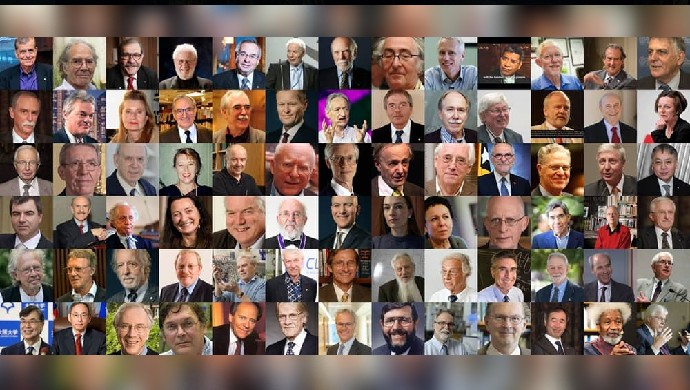

In a powerful demonstration of global solidarity, a coalition of 78 Nobel Laureates has issued a joint statement to United Nations Secretary-General António Guterres, sounding the alarm over the “widespread, systematic, and ongoing” human rights violations in Iran. Emphasizing that human rights—including the right to life, freedom of expression, and freedom from torture—are universal and inalienable, the laureates noted that the people of Iran have been deprived of these basic rights for decades.
The signatories represent global academia and humanitarianism, hailing from over two dozen countries including the United States, France, Germany, the United Kingdom, Japan, Canada, and Ukraine. The coalition spans all major academic and humanitarian disciplines, consisting of 22 Chemistry laureates, 21 Physics laureates, 18 Medicine laureates, seven Literature laureates, six Peace laureates, and four Economics laureates. Prominent signatories include sitting world leaders like Timor-Leste President José Ramos-Horta, acclaimed literary figures like Sir Kazuo Ishiguro, as well as renowned intellectuals like AI pioneer Professor Geoffrey Hinton, and NASA scientist Professor John Mather.
A devastating wave of repression
The laureates issued their statement in response to a brutal new wave of executions initiated by Iran’s ruling theocracy. Following the massive nationwide protests in January 2026, the regime has intensified its crackdown to maintain its grip on power. Citing the United Nations High Commissioner for Human Rights, the statement highlights that dozens of political prisoners have already been executed. Those targeted include demonstrators from the January protests, political activists, and individuals affiliated with the main opposition, the People’s Mojahedin Organization of Iran (PMOI/MEK).
The sheer scale of the regime’s panic is evident in its crackdown: over 4,000 individuals have been arrested on security-related charges. Furthermore, sources indicate that “several thousand” victims were killed during the suppression of the January protests, a scale of tragedy that even some Iranian officials have alluded to.
Pointing to the devastating cost of inaction by the international community, the laureates issued a stark warning: “International silence serves as a green light for repression; and with every passing day that this silence endures, another noose is tightened around another human life.”
Concrete policy recommendations for the international community
The Nobel laureates provided a clear policy roadmap for democratic governments and the UN to hold the Iranian regime accountable. They issued four critical demands, including “the immediate halt of executions, particularly in cases of a political nature,” and “the release of political prisoners and detained protesters.”
The laureates also called for “unrestricted access for international monitoring mechanisms to detention centers and independent oversight of detainees’ conditions.” Crucially, they urged “democratic governments and institutions to reassess their relations with Iran and to make the abolition of the death penalty a fundamental benchmark in all diplomatic engagement.”
Endorsing the democratic alternative
Looking forward, the laureates stressed that Iran’s future must be determined solely by its citizens through their free and sovereign will. They explicitly rejected “any return to dictatorship—whether under the guise of monarchy or religious absolutism,” and stated that the transition to democracy must happen “without war, without foreign military intervention.”
To this end, the coalition threw its full political weight behind the Iranian Resistance. They noted that the plan presented by the National Council of Resistance of Iran (NCRI) for the establishment of a temporary transitional government, as articulated in Mrs. Maryam Rajavi’s Ten-Point Plan, offers a “clear and democratic vision” for Iran’s peaceful transition toward freedom and popular sovereignty.
The road to Paris
This historic statement serves as a prelude to June 20, 2026, officially commemorated as the Day of Martyrs and Political Prisoners. On this day, more than 100,000 Iranians and international supporters of a Free Iran are expected to gather for a massive rally in Paris. The gathering will amplify these exact demands to the global community, proving that with the world’s scientific, cultural, and political elite standing firmly beside the Iranian people, the international community can no longer afford to remain silent on Iran.