

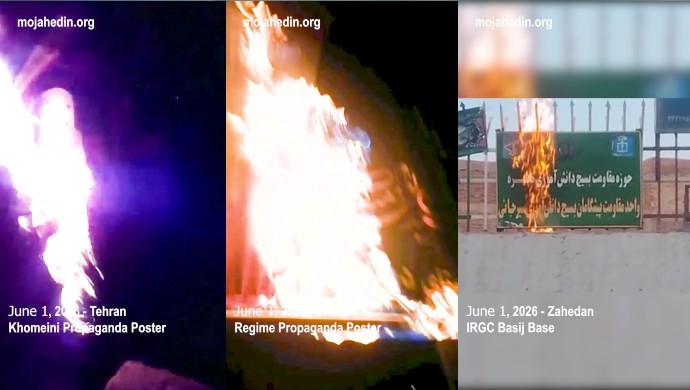

As the Iranian regime attempts to subdue the nation’s rebellious youth through a massive wave of executions, the PMOI/MEK Resistance Units are actively striking back with daring operations across the country. Defying the intense climate of repression and the threats from promoters of the shah’s brutal SAVAK police, these units are targeting centers and symbols of the regime’s apparatus.
On June 1, Resistance Units set fire to large banners and posters featuring regime founder Ruhollah Khomeini, former supreme leader Ali Khamenei, and current supreme leader Mojtaba Khamenei in major cities, including Tehran, Hamedan, Shiraz, Karaj, Mashhad, and Dehloran. In Zahedan, they targeted an IRGC Basij base tasked with suppressing students, while in Dehdasht and Ramhormoz, they struck regime centers for fundamentalism and terrorism. These operations were guided by the slogan, “Down with the oppressor, be it the shah or the supreme leader,” unequivocally rejecting all forms of dictatorship.
June 1—Iran
As the regime tries to subdue the rebellious youth of Iran through a mass wave of executions, PMOI/MEK Resistance Units carry out daring operations across Iran. They defied both mullahs' regime and the promoters of the shah's brutal SAVAK police who threaten Iran's… pic.twitter.com/Mor8DC0eQL— People's Mojahedin Organization of Iran (PMOI/MEK) (@Mojahedineng) June 5, 2026
The strategy of the noose and rising executions
The mullahs find themselves in an impasse, unable to return to the status quo that preceded the mass uprisings and massacres of January 2026. Exploiting recent wartime conditions, the regime has implemented a “strategy of the noose” to violently purge its prisons. Since the start of the war, authorities have arrested 6,500 people—including 567 connected to the PMOI—and have executed eight PMOI members alongside more than 20 young protesters who fought against the Revolutionary Guards.
The killing machine continues unabated. On May 31 and June 1 alone, at least 18 prisoners were sent to the gallows. On May 31, 12 prisoners were hanged in Zanjan, Arak, and Shiraz, including minority Baluch and Afghan nationals. On June 1, six more were executed, including 38-year-old Behnam Nemati, who was brutally hanged in public in Rasht.
Zahedan
Resistance Units target IRGC Basij base tasked with suppressing students pic.twitter.com/2vzHOqtM10— People's Mojahedin Organization of Iran (PMOI/MEK) (@Mojahedineng) June 5, 2026
Despite these horrific crimes, the regime’s executions are failing to thwart the impending uprising. The mullahs remain terrified following the assault by 250 MEK freedom fighters on Khamenei’s headquarters just five days prior to the forty-day war. This offensive has galvanized a new generation toward resistance, and the daily operations of the Resistance Units continue unabated.
The regime has gravely miscalculated by believing hangings will halt this momentum.
Rejecting both past and present dictatorships
The Iranian people are fighting a two-front battle, targeted by appeasers seeking to preserve the regime and remnants of the Shah’s dictatorship attempting to hijack the movement. While Khamenei plunged the January uprisings into a vortex of blood, the Shah’s remnants dealt the movement political blows by labeling the legitimate aspirations of Kurdish, Baluchi, Turkmen, and Arab compatriots as “separatism.” They overtly pledge to impose unchecked autocracy, establish martial law, and resurrect the dreaded SAVAK secret police—the very blueprint for Khomeini’s Ministry of Intelligence.
Tehran
Resistance Units torch poster of Ali Khamenei pic.twitter.com/axhf8Ksen1— People's Mojahedin Organization of Iran (PMOI/MEK) (@Mojahedineng) June 5, 2026
However, the era of both the Shah and the mullahs is over. The current regime leader Mojtaba Khamenei seeks to maintain power, while the Shah’s son seeks to gain it, but Iranian society will neither revert to a monarchical autocracy nor remain under a religious one. Instead, the nation is moving toward a democratic republic based on the separation of religion and state, gender equality, and autonomy for oppressed nationalities, guided by the National Council of Resistance of Iran’s Ten-Point Plan for a provisional government.