

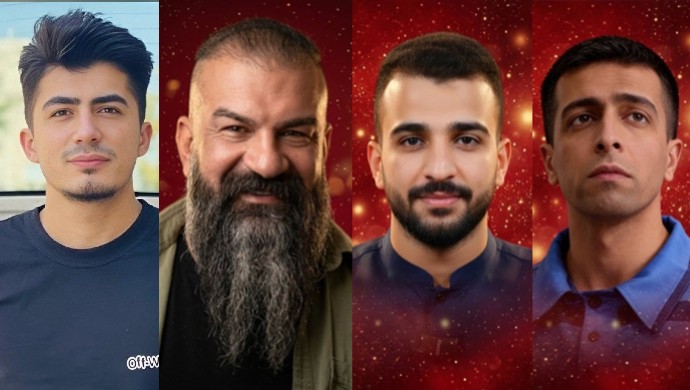

The Iranian regime has intensified its brutal wave of executions, targeting dissidents and courageous young protesters in a desperate bid to maintain control. In two days, the regime’s judiciary has hanged four young men: Mehrab Abdollahzadeh in Urmia, alongside Mehdi Rasouli, Mohammadreza Miri, and Ebrahim Dowlatabadi in Mashhad.
In the early hours of Sunday, May 3, 2026, the mullahs’ regime executed 28-year-old Kurdish rebellious youth Mehrab Abdollahzadeh in Urmia Prison. Arrested in October 2022 by the IRGC Intelligence Organization, he was sentenced to death in September 2024 by a sham Revolutionary Court presided over by the executioner judge Reza Najafzadeh. Abdollahzadeh was accused of participating in the elimination of Abbas Fatemieh, a criminal Basij member, during the 2022 uprising. The death sentence was carried out despite the complete absence of convincing judicial evidence and Abdollahzadeh categorically denying all charges one by one.
On May 4, the regime announced the executions of Rasouli, Miri, and Dowlatabadi. According to Mizan, the judiciary’s news agency, these youths were accused of “leading and directing rioters” and eliminating several Basij forces—paramilitaries directly involved in killing thousands of protesters. Mizan reported that Rasouli and Miri had a direct role in killing Basij member Hamidreza Yousefinejad during the December 2025 to January 2026 uprisings, while Dowlatabadi was labeled a main leader of unrest in Mashhad’s Tabarsi district.
A moribund regime’s blind revenge
Mrs. Maryam Rajavi, President-elect of the National Council of Resistance of Iran (NCRI), highlighted that the ruling clerics, surrounded by insoluble domestic and foreign crises, are desperately attempting to delay their inevitable overthrow through daily executions. She described the hangings in Mashhad as “a blind and ruthless act of revenge against a people who rose up last January to overthrow religious fascism.”
The Iranian regime’s judiciary, persisting in its daily and systematic abuses in Iran, has announced the execution of three courageous young men—sons of Mashhad: Mehdi Rasouli, Mohammadreza Miri, and Ebrahim Dowlatabadi. The regime has accused them of “leading and directing…
— Maryam Rajavi (@Maryam_Rajavi) May 4, 2026
Mrs. Rajavi emphasized that this unbridled bloodshed will not remain unanswered. She noted that the sweeping uprisings in Tehran, Mashhad, and Isfahan have so profoundly shaken the ruling clerics that they now resort to desperate crimes. The day of the eruption of the people’s anger and holding the regime’s leaders and ruthless judges accountable is near.
A post-uprising purge
These recent hangings do not occur in a vacuum; they follow the massive nationwide uprising of December 2025 to January 2026 that brought the clerical establishment to its knees. In a desperate domestic purge, the regime’s killing machine has accelerated.
On April 30, 2026, the regime executed Sasan Azadvar, a 21-year-old karate champion from Isfahan. Sentenced by the notorious executioner judge Morteza Barati, Azadvar was severely tortured before his death. He was charged with attacking State Security Force (SSF) officers and inciting riots. The judiciary’s own account highlighted his bravery, detailing how he attacked an SSF minibus while oppressive forces were inside.
Just days prior, on April 25, the regime hanged another rebellious youth from Isfahan, Erfan Kiani. Furthermore, the regime continues to ruthlessly target oppressed minorities, executing 18-year-old Baluch political prisoner Amer Ramesh in Zahedan Central Prison on April 26.
The necessity of international accountability
As the execution apparatus accelerates, the responsibility of the international community becomes paramount. Mrs. Rajavi called on the United Nations Security Council, its member states, and all human rights defenders to decisively condemn these executions and to take immediate, effective practical measures to halt Iran’s machine of torture and execution and save the lives of other political prisoners.
At dawn today, May 3, in Iran, a defiant youth, #MehrabAbdollahZadeh, a 28-year-old Kurdish compatriot, was executed by the henchmen of the mullahs’ regime in Urmia Prison. Arrested during the 2022 uprising, he was sentenced to death in September 2024 by the so-called… pic.twitter.com/D29jqrrBXf
— Maryam Rajavi (@Maryam_Rajavi) May 3, 2026
Silence in the face of such crimes is a blatant disregard for universal human rights and only emboldens the Iranian regime to continue its repression. Ultimately, these executions are not a sign of the regime’s power but of its profound weakness. They belie the regime’s absolute fear of an increasingly restive society that does not fear standing up against the apparatus of repression. No amount of brutality can shield the ruling clerics from the inevitable force of a people’s rage or avert their ultimate downfall.