

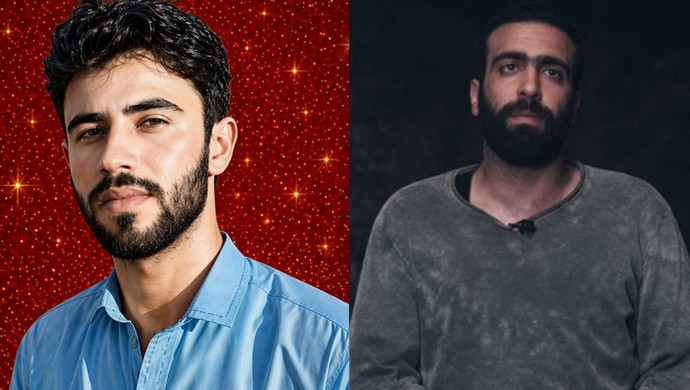

In a relentless continuation of its daily bloodshed against dissidents, the Iranian regime’s killing machine has claimed the lives of two more political prisoners over the past two days. Coming in the aftermath of the massive December 2025–January 2026 nationwide uprising that brought the clerical establishment to its knees, these executions serve as a desperate domestic purge. While the regime attempts to project power and control through these brutal hangings, in reality, it is exposing its deep-seated fear of an increasingly restive society.
The execution of uprising protesters
Early Saturday morning, on April 25, 2026, the regime’s judiciary hanged Erfan Kiani, a brave rebellious youth from Isfahan. Kiani was arrested during the recent nationwide protests. Mizan, the judiciary’s news agency, attempted to justify the execution by accusing him of “destroying public and private property, setting fires, carrying and using Molotov cocktails, carrying cold weapons, blocking the path of vehicles, and attacking agents.” The regime claimed he acted as a ringleader, stating that “by carrying pre-prepared wooden boards and tires, he facilitated setting fires in the streets” during the January uprising.
Iran’s regime has executed Erfan Kiani this morning in Isfahan. Erfan was one of the protesters arrested during the nationwide uprising in December 2025–January 2026.
Mizan, the news agency of the regime’s judiciary, claimed that execution of Erfan Kiani was the "use of Molotov…
— People's Mojahedin Organization of Iran (PMOI/MEK) (@Mojahedineng) April 25, 2026
This marks the 9th execution directly related to the recent uprising and the 17th political execution in the past month alone. Furthermore, the judiciary announced that cases of 15 other individuals tied to the protests have been processed, resulting in prison sentences.
The threat of execution now looms over other detained protesters. In Tehran, the regime’s Supreme Court has upheld the death sentences of three young rebellious youths: Ehsan Hosseinipour, Matin Mohammadi, and Erfan Amiri. Their cases have been forwarded to the Office for the Execution of Sentences. The regime accuses them of using Molotov cocktails to attack a Basij gathering at a mosque in Pakdasht during the January uprising, resulting in the deaths of two Basij members.
Brutal targeting of oppressed minorities
The regime’s killing machine also continues to ruthlessly target oppressed minorities. On the morning of Sunday, April 26, the regime executed Amer Ramesh, a Baluch political prisoner, in Zahedan. Ramesh was only about 18 years old at the time of his arrest. Highlighting the regime’s initial brutality against him, he had previously been shot by security forces during a raid on a shop. He hailed from Belengi, a rural area near Chabahar in Sistan and Baluchestan province.
This morning, in continuation of its daily criminal bloodshed of dissidents, Iran’s regime has executed Baluch political prisoner Amer Ramesh in Zahedan.
Mizan, the judiciary’s news agency, stated that the reason for the execution of this political prisoner was "bomb planting,… pic.twitter.com/n0WmB4Oa2L
— People's Mojahedin Organization of Iran (PMOI/MEK) (@Mojahedineng) April 26, 2026
On Friday, April 24, Ramesh informed his family via a phone call that he had been transferred from Zahedan Central Prison to quarantine and that his execution was scheduled for Sunday dawn. Mizan stated the execution was based on charges of “bomb planting, carrying out an ambush against military forces, and membership in the Jaish al-Adl group.”
Calls for international accountability
These atrocities demand an immediate response. The international community has a profound duty to hold the Iranian regime accountable for its criminal executions and to take decisive measures to protect the lives of political prisoners.
Mrs. Maryam Rajavi, President-elect of the National Council of Resistance of Iran (NCRI), stated that the mullahs’ regime, terrified of the escalation of popular uprisings and the expansion of operations by rebellious youths, sees erecting gallows and accelerating death sentences as its only solution. She emphasized that these relentless executions will not save the regime from its inevitable overthrow; instead, they will only further ignite the fire of the people’s anger and strengthen the resolve of the brave Iranian youth.
At dawn today, Erfan Kiani, a courageous young man from Isfahan, was executed by the brutal clerical dictatorship in Iran, joining the ranks of rebellious youth who have risen for freedom.
The ruling mullahs will gain nothing from these daily executions. Their attempt to escape…
— Maryam Rajavi (@Maryam_Rajavi) April 25, 2026
Mrs. Rajavi called for immediate and practical action by the United Nations Security Council and its member states to stop the executions and save the lives of prisoners on death row. She reiterated that the regime’s leaders must be brought to justice for more than four decades of crimes against humanity and genocide. Ultimately, a young generation that does not fear standing up against the apparatus of repression will not be intimidated by these desperate acts of a failing regime.