

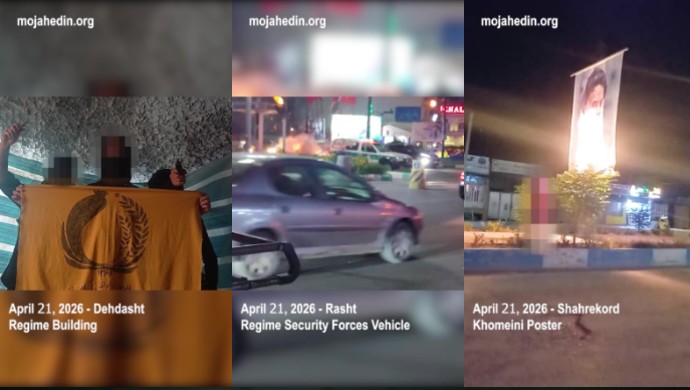

On April 21, in direct response to the criminal execution of PMOI members Hamed Validi and Mohammad (Nima) Massoum-Shahi, the PMOI Resistance Units launched a wave of daring operations across Iran. These valiant acts targeted regime centers and symbols of repression, sending a clear message that the regime’s brutality will not deter the Iranian people from overthrowing the dictatorship and establishing a democratic republic.
In Rasht and Parand, Resistance Units targeted vehicles belonging to the repressive State Security Forces. In Qahdarijan, a regime building associated with corruption and the looting of national wealth was targeted.
April 21—Iran
In response to the criminal execution of PMOI members Hamed Validi and Mohammad (Nima) Massoum-Shahi, Resistance Units in different cities targeted regime centers and symbols of crime and repression. With their daring and valiant operations, the PMOI Resistance… https://t.co/HCM9cTP2Qj pic.twitter.com/aPqY8Us0pr— People's Mojahedin Organization of Iran (PMOI/MEK) (@Mojahedineng) April 23, 2026
Across several cities, symbols of the regime’s decaying leadership were destroyed. Resistance Units set fire to posters, banners, and billboards featuring eliminated former supreme leader Ali Khamenei in Ramhormoz, Semirom, and Talesh. In Shahrekord and Shiraz, a large poster and a monument honoring regime founder Ruhollah Khomeini were torched.
Demonstrating their unwavering resolve, Resistance Units in Dehdasht recorded themselves holding the National Liberation Army (NLA) emblem while chanting, “Viva the National Liberation Army of Iran,” before targeting a regime building.
The catalyst: sham trials and executions
This nationwide defiance was ignited by the regime’s execution of 45-year-old civil engineer Hamed Validi and 38-year-old technical worker Nima Shahi in the early hours of April 20, 2026. The two heroic PMOI members were arrested in Tehran on May 13, 2025, alongside relatives, and subsequently subjected to severe physical torture and interrogation.
The state murder of these political prisoners followed a deeply flawed judicial farce. In September 2025, the Chief Justice of Alborz province absurdly accused them of espionage connected to a 12-day war—despite the glaring chronological flaw that they had been arrested a full month before that war even began. Following extensive torture, the Karaj Revolutionary Court sentenced them to death in October 2025 on fabricated charges that included “Moharebeh” (waging war against God), “cooperation with hostile groups and the Zionist regime,” and “assembly and collusion against national security.”
Fabrications and a broader wave of executions
To justify these executions, state-run media, including Mizan and Tasnim, falsely labeled the PMOI members as a “spy network linked to Mossad,” claiming they constructed explosive projectiles. The mullahs use these worn-out “foreign spy” narratives to conceal the prisoners’ true identity as native dissidents, terrified of the growing gravitation of Iranian youth toward the Resistance Units.
In Parand, Resistance Units targeted a vehicle belonging to the regime's repressive security forces. pic.twitter.com/DKw6m1GHpG
— People's Mojahedin Organization of Iran (PMOI/MEK) (@Mojahedineng) April 23, 2026
These murders do not happen in a vacuum; they are part of a broader, desperate campaign by a decaying regime facing an existential threat from an arisen population. The regime recently executed seven young protesters arrested during the massive December-January nationwide uprisings: Saleh Mohammadi, Mehdi Ghassemi, Saeed Davoudi, Amirhossein Hatami, Mohammad Amin Biglari, Shahin Vahedparast, and Ali Fahim. This comes directly on the heels of the recent executions of six other PMOI members: Mohammad Taghavi, Akbar Daneshvarkar, Babak Alipour, Pouya Ghobadi, Abolhassan Montazar, and Vahid Bani Amerian. Paralyzed by the fear of another uprising, the moribund regime is exploiting the fog of external wars to systematically wipe out dissidents, preparing to repeat the history of Ruhollah Khomeini’s 1988 genocide of political prisoners.
However, as the Resistance Units have proven with their rapid responses, these executions are merely a desperate smokescreen hiding the regime’s profound domestic weakness. The blood of martyrs like Hamed and Nima will only fuel the flames of future uprisings, strengthening the Resistance Units and the National Liberation Army, and paving the way for the overthrow of a collapsing regime.