

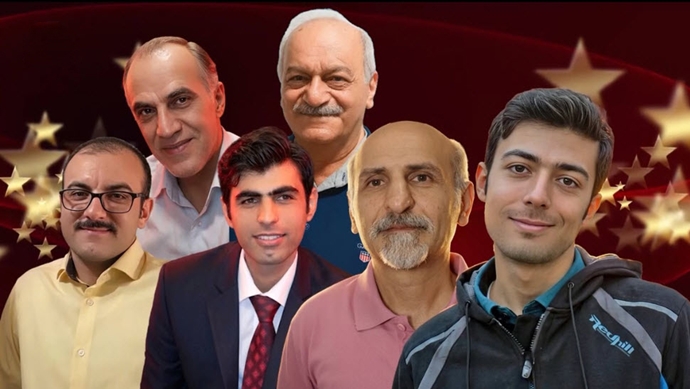

Between March 30 and April 4, 2026, six imprisoned PMOI/MEK members—Vahid Bani Amerian, Mohammad Taghavi, Babak Alipour, Pouya Ghabadi, Akbar Daneshvarkar, and Abolhassan Montazer—were executed in Ghezel Hesar Prison. More than a year earlier, on March 2, 2025, after receiving their death sentences, they wrote the statement below and sent it from prison. Today, that text stands not only as their final political message, but as a testament of courage, conviction, and defiance in the face of death.
This is not an ordinary political statement. It is the voice of six men writing from death row, fully aware that the regime could carry out their executions at any moment. They wrote with clarity, dignity, and unwavering resolve. In the end, the Iranian regime did execute all six. Their case drew particular attention because of serious concerns over the injustice of the proceedings, including torture and forced confessions.
This is not simply a political declaration but a historical testament written in the shadow of the gallows. Its language carries more than a century of Iranian resistance and sacrifice. It moves from the Constitutional Revolution and the Jangali movement to Qazi Mohammad, Mossadegh, the anti-Shah struggle, the rise of the PMOI/MEK, the repression that followed the 1979 revolution, Khavaran, the 1988 massacre of political prisoners, and the victims of more recent uprisings. The authors place themselves consciously in that long chain of struggle and sacrifice, presenting their own fate as part of Iran’s unfinished fight for freedom, justice, and popular sovereignty. Because the statement is rich with historical and political references that may be unfamiliar to non-Iranian readers, it is published here with brief explanatory endnotes.
🚨 #Iran News Alert –
On April 4, 2026, the Iranian regime hanged two PMOI members, Vahid Baniamerian (“Commander Vahid”) and Abolhassan Montazer.
This video shows them alongside four other PMOI members—Babak Alipour, Pouya Ghobadi, Mohammad Taghavi, and Akbar (Shahrokh)… https://t.co/9BFaFntZd6 pic.twitter.com/G6mluFM8lm
— SIMAY AZADI TV (@en_simayazadi) April 4, 2026
Statement of Six Heroic PMOI/MEK Members Facing the Gallows
Vahid Bani Amerian, Seyed Mohammad Taghavi, Babak Alipour
Pouya Ghabadi, Akbar Daneshvarkar, and Abolhassan Montazer
Evin Prison –2 March 2025
We have already been executed hundreds of thousands of times throughout Iran’s history!
From that sacred day when we entered into an unwritten covenant with our people to rescue our homeland, at any cost, from the claws of despotism and dependence, we were once known as the Mujahideen of Tabriz. At the side of Sattar Khan (1), we built inspiring bastions of resistance, or advanced with the Bakhtiari forces to conquer Tehran. And later, our mangled bodies were found in Amirkhiz and Khiaban (2), beneath the rubble of cannon fire, or lying on the ground amid the ruins of Baharestan. Such was the blood price of reviving constitutionalism, which soon afterward perished with hands “empty of weapons” and feet wounded by the bullets of the usurpers of the revolution.
On another day, we hastened to Gurab Zarmikh (3), so that row upon row, in the presence of Mirza Kuchak (4) we might swear together to remain faithful to our first covenant. They called us “Jangalis.” For years we were cast into exile, and on the road to the republic we were hanged, or our frozen bodies in the mountains of Gaduk (5) were left as prey for the wolves.
Our heads went to the gallows in groups alongside Qazi Mohammad (6), and the throats that had escaped the boots of Reza Khan were once again silenced—those very throats that, this time under the name of Peshmerga, had cried out from Kurdistan for freedom and the end of discrimination.
We never died, and we found one another again in the streets around Baharestan, with the slogan “Either death or Mosaddegh,” in an unequal battle against the tanks of the Pahlavis. But they staged a coup against our bloody victory, and we were left with Fatemi (7), the firing squads, and the blood that dripped from our bodies at the University of Tehran.
Amid the bloody trials of history, we evolved and became organized, this time in the proud form of the “Mojahed” and the “Fedayi.” From then on, there were our unyielding bodies on torture beds, our innocent feet lashed thousands of times by SAVAK, and our fearless heads split open by hot bullets on the hills of Evin or in Jaleh Square. Sharing the creed of the “Father” (8) and allied with “Hanif,” (9) we fought until our blood became a flood and shattered the Shah’s throne and crown, and our free spirits multiplied in the uprising of the revolution, finding a blessed incarnation this time in the body of the young people who had been organized to expose the regime.
We, who had risen many times before against monarchy and foreign powers and had been crucified by both—and whose bodies had at times, in the manner of Sharif (10), even been trampled by opportunists—had now defeated them, only to find ourselves face to face with a monster named Khomeini, whose forebears had repeatedly stabbed us in the back with the dagger of takfir, and who had now stolen our people’s revolution and intended, vulture-like, in the name of “Velayat,” to enthrone himself upon the pulpit of despotism. And he did.
And on 30 Khordad, we swore together with “Massoud” (11) to stand against this final, ancient, hate-filled enemy with everything we had—like the teenage militia in Evin who, instead of giving their names, shouted “Freedom!” and were shot.
And that was only the beginning of a new chapter of whips, branding irons, torture, and massacre in our history—and from then on, all across the soil of Iran: Khavaran!
Yes! O you cursed by the mothers of Aban! (12)
O killers of Khodanour, Hadis, Koumar, and Aylar! (13)
O executioners of “the most beautiful children of the sun and the wind”!
We are certain that the overthrow of your tyrannical clerical despotism will be the final act in our long history of suffering and torment, and the dawn of the fulfillment of our first covenant!
So if fate decrees that you execute us hundreds of thousands of times again, in the hope of the victory of a democratic republic and the freedom and flourishing of this captive homeland—from blood-soaked Kurdistan and Baluchestan to the reed beds of Mahshahr, Tehran, and all the cities of Iran—we will still stand firm in our rebellious position, and we repeat Behrouz’s message:
“We do not bargain with you over our lives!”
We are the ones who have charted your end;
We are the challengers who enter the field against you.
We are the spring from which that blossoming dawn arises;
On the page of history, you are winter.
- Vahid Bani Amerian
- Seyed Mohammad Taghavi
- Babak Alipour
- Pouya Ghabadi
- Abolhassan Montazer
- Akbar Daneshvarkar
We request that this statement be published on Simaye Azadi and in the Resistance media as soon as our sentences are confirmed by the high court.
With many thanks
2 March 2025
Notes for Readers
- Sattar-Khan
Haji Hassan Qarajeh-Daghi (1868–1914), popularly known as Sattar-Khan, was a leading figure in Iran’s Constitutional Revolution of 1906 against the Qajar monarchy. A native of Tabriz, he became a symbol of armed resistance in defense of constitutional rule. After the revolution’s initial successes, central authorities moved to disarm him and his fighters, known as the Mojahedin. He was wounded in the ensuing conflict and died a few years later. - Amirkhiz and Khiaban: Two old neighborhoods in the city of Tabriz that served as strongholds of resistance during the Constitutional Movement.
- Gurab Zarmikh, a region in Gilan associated with Mirza Kuchik Khan and the Jangal Movement.
- Mirza Kuchek Khan Mirza Younis, known as Mirza Kuchek Khan Jangali (1880–1921), was a revolutionary leader associated with the Jangali movement in Gilan. Originally a clergyman, he played an important role in the Constitutional movement and later helped establish a republic in Gilan in opposition to foreign domination and central despotism. He died in 1921 after being caught in a snowstorm while fleeing government forces. “Jangali” refers to the forests of Gilan, where his movement was based.
- The mountains of Gaduk: A poetic reference, in some Persian retellings, to the snowy highlands linked to Mirza Kuchik Khan’s last journey and death.
- Qazi Mohammad
Qazi Mohammad (1900–1947) was a Kurdish political and religious leader who headed the short-lived Republic of Mahabad in 1946. After the collapse of the republic, he refused to flee and was executed in March 1947. - Hossein Fatemi
Hossein Fatemi (1917–1954) was an Iranian journalist, intellectual, and politician, and a close associate of Prime Minister Mohammad Mossadeq. He served as foreign minister during the oil nationalization period. After the 1953 coup, he was arrested, tortured, tried, and executed by firing squad under the Shah in November 1954. - “The Father”
“The Father” refers to Ayatollah Mahmoud Taleghani (1911–1979), a prominent progressive Iranian cleric and opponent of the Shah. He spent many years in prison and later became an influential figure in the 1979 revolution. He was widely seen as a relatively independent and moderating voice in the early revolutionary period. He opposed Khomeini’s despotic methods and was a supporter of the PMOI. - “Hanif”
“Hanif” refers to Mohammad Hanifnejad (1938–1972), founder of the People’s Mojahedin of Iran. - Sharif
Sharif refers to Majid Sharif Vaqefi (1949–1975), a prominent PMOI/MEK member remembered as a symbol of steadfastness during an internal crisis in the organization in the 1970s. He opposed the attempt by a Marxist faction to redefine the movement’s ideology, and was later killed by members of that faction. - “Massoud”
“Massoud” refers to Massoud Rajavi, the leader of the Iranian Resistance. - The Mothers of Aban — the mothers of those killed in Iran’s November 2019 protests
- The names of some of those killed in the 2022 uprising