

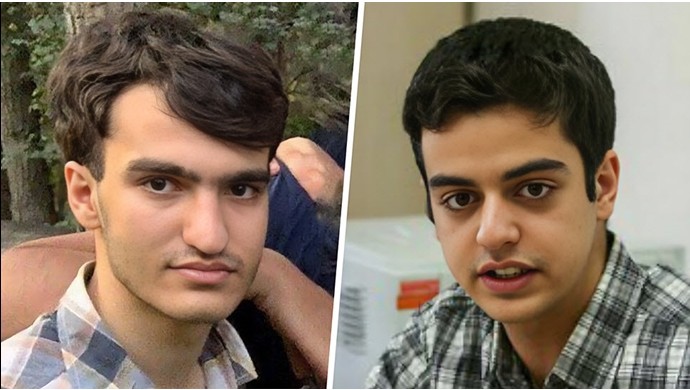

On the anniversary of Student Day in Iran, two of the country’s brightest young scientists – Ali Younesi and Amirhossein Moradi – sent powerful letters from inside prison.
From behind the walls of Evin and Ghezel Hesar, they spoke to their fellow students across Iran, calling on them to continue the struggle against dictatorship and to refuse the “winter” of fear and humiliation the regime tries to impose.
Who are Ali Younesi and Amirhossein Moradi?
Ali Younesi (born 11 October 2000) is a computer engineering student at Sharif University of Technology, one of Iran’s most prestigious universities. Long before his arrest, he was already known across the country as a prodigy in astronomy:
- Silver medal – National Astronomy Olympiad (2016)
- Gold medal – National Astronomy Olympiad (2017)
- Member of Iran’s 12th team for the International Olympiad on Astronomy and Astrophysics (IOAA)
- Gold medalist at the 2017 IOAA
Amirhossein Moradi, a physics student at Sharif, comes from the same circle of scientific excellence. He won a silver medal in the national astronomy Olympiad in 2017 and was considered one of the promising young physicists of his generation.
In a normal, free country, both would now be in research labs, observatories, or international universities, pushing the frontiers of science. Instead, they are political prisoners.
On 22 10 April 2020, both were arrested by security forces.
The judiciary later accused them of links with the People’s Mojahedin Organization of Iran (PMOI/MEK) and alleged “sabotage” activities. After nearly two years of detention and interrogation, both were sentenced to 16 years in prison.
Today, Ali is held in Ghezel Hesar Prison, while Amirhossein is in Evin Prison.
A Letter from Evin: Amirhossein Moradi’s Call From the “Regime of Executions”
In his Student Day message, physics student and Olympiad medalist Amirhossein Moradi writes from Evin Prison “in memory of schoolmates” like Ehsan Faridi (under threat of execution) and Ahmad Baladi (driven to end his life under unbearable pressure).
He begins by placing today’s student struggle in a 72-year timeline, from the massacre of Tehran University students in 1953 under the Shah, to the present-day repression by “the executioner regime.”
A regime that “breaks its own records” of execution
Amirhossein describes a government that has resorted to ever-increasing executions as its main tool of survival. In his words, this is a “regime of executions” that seeks “progress” only in one field: more hangings, more death sentences, more fear. It is, he says, the only arena where the authorities are proudly “breaking their own records.”
For him, every execution is not just a number, but a moral earthquake: Which pure conscience is there that does not die once and live again with each execution?
He reminds readers of the thousands of mothers who are left to mourn children who will never return, and asks: how long can we hear this and remain silent?
Three false roads – and one real path
Amirhossein’s letter is not only an indictment; it is also a strategic reflection.
He asks what should be done in the face of this situation, and he rejects two illusions:
- Waiting for foreign saviors
He warns against those who sit “like the waiters for the ‘appearance’,” hoping that missiles and drones from foreign countries will somehow bring freedom. As recent wars have shown, he writes, such interventions do not deliver liberty to the people. - Waiting for the regime to reform itself
He rejects the idea that a system built on “massacre, plunder, and discrimination” will suddenly soften or reform itself while people passively watch poverty, injustice, and environmental destruction deepen.
Instead, he calls for a third option:
- Breaking the silence and fighting for change
Democracy, he insists, will not “descend from the sky.” It must be created by young people and students themselves, the same generation whose uprising in 2022 shook the foundations of the regime.
“In the winter of the homeland, we must will the spring”
For Amirhossein, universities are once again called to be at the front line. He tells his fellow students that their voices and actions are the real answer to endless executions and suffering:
“You, friends sitting in your classrooms, your cries are the answer to this endless pain. In the winter of the homeland, we must resolve for the spring.”
He describes the student day as a “covenant between generations standing against despotism” and urges today’s students to stay loyal to that covenant and push back the darkness.
A letter From Ghezel Hesar: Ali Younesi on “Winter Geographies” and the meaning of struggle
From Ghezel Hesar Prison, computer engineering student and international gold medalist Ali Younesi sends a letter.
He begins with the calendar: it is the last month of autumn, the season of school and university, as the days slide toward winter. But in prison, he writes, it is supposed to be “always winter” – a place designed for cold, despair, and the destruction of hope.
Yet even there, he says, “there is no news of surrender and hopelessness.”
“How can you live in the coldest geography and not be conquered by winter?”
Ali has now been away from university and his academic dreams for more than 2,000 days. But he speaks of “the lessons of prison and of resistant prisoners” and poses a central question: How can we live in this coldest geography and still refuse to be defeated by winter?
He quickly expands this question beyond the prison walls. In a dictatorship, he argues, the whole country becomes a prison – with many forms, many colors, many “wings.” All are designed to humiliate people and shrink their demands so that they forget the fundamental right that has been stolen from them: freedom.
Rejecting the search for “a better jailer”
Ali’s letter is a sharp reply to those who want people to lower their expectations and simply ask for a “better” authoritarian system:
Shame, he writes, on those who push society to accept “a better prison” and forget that the real issue is the right to determine their own destiny.
Shame on those who encourage people to see themselves as “subjects needing a master,” instead of free human beings.
He also warns against waiting for foreign powers to bring in a more acceptable “jailer.” Freedom is not a gift; it must be taken back by the people themselves.
“There is only one answer: struggle”
For Ali, there is only one answer in this winter geography—whether in Iran as a whole or in the prison yard: struggle.
He describes struggle as: “The liberation of the fighting human being, The burning flame of history, and The exceptional jewel of modern Iran in a region full of dictatorships”
It is struggle, he says, that has prevented winter from completely conquering the hearts of people, whether outside or behind bars.
The university as “the beating heart” of awareness and revolt
Ali returns, like Amirhossein, to the role of the university. He calls it “the beating heart” of the long, painful journey from awareness to organized struggle.
He traces the evolution of student slogans: From “Death to the Shah” to burying the illusion of reform in “Reformist, hardliner – the game is over”, and to drawing the true line between dictatorship and freedom with “Death to the oppressor, be it Shah or Leader”
Student blood, he says, has kept this line clear.
Ali ends by addressing his “unseen friends” in classrooms across Iran, urging them to look into each other’s faces, to “place the mirrors of your hearts in front of one another,” and from this shared determination, raise a storm of revolt and defiance.
Student Day, he writes, still shines with the blood of the three students killed in 1953 and now also with the courage of today’s imprisoned youth – a light that announces, “the spring of freedom and the rebuilding of Iran.”
Why their stories matter
The case of Ali Younesi and Amirhossein Moradi is not only a story of two gifted students turned political prisoners. It represents a larger truth about this generation:
The regime tries to turn elite students into examples: “Even if you are the best and brightest, we can crush you if you dare to think differently.”
Their response, through these letters, is the reverse message: “Even in your harshest prisons, we will keep thinking, speaking, and organizing. You cannot imprison an entire generation’s demand for freedom.”
Their words link to the history of student struggle from 1953 to today, the current wave of executions and repression, and the future horizon of a free, democratic Iran without Shah or mullahs.