

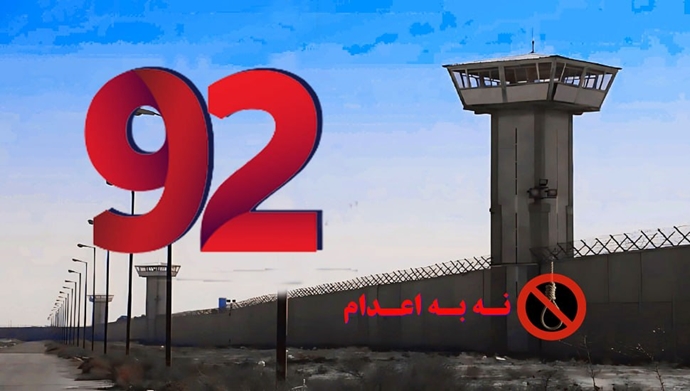

The Iranian regime executed a staggering 283 people in the Persian month of Mehr (September 23—October 22), marking what activists are calling the bloodiest month in decades, as it continues to wield capital punishment to suppress dissent. The grim total for the month included seven political prisoners, seven women, and two juvenile offenders. This surge in state-sanctioned killings was met with resolute defiance as the “No to Executions Tuesdays” campaign entered its 92nd consecutive week, expanding its reach to 54 prisons across the country.
In the last week alone, authorities carried out 59 executions, including two women, underscoring the relentless pace of the regime’s killing machine.
A deliberate campaign of terror
The campaign’s latest statement identified the wave of executions as a “blatant attempt to create terror in society and silence the voice of freedom-loving people.” Activists argue that the regime, after “46 years of corruption and plunder,” is now desperately “using execution as a tool for its own survival.”
This judicial crackdown has been accompanied by the issuing and upholding of new death sentences against political prisoners. The Supreme Court recently upheld the sentences for Manouchehr Fallah and Ehsan Faridi. Meanwhile, new death sentences were issued against Kavous Abdollahzadeh, a Kurdish political prisoner, and Zahra Tabari in Lakan Prison, Rasht.
In a stark example of the tense atmosphere inside the prisons, security forces at Evin Prison attempted to transfer inmate Ehsan Afrashteh for his execution last week but were met with fierce resistance from other prisoners. His transfer is still considered imminent.
Resistance expands behind prison walls
Despite the regime’s efforts, the “No to Executions Tuesdays” movement continues to grow in strength and scope. With the addition of Tircheh Bolouk Prison in Borujerd and Ilam Prison this week, the campaign of weekly hunger strikes and protests now spans 54 prisons nationwide.
From the notorious Evin and Ghezel Hesar prisons in the capital to facilities in nearly every province, including Karaj, Isfahan, Ahvaz, Shiraz, Mashhad, Tabriz, and Sanandaj, thousands of prisoners are participating in coordinated acts of defiance. The campaign, which began in January 2024, has become a powerful symbol of organized resistance from within the regime’s own detention centers.
Streets and prisons unite in defiance
The prisoners’ calls for justice have been echoed by protests on the streets. In solidarity with the 92nd week of the campaign, citizens held demonstrations in dozens of cities, including Tehran, Tabriz, Isfahan, Lahijan, Zanjan, Karaj, and Sanqar.
Protesters held placards bearing the names of death-row inmates and chanted slogans such as “Fire is the answer to execution,” “We will not be silent in the face of executions,” and “Political prisoners must be freed.” Chants specifically demanding freedom for Zahra Shahbaz Tabari, Manouchehr Fallah, and Ehsan Faridi created a direct link between the resistance on the streets and the prisoners on hunger strike. The families of death-row prisoners also held a courageous protest in front of the parliament building, chanting “No to executions.”
In their statement, the campaign members declared that “Execution is a criminal tool for the survival of despotic regimes,” adding that “every execution is a new wound on the body of society and a sign of the failure of law, human dignity, and justice.” The movement has issued clear demands for the international community and the Iranian regime: an immediate halt to all executions, the cancellation of all existing death sentences, and unconditional access for international human rights organizations to Iran’s prisons.