

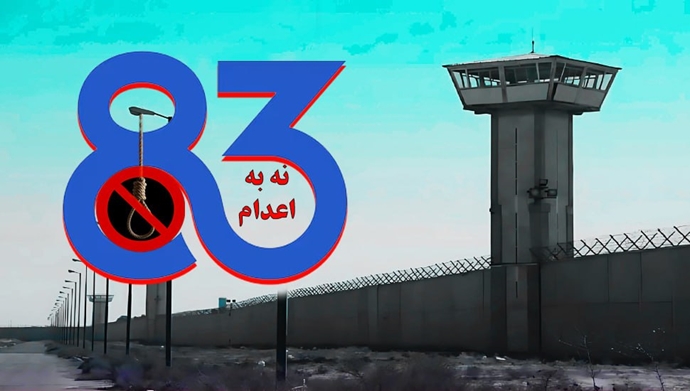

On August 26, 2025, the “No to Executions Tuesdays” campaign marked its 83rd consecutive week with a significant expansion of its coordinated hunger strikes, now encompassing 50 prisons across Iran. This growing protest from within the regime’s penitentiaries was mirrored by a surge of public demonstrations in dozens of cities, creating a powerful, dual-front resistance against the clerical regime’s escalating use of the death penalty.
The wave of defiance comes as the regime accelerates its execution machine. In August alone, at least 166 individuals were put to death, with 31 executions carried out in the last week. Among these were two public hangings in Kordkuy and Beyram, Larestan, a brutal tactic aimed at spreading fear. The campaign’s latest statement condemned this, noting, “The executioner regime intends to plunge society into terror by humiliating and normalizing violence.”
A growing chorus of defiance from behind bars
The campaign, which began in January 2024, has become a potent symbol of resistance inside Iran’s most notorious prisons. This week, it welcomed prisoners from Dehdasht Prison, underscoring its nationwide reach. The campaign’s organizers noted the grim significance of this expansion: “adding the name of Dehdasht prison to the campaign’s list is a reminder of the bitter truth that no corner of Iran is safe from the shadow of execution.”
https://twitter.com/en_simayazadi/status/1960301917097120177
Inmates in key political prisons such as Evin in Tehran and Ghezel Hesar in Karaj continue to form the backbone of the movement, joined by thousands more in a coordinated act of non-violent defiance against the regime’s primary tool of suppression.
Regime attempts to erase history and terrorize public
As internal and external pressure mounts, the regime has also resorted to acts of historical vandalism. Recently, authorities began work to convert Section 41 of Tehran’s Behesht-e Zahra cemetery into a parking lot. This plot is the resting place for thousands of political prisoners executed during the 1980s massacre, and the move has been condemned by Amnesty International.
The “No to Executions” campaign statement described the act as “a shameful attempt to erase collective memory and the evidence of state crimes” and “a blatant disrespect to the victims and their families,” highlighting a desperate effort by the authorities to obliterate their history of atrocities.
Streets fill with solidarity as families lead the charge
In parallel with the prison hunger strikes, hundreds of citizens took to the streets in cities from Tehran and Rasht to Kermanshah and Ahvaz. Protesters brandished placards and chanted slogans that directly challenged the regime’s authority, including, “Our response to execution is a fiery uprising,” “Political prisoners must be freed,” and “The next execution will be an uprising.”
The families of prisoners on death row were a prominent force in these protests. Mothers and fathers, defying immense security pressure, held images of their children and chanted “Do not execute,” “Our children are innocent,” and “Support the ‘No to Executions Tuesdays’.” Their visible pain and unwavering resolve have become a powerful symbol of the human cost of the state’s killing machine.
August 26—Tehran, Iran
In tandem with the 83rd week of the "No to Executions Tuesdays" campaign, families of political prisoners on death row rally to call for the revocation of the death sentence of their loved ones.#StopExecutionsInIranpic.twitter.com/RbAYQqqX9i— People's Mojahedin Organization of Iran (PMOI/MEK) (@Mojahedineng) August 26, 2025
The “No to Executions Tuesdays” campaign has evolved into a unified national movement, linking the silent suffering inside prison walls with the vocal anger on the streets. Its core message, as articulated in its latest statement, is a direct challenge to the regime’s legitimacy: “Execution is not the solution; Execution is a clear violation of the right to life; Execution is a tool to create terror and consolidate political repression.” The campaign concluded its statement with an urgent appeal for global action, asking international bodies and human rights advocates “to stand against this cycle of death and reflect the Iranian people’s protest against executions.”