

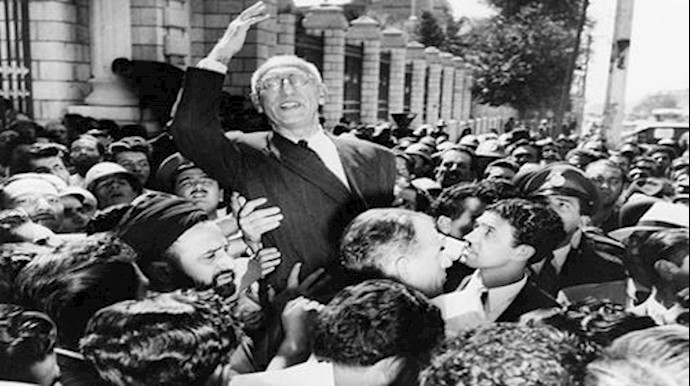

Seventy-two years ago today, on August 19, 1953, a tripartite coalition of foreign colonial powers, the royal court, and reactionary clerics overthrew the national government of Iran’s democratically elected Prime Minister, Dr. Mohammad Mosaddegh.
Mosaddegh was a pioneer in democratic institutions in Iran, the rule of law, and importantly, the leader of the movement to nationalize Iran’s oil industry and help the Iranian people get their rightful due. Naturally, the shah and his cohorts in the clergy, along with their masters abroad, who were totally opposed to the Iranian people controlling their destiny, put in a concerted effort to remove Mosaddegh from power through violence and install a dictator and puppet of foreign powers.
This dark day was not merely a historical event but the original sin that plunged Iran into a continuous, 72-year cycle of tyranny. It set a precedent for suppressing democracy that connects the brutal monarchic dictatorship of the past with the corrupt theocratic fascism of the present.
A legacy of two dictatorships: From the Shah to the mullahs
The immediate outcome of the coup was the return of the fugitive Shah and the establishment of a 25-year royal dictatorship. Learning that his survival depended on absolute repression, the Shah unleashed his newly formed secret police, SAVAK, to crush any dissent. This brutal suppression of all democratic and revolutionary forces created a political vacuum.
The reactionary clerics, whose leading figures like Ayatollah Kashani were partners in the 1953 coup, were allowed to flourish in this environment. They ultimately hijacked the Iranian people’s anti-monarchic revolution in 1979, proving that the true heir to the treacherous and despotic Shah was another traitor and despot named Ruhollah Khomeini. The coup didn’t just install one dictator; it paved the way for his successor, establishing a direct lineage of oppression from the Shah to the Sheikh.
An undeniable crime: Decades of confessions from the perpetrators
The role of foreign powers in this crime against the Iranian nation is not a matter of debate but a confessed historical fact. Over the decades, the perpetrators have been forced to admit their guilt.
In 2000, U.S. Secretary of State Madeleine Albright stated that America played a “significant role” in the coup. In 2009, President Barack Obama acknowledged that the CIA was involved in the overthrow of a democratically elected Iranian government. In 2023, the CIA itself released an audio file admitting the coup was undemocratic.
Britain’s role has been similarly confirmed. Former UK Foreign Secretary David Owen said that the UK should finally acknowledge its leading role in the 1953 coup that toppled Iran’s last democratically elected leader and stated bluntly, “There are good reasons for acknowledging the UK’s role with the US in 1953 in overthrowing democratic developments.”
Most recently, on June 24, 2025, U.S. Tim Senator Kaine reiterated that in 1953, the U.S. overthrew the democratic prime minister at the request of the United Kingdom, whose oil interests were at risk, and helped install the shah dictatorship and train the brutal SAVAK police.
The enduring lesson: Organized resistance is the only path forward
While tyrants failed to learn from history, the Iranian people and their freedom-loving forces learned a crucial lesson from the tragedy of 1953. They understood that even if a popular movement achieves power, it is condemned to failure without a revolutionary organization to lead the struggle. Even Dr. Mosaddegh himself realized this in his final years, writing that those who love their country must follow the path of those who are willing to sacrifice everything for freedom and independence.
Today, the Iranian people’s struggle is not defenseless. That historical lesson has been put into practice. The existence of a formidable, organized resistance and a viable democratic alternative, guided by the clear principle of “No Shah, No Mullahs,” ensures that history will not repeat itself. This organized movement is the Iranian people’s guarantee that the 72-year cycle of dictatorship, which began on this dark day, will be broken for good, leading to the establishment of a democratic republic.