

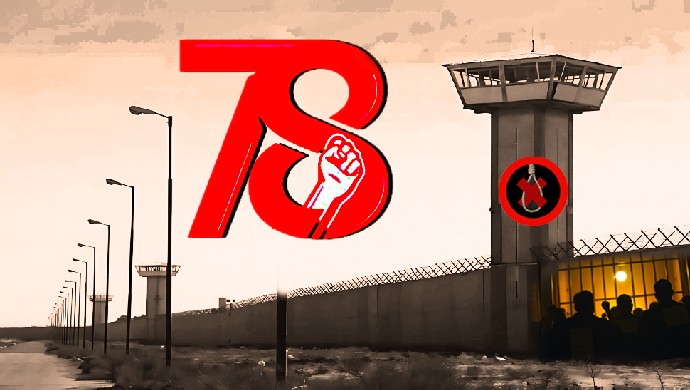

The “No to Executions Tuesdays” campaign, a prisoner-led movement against the Iranian regime’s use of capital punishment, marked its 78th consecutive week with an unprecedented expansion of coordinated resistance on July 22, 2025. As political prisoners held hunger strikes inside 48 prisons across the country, a wave of simultaneous street protests erupted in major cities, demonstrating a powerful new phase of unified opposition to the clerical regime.
The campaign, which began in January 2024, has transformed from a prison-based act of defiance into a national symbol of resistance. On Tuesday, July 22, while inmates across many prisons refused food, citizens in Tehran, Isfahan, Mashhad, Karaj, Tabriz, Rasht, and at least ten other cities took to the streets. They held placards and chanted slogans in a direct public challenge to the regime’s authority, amplifying the prisoners’ demands on a national scale.
A surge in state-sanctioned violence
The growing solidarity between prisoners and the public comes in response to a vicious crackdown by the regime. According to reports cited in the campaign’s weekly statement, authorities carried out at least 71 executions in the Persian month of Tir, which ends on July 22. These death sentences were handed down after trials lacking any semblance of due process and based on forced confessions.
https://twitter.com/en_simayazadi/status/1947569127708618849
In its statement for the 78th week, the campaign detailed the regime’s methods, which extend beyond the gallows. “Alongside this wave of executions, extensive pressure on political activists and imprisoned members of the ‘No to Executions Tuesdays’ campaign has increased,” the statement reads. “Threats, torture, exile, and the arrest and summoning of the families of campaign members, along with deprivation of basic rights, are just a part of this systematic repression against the protesting voice of society.”
The statement also condemned the regime’s indiscriminate violence against its citizens, citing the shooting of a young child, Raha Sheikhi, as a stark example of its “anti-people nature.” The campaign’s organizers forcefully rejected the regime’s justification for capital punishment, declaring: “Execution is not justice, but a tool of terror. We emphasize once again that no human life should be taken by governments, especially when there is no fair trial process and the basic rights of the accused are openly and systematically violated.”
Repression backfires, igniting street protests
A recent attempt by the regime to break the movement’s spirit appears to have backfired, fueling the public outrage seen on Tuesday. The forced exile of Saeed Masouri, one of Iran’s longest-serving political prisoners with 25 years behind bars, was intended to intimidate activists. Instead, reports from inside Iran indicate it triggered an “unprecedented” expansion of support for the campaign.
The anger was palpable in the streets. Protesters chanted slogans that have become synonymous with nationwide uprisings, including “Political prisoners must be freed” and a direct warning to the authorities: “This is the last message, if you execute, there will be an uprising.” Another chant, “Our answer to execution is red fire and uprising,” signaled a hardened resolve among the populace.
July 22—Iran
In tandem with the 78th week of "No to Executions Tuesdays," the family of death row political prisoner Vahid Baniamerian demand the cancellation of the death sentences of political prisoners.#IranProtestspic.twitter.com/qTHYIbo2EO— People's Mojahedin Organization of Iran (PMOI/MEK) (@Mojahedineng) July 22, 2025
Joining the protests were the families of political prisoners, who held pictures of their incarcerated loved ones and signs demanding their immediate and unconditional release. Their presence underscored the human toll of the regime’s policies, transforming the political protest into a deeply personal plea for justice.
The convergence of prison hunger strikes and widespread public protests marks a significant escalation in the organized opposition to the regime. The “No to Executions Tuesdays” campaign has successfully galvanized a cross-section of Iranian society, proving that the regime’s primary tool of control—fear—is losing its effectiveness. The movement’s organizers concluded their weekly statement with a vow of persistence: “Our voice is the cry of ‘No to Executions’; a voice that will grow louder and clearer every Tuesday, until the day executions are permanently stopped in Iran.”
Prisoners participated in the 78th week of the campaign from the following 48 prisons: Ghezel Hesar (Units 3 & 4), Karaj Central Prison, Fardis Prison of Karaj, Greater Tehran Penitentiary, Qarchak Prison, Khorin Prison of Varamin, Choubindar Prison of Qazvin, Ahar Prison, Arak Prison, Khorramabad Prison, Yasuj Prison, Asadabad Prison of Isfahan, Dastgerd Prison of Isfahan, Sheiban Prison of Ahvaz, Sepidar Prison of Ahvaz (men’s and women’s wards), Nezam Prison of Shiraz, Adelabad Prison of Shiraz (men’s and women’s wards), Firuzabad Prison of Fars, Zahedan Prison (women’s ward), Borazjan Prison, Ramhormoz Prison, Behbahan Prison, Bam Prison, Yazd Prison, Kahnuj Prison, Tabas Prison, Mashhad Prison, Gonbad-e Kavus Prison, Qaem Shahr Prison, Rasht Prison (men’s and women’s wards), Rudsar Prison, Havigh Prison of Talesh, Azbaram Prison of Lahijan, Dizel Abad Prison of Kermanshah, Ardabil Prison, Tabriz Prison, Urmia Prison, Salmas Prison, Khoy Prison, Naqadeh Prison, Miandoab Prison, Mahabad Prison, Bukan Prison, Saqqez Prison, Baneh Prison, Marivan Prison, Sanandaj Prison, and Kamyaran Prison.