

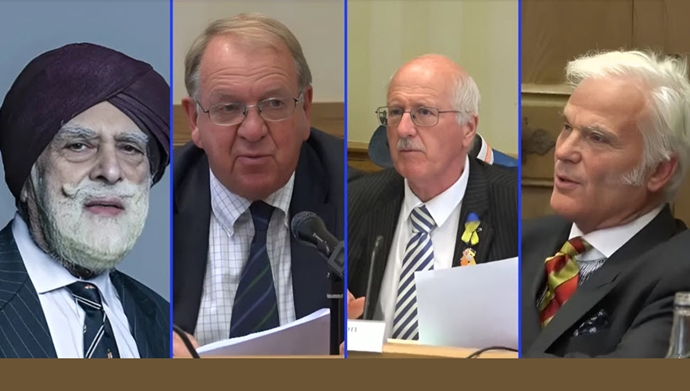

In a significant cross-party conference held at the UK Parliament on July 16, 2025, prominent members of both the House of Commons and the House of Lords, alongside legal experts and former European officials, voiced strong support for a decisive shift in policy towards Iran. The event, hosted by the British Committee for Iran Freedom, focused on the “Third Option”—a path forward that rejects both foreign military intervention and diplomatic appeasement of the current regime.
Opening the session, Baroness O’Loan noted that the recent conflict in the Middle East had been “seized by the regime to intensify its crackdown” on the Iranian people. She framed the conference’s purpose as an urgent discussion of a viable alternative. “For too long, Western policy has been trapped between two failed approaches, military intervention and diplomatic appeasement,” she stated. “But the Iranian resistance movement led by the NCRI and madam Rajavi offers a principled third option, a regime change by the Iranian people and their organized resistance.”
The third option: A democratic alternative to war and appeasement
The central theme of the conference was the resounding endorsement of the “Third Option,” a policy framework championed by the National Council of Resistance of Iran (NCRI) and its President-elect, Maryam Rajavi. Speakers from across the political spectrum described this approach as the only realistic path to a stable, democratic, and non-nuclear Iran. Lord Bellingham lauded Mrs. Rajavi’s leadership, noting her “huge amount of statesmanship, of good judgment” and the widespread support for her Ten-Point Plan for a future Iran. He stressed her commitment to a democratic process, stating, “what she wants is a democratic way forward. She wants the people of Iran to decide their future.”
Ben Lake MP echoed this sentiment, emphasizing that the Ten-Point Plan is powerful because “it’ll be for the Iranian people, to decide.” He urged the UK government to seize the “invaluable opportunity here to show some leadership” by supporting an opposition that champions “the role of justice of democracy and importantly the self determination of people.”
This view was contrasted with the failed policies of the past. Lawyer Massoud Zabeti argued that appeasement has not prevented conflict but has instead enabled the regime’s destructive behavior. “It has always been the view of the Iranian Resistance that there is a third, much better option, which is neither war nor appeasement,” he said. “In fact, it’s appeasement that ultimately leads to war because the situation only gets worse.” MP Jim Shannon offered a direct and forceful conclusion shared by many speakers: “We say no to war, and no to appeasement. Yes to the third option.”
Calls to designate the IRGC as a terrorist organization
A recurring and urgent demand from the parliamentarians was the proscription of the Islamic Revolutionary Guard Corps (IRGC). Speakers characterized the IRGC not as a state military but as a terrorist entity responsible for internal repression and external aggression. Lord Whitty made a direct appeal to the government: “I do call upon our own government to prescribe the IRGC, as they have indicated they are intending to do.” He also pointed to a new joint committee report showing the IRGC’s efforts to “subvert our own democracy, and to threaten, friends of Iranian democracy here.”
Baroness Verma was equally clear, stating, “Let’s be clear. The IRGC must be held accountable and outlawed for its terrorism and crimes against humanity.” MP Jim Shannon described the organization in stark terms as the “Supreme Leader’s private army of terror, repression, and murder,” adding that those who extend a hand to the IRGC are “insulting the Iranian people who suffer at the hands of the IRGC.”
Dowlat Norouzi, the NCRI’s UK Representative, explained the IRGC’s central role in sustaining the regime, calling it “the main pillar of repression inside Iran as well as export of terrorism, war mongering, and particularly acquiring weapons of mass destruction and nuclear capabilities.”
Rejecting all forms of dictatorship: ‘No to the shah, no to the mullahs’
An important theme of the discussion was refuting the idea of a return to the past monarchy as a viable alternative. Speakers forcefully rejected any notion of supporting Reza Pahlavi, the son of the deposed Shah, portraying him as a figure disconnected from the Iranian people’s aspirations for democracy.
Struan Stevenson, a former MEP, delivered a detailed critique, labeling Pahlavi the “clown prince or the emperor with no clothes.” He stated, “Most Iranians associate the Shah’s regime with oppression, human rights abuse, western imperialism… Young Iranians will never rally behind a figure who represents the old regime and its failures.” Stevenson drew a direct parallel between the brutality of the Shah’s secret police, SAVAK, and the current regime’s IRGC, noting that placards across Iran now declare “down with the oppressor, be it the Shah or the Mullahs.”
This sentiment was echoed by other parliamentarians. Lord Whitty stated unequivocally, “We do not support anybody who’s pretending that the Shah’s son is the alternative. We must back the NCRI and Madam Rajavi.” Baroness Verma raised serious concerns about recent claims by Pahlavi of establishing “secret communications with the IRGC,” calling such a move “politically bankrupt” and “dangerously irresponsible.”
Standing with the Iranian people’s struggle for freedom
Throughout the conference, speakers paid tribute to the courage of the Iranian people, particularly the women and youth leading protests inside the country. There was a clear consensus that change must be driven from within. “There will be an overthrow of this regime,” Lord Bellingham declared. “It’ll be overthrown not by outside influences, but by the people of Iran.”
The human cost of this struggle was brought into sharp focus. MP Jim Shannon and Dowlat Norouzi named three political prisoners—Farshad Etemadifar, Masoud Jamei, and Alireza Mardasi (Hamidavi)—who were recently sentenced to death for their support of the PMOI, the principal opposition movement within the NCRI coalition. “We need an urgent action to save the lives of political prisoners,” Shannon pleaded.
Baroness Redfern spoke of the “sheer bravery of the Iranians who have made it their life’s cause to fight for their country” and highlighted the horrific conditions faced by female political prisoners in facilities like Qarchak Prison. The need for practical support was also raised by Lord David Hacking, who stressed the importance of enabling “peaceful demonstrations to go forward, without exposing these brave Iranian citizens to being seized and possibly suffering execution.”
Lord Hamilton captured the urgency of the moment, stating, “The top priority has got to be regime change. We’ve got to get rid of these Mullahs who’ve been running a theocratic state which actually persecutes women and exports terrorism.”
The conference concluded with a unified call for action, best summarized by Lord Bellingham’s challenge to the British government: “Does the UK government want to be on the right side of history or not? …did they try and take a middle road? That’s not going to work. We got to be really firm in our overwhelming support of the people of Iran and of their representatives.” The message from this cross-party gathering was unmistakable: the time for a new, decisive policy that supports the Iranian people’s quest for a democratic republic is now.