

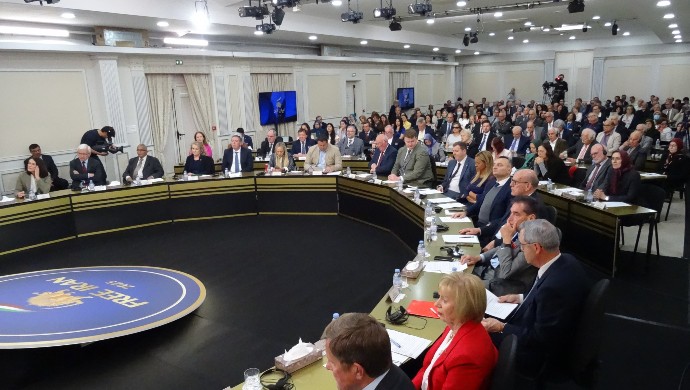

On Saturday, May 17, Paris became the center of international attention as prominent parliamentarians and political figures from across Europe and Canada gathered to discuss key developments in Iran policy. The event, centered on the theme of fostering democratic change in Iran, featured a keynote address by Mrs. Maryam Rajavi, the President-elect of the NCRI, and underscored a growing international consensus for a firmer stance against the Iranian regime and support for its democratic opposition.
Maryam Rajavi: Regime Change by Iranians is the Only Solution
In her address, Mrs. Maryam Rajavi welcomed the international dignitaries, acknowledging their efforts in “supporting democratic change in Iran.” She criticized decades of appeasement policies, arguing they had “helped to close the way of change in Iran.” Mrs. Rajavi asserted that the regime is incapable of reform and will not abandon its nuclear ambitions, regional warmongering, or domestic repression, as these are integral to its survival. “The real solution is the overthrow of the regime by the people of Iran and the Iranian Resistance,” she declared, emphasizing, “The regime is not able to survive. The force that will overthrow the regime is powerful and ready.” She called on European nations to “Add the Revolutionary Guard Corps (IRGC) to the list of terrorist organizations,” “activate the snapback mechanism” regarding UN resolutions, and “recognize the legitimate resistance of brave young Iranians fighting the IRGC.”
Speech at the #FreeIran2025 Conference – Onward to a Democratic Republic
“This regime has taken the freedom of the Iranian people, the peace of the Middle East, and the security of the world hostage.”
Our plan is to establish a republic based on the separation of religion and… pic.twitter.com/7RpdepOK1b— Maryam Rajavi (@Maryam_Rajavi) May 17, 2025
Widespread Parliamentary Support for NCRI and its Ten-Point Plan
A significant theme throughout the conference was the robust international backing for the NCRI as a viable democratic alternative to the current regime, with particular emphasis on Mrs. Rajavi’s Ten-Point Plan for a future Iran.
Bob Blackman, Conservative MP and Chairman of the 1922 Committee, presented a statement signed by 560 UK lawmakers supporting regime change and the NCRI. He stated, “It is time to change course on Iran policy… We must stand with the Iranian people and the organized resistance, led by Maryam Rajavi and her 10-point plan.” Baroness O’Loan from the UK House of Lords announced that “over 330 members of the House of Lords have signed today’s parliamentary endorsement of the statement for Iranian freedom.” An early day motion in the UK House of Commons, signed by 110 MPs, was also presented, calling for accountability for the regime’s human rights violations.
At the #FreeIran2025 Conference, a senior UK parliamentary delegation presented a book signed by a majority of members from both the House of Commons and the House of Lords—over 500 lawmakers—supporting the Iranian people, the NCRI, and Maryam Rajavi’s 10-point plan for a… pic.twitter.com/GwS2TBjCwE
— SIMAY AZADI TV (@en_simayazadi) May 18, 2025
Former UK MP Mark Williams lauded Mrs. Rajavi as “a leader who has given hope to millions of Iranians… providing the real platform for democratic change.” He added, “When the history of Iran’s future democratic republic is written, it will record how you and Masoud Rajavi organized, led the cause, led dissent, led a determined resistance, and built a viable democratic alternative.”
William Powell, Member of the Welsh Assembly, shared that “the majority of Senate members of the Welsh parliament in Cardiff Bay who have also signed up to support the legitimacy of the Ten-Point Plan.” He asserted, “The democratic governments of Europe must recognize the legitimacy of your provisional government, Madam Rajavi.”
Martyn Day, former UK MP, declared, “At the heart of that policy must be support for Iran’s Democratic alternative, which is yourself, madam Rajavi, and the NCRI. The ten-point plan is a plan which no democrat anywhere in the world could not support.” Irish MP James O’Connor echoed this, stating, “Madam Rajavi, your 10 plan offers a real path to freedom, to unity, and to the peaceful transfer of power.”
Erin McGreehan, Member of the Irish Parliament, highlighted the plan’s credibility: “It is not only essential, it is entirely within reach, and it comes with a well-defined plan, Mariam and NCRI’s ten-point plan. This plan offers a democratic, inclusive, and secular vision for a future Iran.” She further noted, “What sets the Iranian resistance apart is not only just its vision but its credibility. The NCRI doesn’t merely advocate women’s leadership. It embodies it.”
Irish Senator Mary Fitzpatrick presented a statement from the Irish Senate which “absolutely endorse the Iranian opposition’s ten-point plan, an alternative plan for a free and democratic Iran.”
https://twitter.com/en_simayazadi/status/1924217351760707710
Prof. António Carmona Rodrigues, former Mayor of Lisbon, emphasized the NCRI’s preparedness: “The National Council of Resistance of Iran, which is committed to establishing a democratic republic and has a clear plan for the Iran’s future… offers a reliable road map to resolve Iran’s major crisis.”
Dorien Rookmaker, former Member of the European Parliament, called Mrs. Rajavi “one of the most visionary leaders of our time,” adding, “Your 10 plan outlines universal principles. There’s no reason to not support it.” Patrick Lussi, Member of the Grand Council of Geneva, announced, “a majority of members of the grand council of Genève have signed a declaration supporting your resistance for freedom and your Ten-point Plan for a future free Iran.”
Canadian Senator Michael L. MacDonald stated, “President-elect Rajavi’s ten-point plan outlines a vision for a free Iran emphasizing fundamental rights, gender equality, and peaceful coexistence. Supporting the democratic option such as the NCRI, is essential.” Rt Hon David Jones, former UK Cabinet minister, urged governments “to recognize the Iranian people’s democratic aspirations and support Mariam Rajavi’s ten point plan.”
Acknowledging the Role of Resistance Units and the PMOI
Speakers repeatedly highlighted the crucial role of the People’s Mojahedin Organization of Iran (PMOI/MEK) and its Resistance Units within Iran.
Bob Blackman praised the NCRI and PMOI: “Without the NCRI’s vigilance and without their PMOI and its courageous network inside the country, a nuclear armed regime exporting terrorism might already exist in Tehran.” Mark Williams saluted “the courage of those Resistant Units, and the courage of the people in Ashraf 3.”
https://twitter.com/en_simayazadi/status/1924220578115793407
Irish Senator Gerard Craughwell observed, “Across the country, growing numbers of resistant units have been formed… They’re a part of a broader movement led by the National Council of Resistance of Iran.” Former Irish Senator Gerry Horkan praised, “The resistance units at the forefront of this fight, brave men, women, and indeed children from every walk of life defy repression with extraordinary courage.”
James O’Connor, Irish MP, noted the regime’s fear of these groups: “The regime increasingly focuses on those with ties to the Resistance, especially the PMOI. Many now face execution simply for supporting the NCRI and your 10 plan, madame Rajavi.” David Jones from the UK Parliament also acknowledged their bravery: “We owe a great deal of debt, madam Rajavi, to the NCRI, PMOI and its network within Iran for exposing the true intentions of the regime despite the heavy cost that has been inflicted upon its brave members.”
Unified Call for IRGC Terrorist Designation
A strong and unified demand resonated through the conference: the proscription of the Islamic Revolutionary Guard Corps (IRGC) as a terrorist organization. The context provided for the conference highlighted that the statement by 560 UK lawmakers, spearheaded by Bob Blackman, “urges the UK government to proscribe the Revolutionary Guard Corps (IRGC) as a terrorist entity.”
Bob Blackman himself reiterated this, “It’s also been a privilege to lead efforts in the United Kingdom parliament to prescribe the Iranian Revolutionary Guard Corps as a terrorist organization, and we still call on our government to do so today… the IRGC is a terrorist entity.” He dismissed concerns about diplomatic repercussions, stating, “To those who fear for the closure of our embassy in Tehran if we outlaw the IRGC, I say good. The only diplomatic relations we need are with the NCRI, Madam Rajavi, and the Iranian people.”
https://twitter.com/en_simayazadi/status/1924223046446993516
Martyn Day, former UK MP, was unequivocal: “We need to designate the IRGC as a terrorist group. I called for it to be proscribed many times while I was in parliament.” David Jones MP also emphasized the need: “The first step must be to cut off the regime’s tools of terror, and most importantly, as colleagues have already said, to proscribe the Islamic, Revolutionary Guard Corps, the IRGC.”
Baroness O’Loan added her voice, “The UK must now prescribe the IRGC as a terrorist organization… At the present time, the United Kingdom government has a senior lawyer working on the question of the prescription of the IRGC. We await that report, and we urge the government to prescribe the IRGC as rapidly as possible.”
Erin McGreehan from Ireland stated, “The EU must designate the IRGC as a terrorist organization.” Tony McCormack, Irish MP, supported this: “Beginning with the designation of the IRGC as a terrorist organization… If the EU and the UK act in tandem and designate the IRGC… then the regime will understand that the era and culture of impunity is over.”
Patrick Lussi of the Grand Council of Geneva insisted, “We insist to the Swiss government to take a courageous stand, designate the IRGC as a terrorist organization.” Canadian Senator Michael L. MacDonald commended his country’s action and urged others to follow: “As a Canadian, I commend Canada’s designation of the IRGC as a terrorist entity… The UN and EU, and I trust soon the UK will follow suit.”
https://twitter.com/en_simayazadi/status/1924159137937555952
Support for Protests and Rejection of All Forms of Tyranny
Speakers voiced strong support for the Iranian people’s ongoing protests and their clear desire to reject all forms of dictatorship, including both the current clerical regime and the former Shah’s monarchy.
Mark Williams, former UK MP, highlighted the protesters’ slogans: “The powerful slogans we saw on the screens earlier this afternoon of the 2019 and 2022 uprisings, down with the oppressor, be it the shah or Supreme Leader, reformist, hardliners, the game is over. This makes it crystal clear that people are demanding change and fighting for a democratic republic.” He emphasized, “they reject both the dictatorship of the Shah and the religious tyranny of today.”
Gerard Craughwell, Irish Senator, directly addressed the Iranian people: “Fear is the only thing the regime have. And the people of Iran, the good people of Iran, you have nothing to fear but fear. You need to rise up, call the citizens of Iran together, and say enough.”
https://twitter.com/en_simayazadi/status/1924221332687925442
Mary Fitzpatrick, Irish Senator, recalled the regime’s brutal suppression following Mahsa Amini’s death but affirmed, “Two and a half years on since Mahsa Jina Amini’s death, the Iranian people’s demands remain unanswered. But they will not be silenced, and they will continue to protest. And for as long as they draw breath and they protest, we will stand with them.”
Judy Sgro, Canadian MP, also referenced the popular sentiment: “The Iranian people have made their aspirations clear. They reject both the Shah’s dictatorship and the current theocracy, and they seek to establish a democracy and a democratic republic.” She pointed out that “fake oppositions, such as Reza Pahlavi, the son of the former monarch, whose brutal dictatorship was decisively rejected by the Iranian people. The slogans down with the oppressor, be it the Shah or the supreme leader, sends a very clear message out there.”
https://twitter.com/en_simayazadi/status/1924193508912500903
Petre Roman, former Prime Minister of Romania, drew parallels with his own country’s experience: “I stand before you today, first of all, as a person who, twenty-five years ago, was in the very similar position as you, which was fighting, dictatorship at any cost.”
Patrick Lussi from Geneva stated, “The Iranian people have rejected theocratic and monarchical dictatorships, aspiring instead to a democratic republic.”
Baroness O’Loan argued that the regime’s repression, “particularly against women, reflects its fear of another uprising, recognizing the pivotal role of women in the pursuit of a democratic Iran… The Iranian people, through their protests and sacrifices, have demonstrated their readiness for change.”
Conclusion: A Call for Decisive International Action
The Paris conference served as a powerful testament to the growing international alignment with the Iranian people’s quest for freedom and the NCRI’s vision for a democratic, secular, and non-nuclear republic. The collective voice of parliamentarians from numerous Western nations underscored a clear message: the era of appeasement must end, and a new, decisive policy that supports the Iranian Resistance and holds the regime accountable for its domestic atrocities and international destabilization is urgently needed. The emphasis on proscribing the IRGC, activating the snapback mechanism on nuclear sanctions, and recognizing the legitimacy of the Iranian people’s struggle for self-determination signals a potential paradigm shift in how the international community engages with the crisis in Iran. As speaker after speaker affirmed, the path to a free Iran lies with the Iranian people and their organized resistance, a sentiment that resonated strongly throughout the day’s proceedings.