

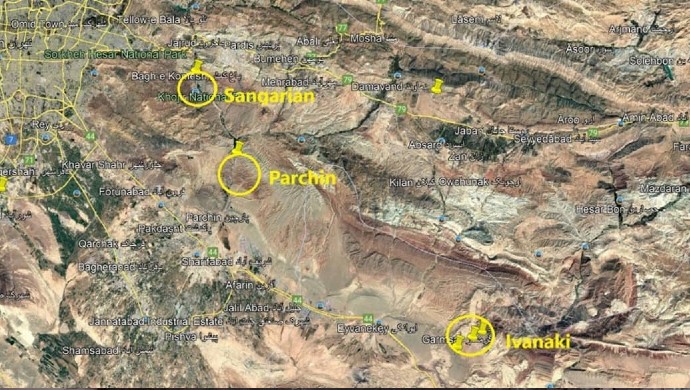

Hours after the major nuclear revelation at the press conference held by the representative office of the National Council of Resistance of Iran (NCRI) in Washington, D.C., the howls of regime operatives and state-controlled media erupted from all directions.
Abbas Araghchi, the regime’s Foreign Minister, frantically and vehemently denied the existence of secret nuclear facilities. Araghchi posted on X: “Like clockwork, more Very Scary Satellite Images are being circulated as Iran-U.S. indirect nuclear talks are set to resume.”
According to Tasnim News Agency, affiliated with the terrorist Quds Force, the regime’s mission to the United Nations also began its defensive clamor in the middle of the night, writing that the modus operandi of the People’s Mojahedin Organization of Iran (PMOI/MEK) indicates that they provide fabricated reports disguised as so-called intelligence findings to Western services, including the U.S., to gain credibility. However, when these organizations realize their lack of credibility, the PMOI then chooses Western media as its next client to exploit their capacity for sensationalism.
Hours after the exposure of the regime’s secret project and clandestine activities in Semnan province, the state-run website Ensaaf News wrote: “On August 14, 2002, a spokesperson for the PMOI, presenting images of the Natanz and Arak atomic facility sites, claimed that Iran had built uranium enrichment facilities and a heavy water reactor. This news was initially covered by CNN, after which a new wave of anti-Iran propaganda was created in Western media. Now, 23 years after that news, which laid the groundwork for Iran’s nuclear crisis, Fox News has engaged in dangerous sensationalism reminiscent of 2002 regarding the Natanz facilities. Notably, in this sensationalism, PMOI is once again involved.”
The scar from the Natanz revelation in August 2002, and the unraveling of the nuclear ambitions of the regime, will never be erased from the memories of Iranian regime leaders and offiials. Seventeen years ago, Mahmoud Ahmadinejad, the regime’s former president, when asked, “What happened that we have now reached this point in the nuclear discussion?”, lamented with great regret: “This affair started in July 2002; a group from the [PMOI] came and published some reports about Natanz and Arak and these things, sensitivity was created, the Agency [IAEA] got involved, then came the Board of Governors’ resolutions, one after another, one after another” (Source: State television, February 23, 2008).
Hassan Rouhani, former president and secretary of the regime’s Supreme National Security Council at the time of the Natanz revelation, also wrote in his book “National Security and Nuclear Diplomacy”: “In 2002, activities were progressing in a calm atmosphere, but suddenly the PMOI, by arranging a press conference and making baseless accusations, created a lot of noise… The Atomic Energy Organization’s (AEOI) view was that the Natanz facilities should be completed and then the Agency [IAEA] informed so that they would be faced with a fait accompli…» (ISNA, January 25, 2019).
The state-run ISNA news agency, by publishing a report on the regime’s nuclear activities, once again exposed the clerics’ heartache over the major political and strategic blow dealt to the clerical dictatorship. Referring to the successive UN Security Council resolutions against the regime, it wrote: “With the publication of this news, resolutions were issued one after another against the system in the Security Council. In July 2006, the Security Council adopted Resolution 1696 in response to the state’s nuclear actions, demanding the suspension of uranium enrichment in Iran. After that, UN Security Council resolutions were serially approved against the state, each imposing more political, economic, and security restrictions on us.”
The Iranian Resistance, with its series of revelations, not only alerted the world to the threat of the Iranian regime’s nuclear weapons program, but also raised the flag of confronting the regime in rejection of the appeasement policy. The Iranian Resistance’s clarifications in this regard have been repeatedly appreciated by defenders of peace and human rights as a great service to the highest national interests of Iran and to peace in the region and the world.