

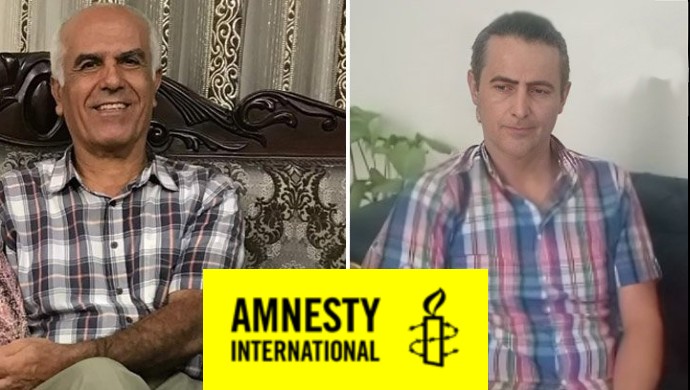

Amnesty International has issued an urgent warning about the imminent risk of execution facing two Iranian political prisoners, Behrouz Ehsani and Mehdi Hassani, currently held in Ghezel Hesar Prison. The warning follows the rejection of their second judicial review requests by the Iranian regime’s Supreme Court—a decision that rights groups and legal experts are calling a grave violation of due process.
The international human rights organization sounded the alarm in a series of posts on X (formerly Twitter), stating, “Global action is needed NOW urging Iran’s authorities to halt any plans to execute them!” Amnesty cited credible reports that both retrial requests were dismissed without even reviewing the case files from the lower courts.
Amnesty International is gravely concerned that Behrouz Ehsani & Mehdi Hassani are at imminent risk of execution in Ghezel Hesar prison after their 2nd judicial review request was rejected. Global action is needed NOW urging Iran's authorities to halt any plans to execute them! https://t.co/pdssTZpeJT
— Amnesty Iran (@AmnestyIran) April 24, 2025
The rejection of due judicial process has provoked widespread condemnation. On the evening of April 22, Mehdi Hassani’s attorney, Adel Ahmadian, announced that Branch 29 of the Supreme Court had dismissed his client’s retrial request without even summoning the case file from Branch 26 of the Tehran Revolutionary Court, which initially handed down the death sentence in September 2024. Ahmadian denounced the move as “a total disregard for judicial transparency,” revealing that he had been denied access to the case file entirely.
According to Iran Human Rights Monitor (Iran HRM), Behrouz Ehsani, a 70-year-old dissident and former political prisoner from the 1980s, also had his request for retrial denied, similarly without due judicial procedure. Both men now face imminent execution in Ghezel Hesar Prison’s political ward.
The two were convicted on charges including “armed rebellion (baghi), waging war against God (moharebeh), corruption on earth,” and “membership in the PMOI [People’s Mojahedin Organization of Iran],” in a verdict issued by Judge Iman Afshari, notorious for delivering harsh sentences against political opponents. The sentences were upheld by the Supreme Court on January 7, 2025, without allowing for a proper appeal.
Human rights organizations have also raised the alarm over the brutal treatment both men endured in detention. Ehsani and Hassani were tortured in Evin Prison’s Ward 209, an infamous facility where detainees are routinely held in prolonged solitary confinement and subjected to interrogations under duress. Ehsani, despite his advanced age and deteriorating health, reportedly endured extensive torture following his December 2022 arrest. In a defiant statement from prison after his sentencing, Ehsani declared, “I will not bargain with anyone over my life and am ready to sacrifice my life for the cause of the liberation of the Iranian people.”
Hassani, a 48-year-old father of three from Zanjan, was arrested in September 2022 and also subjected to abuse. Reports indicate he was denied legal counsel for much of his detention, a violation condemned by multiple international rights bodies.
The urgency of Ehsani and Hassani’s situation is underscored by the broader context of Iran’s execution crisis. Since Masoud Pezeshkian assumed the presidency in July 2024, the regime has overseen the executions of over 1,050 individuals, including political prisoners, ethnic minority activists, and individuals accused of non-violent crimes such as drug offenses—many of them following trials that failed to meet international standards of fairness.
The situation reached a new peak this week. On April 24, the National Council of Resistance of Iran (NCRI) reported a staggering 22 executions in the span of three days—averaging one every 3.5 hours. The victims were executed in Hamedan, Arak, Yazd, and Ghezel Hesar Prison, the same facility where Ehsani and Hassani are held.
In a statement, the NCRI described this wave of executions as part of a “desperate and brutal campaign by [Iranian regime supreme leader] Khamenei’s regime to crush dissent amid rising fear of a public uprising.” The group emphasized that far from securing stability, these executions only “further fuel the flames of public anger.”
The cases of Behrouz Ehsani and Mehdi Hassani now serve as a chilling symbol of the Iranian regime’s use of capital punishment as a political weapon. Their fate hangs in the balance—dependent now not on the courts that failed them, but on international pressure, public outcry, and global solidarity with those risking their lives for freedom in Iran.