

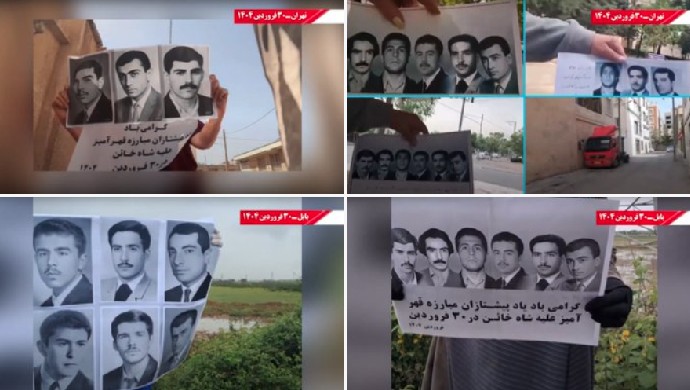

On the anniversary of the execution of the first members of the central committee of the People’s Mojahedin Organization of Iran (PMOI/MEK) and their fellow Fedayeen and PMOI comrades, Resistance Units carried out more than 60 revolutionary actions across Iranian cities. These activities commemorated the martyrs who ignited the first organized path of resistance against the Shah’s dictatorship—a path that continues to this day in the fight against the regime of the mullahs.
"April 19, 1972, marks the martyrdom of the first group of PMOI members by the Shah regime and SAVAK" pic.twitter.com/CNKF5D2aJp
— People's Mojahedin Organization of Iran (PMOI/MEK) (@Mojahedineng) April 19, 2025
On April 19, 1972, the Shah’s regime executed four pioneering MEK leaders—Ali Bakeri, Nasser Sadegh, Ali Mihandoust, and Mohammad Bazargani—following trials in military courts under the oversight of notorious SAVAK police and the shah’s army. Exactly three years later, on April 19, 1975, nine political prisoners were massacred on the hills of Evin prison, including Bijan Jazani and several Fedayeen comrades, as well as PMOI members Kazem Zolanvar and activist Mostafa Javan Khoshdel.
"From Zahedan to Tehran, down with the oppressor, be it the Shah or the mullahs" pic.twitter.com/mvMr732YTK
— People's Mojahedin Organization of Iran (PMOI/MEK) (@Mojahedineng) April 19, 2025
With their activities, the Resistance Units commemorated these martyrs and defied the mullahs’ regime, which continues the crimes of the Shah regime. From Tehran and Mashhad to Neyshabur, Zahedan, Isfahan, and Tabriz, slogans were written by hand, posters were hung, and flowers were laid at the graves of the martyrs in Behesht Zahra cemetery in Tehran. There, messages such as “We swear by the blood of our comrades: we will stand until the end” and “Death to the oppressor, be it the Shah or the Supreme Leader” resonated with power.
Tehran
Photos of political prisoners murdered by the Shah regime on April 19 pic.twitter.com/nfG4jIut8h— People's Mojahedin Organization of Iran (PMOI/MEK) (@Mojahedineng) April 19, 2025
In the universities of Tehran, Tabriz, and Isfahan, Resistance Units declared: “We don’t want the Shah, nor the mullahs,” and “Glory to the pioneers of armed resistance against the treacherous Shah.” Another message read: “The SAVAK of yesterday is today’s IRGC.”
Across cities like Zahedan and Saqqez, slogans were painted on walls: “Monarchy and mullahs are thirsty for the people’s blood… Baluchestan is awake and rejects both the Shah and the mullahs.” In Neyshabur and Rasht, activists affirmed: “The only path to freedom is through arms and overthrow,” and “Eternal glory to the martyrs of April 19.”
Babol
Images of PMOI members executed by the Shah regime pic.twitter.com/nZT685lC8N— People's Mojahedin Organization of Iran (PMOI/MEK) (@Mojahedineng) April 19, 2025
The message of these nationwide actions was unmistakable: The regime that murdered the founding martyrs of the resistance is still alive—now dressed in clerical robes. But the organized resistance that began on April 19, 1972, has not only survived—it has evolved, expanded, and become more determined than ever.
Resistance Units, as the living continuation of the PMOI and Fedayeen legacy, reaffirm today—as every day—that the Iranian people are prepared to pay the price of freedom with their blood, for as long as it takes.
Isfahan
"Honoring the memory of vanguards in the resistance against the shah regime" pic.twitter.com/p9BBwQuLUK— People's Mojahedin Organization of Iran (PMOI/MEK) (@Mojahedineng) April 19, 2025
The path that began with the April 19 martyrs will continue until Iran is free and a democratic republic is established.