

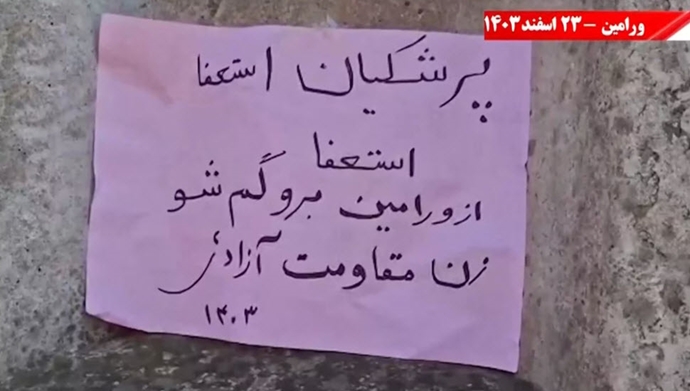

Coinciding with the visit of Iranian regime president Masoud Pezeshkian to the city of Varamin in Tehran Province, PMOI Resistance Units carried out extensive protest activities, including distributing leaflets and writing slogans on walls. These activities rejected his presence and emphasized his direct responsibility for human rights abuses and executions against the Iranian people.
In clear defiance of the Iranian regime, leaflets and graffiti appeared throughout various parts of Varamin, demanding Pezeshkian’s immediate departure and resignation. His presence was seen as provocative by the local residents who have endured considerable repression and systematic violence. Among the prominent slogans were:
“Woman, Resistance, Freedom,” “Pezeshkian, resign and leave, Varamin is not your place, leave immediately,” and “Pezeshkian resign, resign… Get out of Varamin and Qarchak.” Another repeated slogan was, “Pezeshkian, have some shame and leave Varamin,” echoing loudly as a direct challenge against a figure protesters labeled as “Khamenei’s executioner.”
Pezeshkian, who has obtained his mandate with the blessing and approval of regime Supreme Leader Ali Khamenei, is one of the prominent officials within the Iranian regime involved in supporting and executing arbitrary and oppressive death sentences. Protesters describe him as “the implementer of Khamenei’s will” or “Khamenei’s puppet,” highlighting his role in oppressing the Iranian people and enforcing repressive policies affecting all segments of society, particularly women and youth.
The actions of the Resistance Units in Varamin are part of a clear strategy aimed at exposing and publicly shaming key figures of oppression within the Iranian regime, while simultaneously promoting a spirit of popular resistance against tyranny and injustice. Activists of the Resistance Units affirm the continuity of their activities in various regions across Iran, aiming to expand public confrontation and pressure against the regime and its affiliates.
Choosing Varamin and Qarchak for these protests is significant due to their historical symbolism in resisting the Iranian regime and confronting its repressive policies. These activities reinforce the popular determination to reject the regime and its representatives and highlight the Resistance Units’ commitment to continue their struggle until the Iranian people’s aspirations for freedom, democracy, and the overthrow of a regime that has brought nothing but suffering and pain to Iranians are fully realized.