

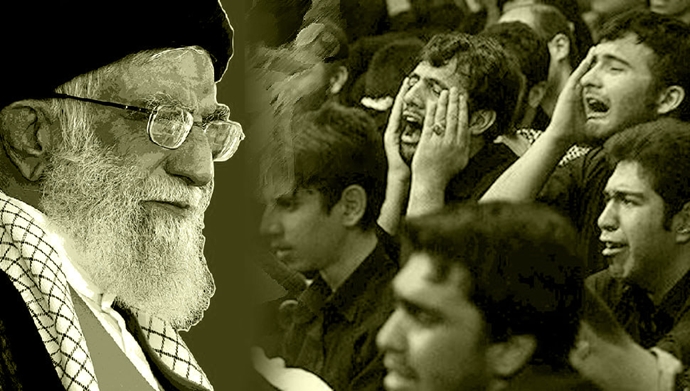

On Wednesday, February 12, Iranian regime supreme leader Ali Khamenei staged a ridiculous claim, using the state-run demonstrations of February 10 to assert that the situation in his crisis-ridden regime was more stable than ever in history. Meanwhile, social media was flooded with embarrassing scenes from the February 10 rallies, including footage of plainclothes regime agents chanting “mercenary” and “shameless” at former Iranian President Hassan Rouhani, forcing him to be quickly escorted into a car and removed from the rally.
A few days earlier, during the Friday Prayer sermon in Tehran, as soon as cleric Kazem Seddiqi brought up the topic of negotiations, hardline supporters of the regime erupted with chants of “Zarif, get lost!”—a direct attack on the strategic deputy of regime president Masoud Pezeshkian. Seddiqi, instead of condemning the outburst, endorsed the chants, saying: “I bow in humility before the sublime and honorable spirit of our people.”
MP Hamid Rasaee provided an explicit justification for these orchestrated attacks on February 10, stating, “Anyone who talks about negotiating with America is both foolish and dishonorable. Because the Supreme Leader says negotiations with the U.S. are neither rational, nor intelligent, nor honorable. Anyone, at any level, in any position, wearing any uniform, who speaks of negotiating with America must be called foolish, dishonorable, and someone without intellect or awareness.”
Similarly, in the Iranian parliament, MP Amir Hossein Saeedi reinforced the message, declaring, “Those who advocate negotiations with America are ignorant, foolish, and devoid of honor.”
Prior to this, Hossein Shariatmadari, the editor-in-chief of Kayhan newspaper, appeared on state television to condemn negotiations, calling them a “source of loss” and equivalent to “surrender.” He stated, “The limits of negotiations are pre-set by the other side. When they define the ceiling of negotiations in advance and then invite us, what they are really doing is inviting us to surrender. This is no longer called negotiations—no political analysis would label it as such…”
Shariatmadari, who is the de facto spokesperson of Khamenei in Kayhan, continued to reinforce the “No Negotiation” doctrine, stating: “His Eminence [Khamenei] has spoken about the harmful, futile, and damaging nature of negotiations approximately 24 to 25 times.”
However, the core message had already been delivered by Khamenei himself on Friday, February 7. He explicitly forbade any discussion of negotiations within the regime, declaring: “Negotiating with America has no impact on solving the country’s [i.e., regime’s] problems—we must understand this correctly.” He added, “One should not negotiate with such a government. Negotiations are neither rational, nor intelligent, nor honorable.”
Just hours after Khamenei’s ruling, Shariatmadari reiterated the message in Kayhan, saying, “Those who tune the out-of-tune instrument of negotiations with America are either ‘fools’ or ‘traitors’—and in either case, they are unfit to hold key positions in the state.” He further questioned, “To those who claim political understanding—do they not comprehend the heavy losses that negotiations with the U.S. entail?”
Even more telling was the reaction of Pezeshkian, who just weeks earlier had been one of the biggest advocates for negotiations during the regime’s sham presidential election against Saeed Jalili. However, a mere day after Khamenei crushed any hope for negotiations, Pezeshkian quickly reversed course, sheepishly saying, “Yesterday, the Supreme Leader gave a beautiful speech!”
Pezeshkian, who has rose to presidency with Khamenei’s blessing, continued his servile praise of both Khomeini and Khamenei, adding, “They think that if they besiege us, we will starve… But I firmly believe that we can, with strength, reach the peaks that have been drawn and mapped for us.”
Pezeshkian did not specify where these “mapped peaks” were or how exactly he intended to reach them “with strength.” However, it seems clear that Khamenei has made him fully understand that with the collapse of the regime’s regional influence and the downfall of the Assad regime in Syria, the Iranian regime is in such a fragile and terminal state that seeking negotiations would mean nothing short of “surrender”—or, to put it more bluntly, political suicide.