

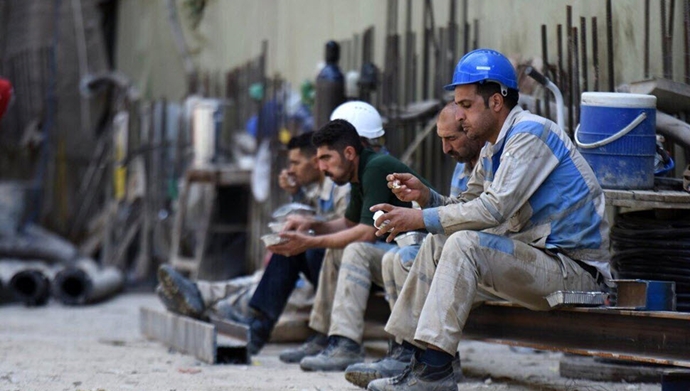

For years, the livelihood issues of Iranian workers have been one of the major social and economic challenges in the rent-seeking system of Iran’s regime. What stands out the most is the deep gap between living expenses and the wages received by this hardworking class. Poor economic policies, systemic corruption, and inefficient decision-making structures have forced workers to endure unbearable living conditions.
Specifically, workers struggle with the mismatch between their wages and daily living expenses. Even those earning above the legally mandated minimum wage cannot cover their costs. The situation is so dire that many workers prefer turning to informal jobs, such as driving for Snapp (Iran’s version of Uber). These jobs, despite requiring less time, offer higher income compared to formal employment.
Iran’s Wage System
Iranian workers’ wages not only fail to meet their basic living needs, but according to experts, wage determination in the Supreme Labor Council has always been influenced by the government. In 2024, the minimum wage covered only half of the cost of a basic livelihood basket, and with rising inflation, this ratio has now dropped to one-fourth. This alarming trend directly indicates the decline in workers’ purchasing power and their standard of living.
One of the fundamental problems is that wage increases do not keep pace with inflation. Reckless economic policies, such as uncontrolled price liberalization, currency devaluation, and lack of regulation over essential goods, have effectively destroyed workers’ livelihoods.
In the winter months of 2024, due to rampant inflation, the purchasing power of low-income groups, especially workers, has significantly declined, putting them in dire conditions. Prices of many goods and services have surged dramatically. Medicines have become up to 400% more expensive, food baskets have increased by at least 30%, and intercity bus tickets have risen by 25% with government approval. In these circumstances, serious questions arise about the regime’s intent and ability to control inflation and ensure social justice.
Wage mismatch with cost of living
The Supreme Labor Council in Iran is a regime-controlled entity officially tasked with setting the minimum wage for workers. However, in practice, this council is neither capable nor willing to advocate for workers’ rights.
The situation has become so dire that even Hossein Habibi, a board member of the so-called Supreme Islamic Labor Councils, admits:
“An effective mechanism for improving workers’ livelihoods is to conduct wage negotiations with power and seriousness, using the cost of living as the benchmark, while simultaneously directing demands at the government. The real issue is the government; it is both the main driver of inflation and the primary ally of employers in the Supreme Labor Council, where it ultimately pursues its own interests.
“According to Habibi, most workers covered by labor laws are employed in government-affiliated, semi-private, and public institutions. As a result, the government acts as a super-employer in the Supreme Labor Council and protects its own employer interests.” (Source: the state-run Eghtesad 24 news website, January 26)
The Government’s Role in Inflation
Inflation in Iran is not only continuously rising but is also deliberately manipulated by the government. The regime itself is the primary cause of inflation, and price hikes are intentional, serving specific interests.
Habibi further states, “Given the astronomical gap between cumulative inflation and workers’ wages, and the reality that inflation has no end, with prices rising daily, even a 100% increase in the minimum wage would still be insufficient.”
The streets: Workers’ only leverage
Under these circumstances, it seems that the only viable solution for improving workers’ living conditions is to build strong collective will and exert continuous pressure on the government and employers.
If a collective will to improve workers’ livelihoods is not formed, the ongoing problems in this anti-worker regime will persist.