

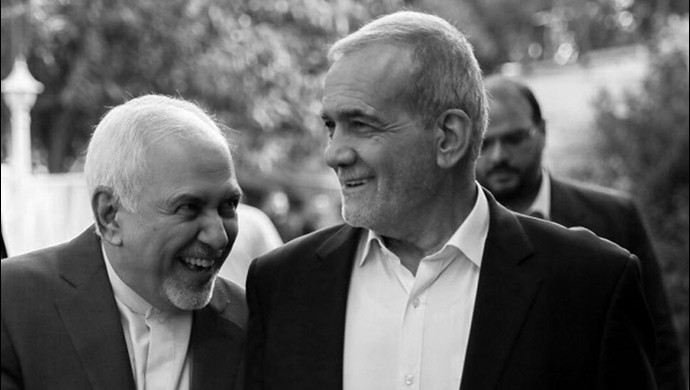

On Sunday, January 26, the public session of the Iranian regime’s parliament turned into a dramatic spectacle of infighting among regime factions, centered on negotiations with the United States and the collapse of the country’s economy. In this scene, parliament members fiercely attacked Javad Zarif, the regime’s Vice President for Strategic Affairs. And they did not spare regime president Masoud Pezeshkian either.
The attack was initiated by Mohammad Bagher Ghalibaf, the Speaker of the regime’s parliament, who, referring to Zarif, said, “Those who are considered officials of the state must be cautious in their remarks so that the message conveyed to the enemy does not endanger national interests. Discussing internal issues and disputes in international arenas weakens unity against foreign enemies, and any perception of weakness from the state leads to miscalculations by the new U.S. president and increased economic pressures on the country.”
Ghalibaf then emphasized that the regime’s positions, including foreign policy, are dictated by regime supreme leader Ali Khamenei. He held Abbas Araghchi, the foreign minister, accountable and added, “He is also obligated to explain his actions to the parliament and the public in compliance with the Strategic Action Plan law, which ensures economic benefits and the practical lifting of sanctions…”
After Ghalibaf, it was MP Hamid Rasaee’s turn, who pressed on the old wound of Zarif’s “illegal” appointment by Pezeshkian. He said: “An illegal appointment has occurred. The entire government’s efforts, instead of solving people’s problems, addressing economic issues, and improving livelihoods, have been focused on keeping one person in an illegal position. Not only do they keep him, but they also send him on foreign trips with bizarre positions at the Davos Summit…”
Rasaee, seeking Zarif’s dismissal and blaming Pezeshkian for the illegal appointment, addressed Ghalibaf, saying, “You must demand Mr. Eje’i to investigate this appointment,” referring to the regime’s chief of judiciary Gholamhossein Mohseni Eje’i.
Ghalibaf responded to Rasaee by saying: “Certainly, this matter should be pursued by the Supervisory Department; both the Administrative Justice Court and the Inspection Organization should investigate this matter to clarify it.”
MP Mohammad Taghi Naghd Ali also emphasized that “a decisive response must be given to Zarif,” and said, “The fact that someone sits in international forums and speaks on behalf of Iranian leaders—firstly, the word ‘leadership’ refers to [Khamenei], and secondly, after raising certain positions and issues about hijab and elections, he mentions the name of the Speaker of Parliament, a person whose legal position is shaky.”
Addressing Ghalibaf, Naghd Ali added, “In response to these stances, give a crushing answer. We believe that the storm is in your heart; show and express this storm to bring joy to the hearts of Hezbollah’s followers.”
MP Mohammadreza Ahmadi Sangari said, “Why should someone who lacks legal standing and has no official position go and speak on behalf of the parliament? For example, saying that hijab in the country is being implemented in such a manner, just to boast and declare that the [hijab] law is not being upheld.”
In his attack on Zarif, MP Ali Khezrian also targeted Pezeshkian, mocking his slogan of unity and sarcastically thanking Zarif for “revealing the strategic secrecy of the government of unity. Zarif shouted out this hypocritical secret of unity’s slogan in global forums.”
Thus, the attack on Zarif became an opportunity for parliament members to criticize Pezeshkian, blame him for the economic crisis, and warn about the explosive state of a frustrated society.
MP Ali Babayi Karnami said, “We are truly under question in the country. The currency [exchange rate against the U.S. dollar] has actually reached 800,000 to 1,000,000 rials.”
MP Mohammad Sabzi said, “When we go to the towns, we really can’t answer the people… They ask, ‘What is the parliament even doing?’ What should we say in response? With this inflation, rising prices, and currency rates, does the parliament really not intend to do anything?”
The Sunday session of the regime’s parliament was a reflection of the acute internal crisis within the regime. However, the underlying factor behind this crisis, which has caused negotiations with the U.S. and Zarif’s remarks at the Davos Summit to create such turmoil in the regime, is the fear of the current explosive situation of society and the prospect of an uprising that will lead to the regime’s overthrow.