

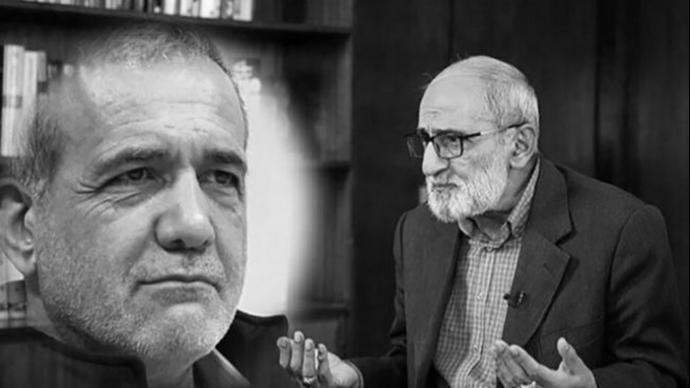

Recent political developments, including the fall of the dictatorship in Syria and the ceasefire in Gaza, have once again revealed the crisis and deadlock in decision-making at the helm of the Iran’s regime. On the one hand, one faction insists on resisting international pressures, while on the other hand, figures like regime President Masoud Pezeshkian and so-called reformists signal willingness to reduce tensions and negotiate. This disparity underscores a deep rift within the regime. It demonstrates that the regime is in a dire crisis, unable to acknowledge international realities or formulate a cohesive strategy to navigate its crushing challenges.
In Pezeshkian’s interview with NBC, a series of contradictory positions were evident. On the one hand, he denied any plans to assassinate Donald Trump and affirmed a commitment to regional peace and stability. On the other hand, he expressed readiness for direct negotiations with the United States. These undeniable contradictions not only reveal confusion in the regime’s foreign policy but also indicate serious divisions among power factions regarding key issues.
Efforts by some of Pezeshkian’s associates to reduce tensions and create the illusion of wanting to negotiate with the West have clearly faced strong opposition from the faction close to regime supreme leader Ali Khamenei. The direct attacks on the regime’s president signify deep conflicts between the regime’s mafia-like power factions.
The reactions from media outlets, individuals, and various institutions opposed to Pezeshkian’s faction revealed deep divisions and a power struggle at the regime’s core. On January 16, Kayhan newspaper, Khamenei’s mouthpiece, condemned the signaling for negotiations and invoked Khamenei’s statements about avenging Qasem Soleimani, who was killed by a U.S. drone in January 2020.
In one excerpt, Khamenei is quoted as saying:
“The assassin of Soleimani and the one who ordered his killing must be avenged; that is reserved in its place. Even as one respected individual said, Soleimani’s shoe is worthier than the assassin’s head. Even if the assassin’s head is taken, it would not equate to the value of Soleimani’s shoe. That said, they made a mistake and must pay for it. Both the executor and the instigator must know that at any possible time, when the opportunity arises—we are waiting for that opportunity—they will face their retribution.”
Kayhan further addressed Pezeshkian, writing: “The adoption of such strange and thought-provoking positions by the honorable president not only conveys a dichotomy in the regime’s stance and reveals discrepancies between the state’s overarching approach and the government’s policies but also displays another form of duality between the government and the foreign ministry. This weakens the hand of the 14th government’s negotiators in any potential negotiation and paves the way for the enemy to exploit the perceived rift within the country’s institutions.”
In another piece, Kayhan’s editor-in-chief, Hossein Shariatmadari, went even further, writing:
“Mr. Pezeshkian, you are not the owner of Iran! You are the president of Iran, entrusted with the country’s executive branch for four years as a trust. The mechanisms for using this trust and the scope of your authority are clearly outlined in the law, and you are obliged to operate within these legal frameworks.”
JCPOA: A Legacy Without Resolution
One of the primary battlegrounds among regime factions is the fate of the nuclear agreement with Iran’s regime, also known as the Joint Comprehensive Plan Of Action (JCPOA), which was initially hailed as a diplomatic success but whose futility is now more evident than ever.
Regarding the president’s NBC interview, Mohammad-Mehdi Tabatabaei, Pezeshkian’s communications deputy, wrote on X: “The Islamic Republic desires peace and the reduction of tensions in the region and the world; it is prepared for honorable and equal negotiations.”
Kayhan dismissed these remarks as “continuous and one-sided signaling to the Trump administration,” interpreting them as “weakness and begging.” The regime-affiliated outlet sarcastically added:
“The only practical response Trump gave to such vulgar signals was the participation and speech of his special envoy on Russia and Ukraine at a People’s Mojahedin Organization of Iran (PMOI) meeting in Paris; notably, he emphasized the continuation of the maximum pressure policy there.”
Domestic and International Deadlocks
The confusion and internal power struggles within the regime over key policies, including the JCPOA, reflect the recurring deadlocks it faces. Today, the Iranian regime finds itself in a position where it can neither sustain direct confrontation with the West nor retreat from its strategies. The revival of maximum pressure policies under the Trump administration has posed a significant challenge to the regime. Economic sanctions, reduced oil revenues, and international isolation have created a situation where even traditional allies, like Iraq, avoid engaging with it.
Meanwhile, the regime faces a dual challenge: on one hand, it urgently needs to reduce tensions and open economic channels with the West, and on the other hand, it fears exposing its financial and military secrets.
Another crisis for the regime is the high cost of its regional interventions. Financial and military support for proxy groups in Lebanon, Yemen, Iraq, and Syria has driven Iran’s economy to the brink of collapse.
The Burned-Out Tactic of Buying Time
The regime is inevitably moving toward further deadlocks. Domestically, structural corruption and widespread repression of popular protests have brought society to the brink of an explosion. Internationally, political and economic isolation has become a significant obstacle to the regime’s survival. This situation will worsen with the advent of a new U.S. administration. The talk of “honorable negotiations” by Pezeshkian is, in practice, nothing more than a tactic to buy time to continue regime’s repressive and terrorist policies.
The opportunities for the regime have run out. Its overthrow is not just a historical necessity but also a response to the demands of the people, who have been counting down the days for this critical milestone.