


On January 15, 2025, the state-run newspaper Setareh Sobh, published an article titled “Opportunities in Dangerous Days,” discussing shifts in the region’s “geopolitics,” “geostrategy,” and “geo-economics,” triggered by Hamas’ attack on October 7, 2023. It argued that this event paved the way for Israel and its allies to initiate their long-standing aspirations. The article outlined five roadmaps or plans designed for the Middle East: Plan A Gaza, Plan B Lebanon, Plan C Syria, Plan D Iraq, and Plan E Iran.
The newspaper warned that out of these five plans, the first three—devastation and killings in Gaza, destruction of Hezbollah’s infrastructure in Lebanon, and the downfall of Bashar al-Assad—have already been realized, leaving the remaining two plans to be implemented.
Some of Iran’s regime-affiliated newspapers implicitly or explicitly acknowledge that the regime’s influence in Iraq is nearing its end. On January 5, the state-run newspaper Ham-Mihan published an article titled “Iraq, Iran’s Last Stronghold,” stating, “Iran has completely lost Syria, and Hezbollah has been severely weakened… Currently, Iran has minimal leverage, and if Trump moves towards implementing a policy of maximum pressure, Iran will face greater strain than before.”
The newspaper fearfully added, “If the fragile situation in Syria spills over into Iraq, Iran faces the existential threat of its entire national security strategy, developed over the past 40 years, collapsing. In fact, Iraq is now Iran’s last stronghold.”
The ripple effects of Syria’s turmoil on Iraq also overshadowed the recent visit of Iraqi Prime Minister Mohammed Shia’ Al-Sudani to Tehran. According to Al-Arabiya television on January 9, “Al-Sudani brought a message to Tehran, stating that Iran must revise its policies regarding proxy forces and that there is no longer any place for the Iranian regime’s arms in Iraq.”
Al-Sudani met with regime supreme leader Ali Khamenei during his visit to Tehran. Addressing the Iraqi Prime Minister, Khamenei stated, “The Popular Mobilization Forces [PMF] are one of the key components of power in Iraq, and their preservation and further strengthening must be prioritized” (Regime TV – January 8, 2025).
It is evident that following the crippling of Hezbollah in Lebanon, the fall of Bashar al-Assad’s dictatorship, and the collapse of the Iranian regime’s strategic depth in Syria, Khamenei is doing everything in his power to maintain Iraq as his “last stronghold” and to preserve the PMF as his primary tool of influence in Iraq. In this context, before Al-Sudani’s visit to Tehran, Khamenei sent IRGC Quds Force commander Esmail Qaani on an unannounced trip to Iraq. According to Iraqi Kurdistan media, “Amid U.S. pressures, Qaani’s negotiations focused on temporarily concealing Iran-aligned militias to find ways to rebuild the collapsed axis” (Kurdistan Watch – January 5, 2025).
Earlier, on December 18, 2024, Asharq Al-Awsat newspaper quoted Ibrahim Al-Sumaidaie, an advisor to the Iraqi Prime Minister, as saying: “If we do not act to disband the armed groups ourselves, others will do so by force. Iraq cannot continue to be the sword of the Resistance Axis after the fall of Assad’s government and the weakening of Hezbollah in Lebanon.”
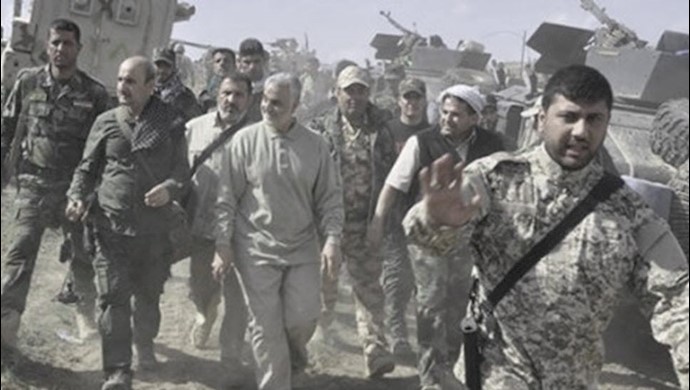
Khamenei and his affiliates portray the PMF as a pillar of their power in Iraq. However, the real power in Iraq lies with its people, whether Shia, Sunni, or the rebellious Iraqi youth. Khamenei, through his terrorist mastermind Qassem Soleimani and other operatives, spared no cruelty or barbarity in suppressing them. Yet, this popular force in Iraqi society remains like embers beneath the ashes, having repeatedly, including during the “October Revolution,” shaken the ground beneath the feet of Iran’s regime and its proxies.