

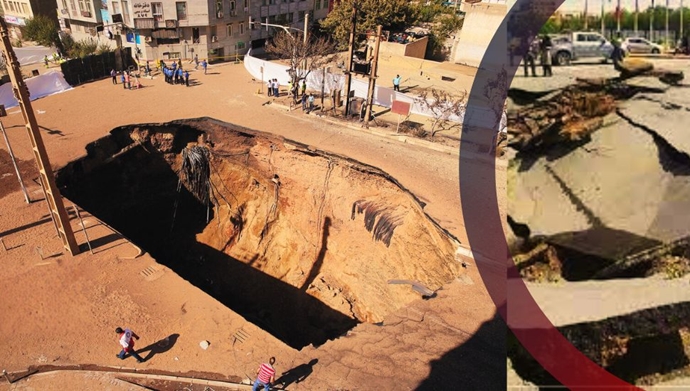

Land subsidence is a phenomenon caused by the reduction in volume of the Earth’s subsurface layers, leading to the gradual sinking of the ground’s surface. In recent years, this issue has become one of Iran’s primary environmental and infrastructural challenges. In short, the monster of subsidence is consuming Iran, and without serious and immediate action, it will bring disastrous consequences for infrastructure, the environment, and even the daily lives of people.
The excessive use of groundwater, drilling of legal and illegal wells, and exploitation of water resources for profiteering purposes are among the main reasons for land subsidence in Iran. Groundwater reserves, formed over thousands of years, have been depleted due to over-extraction and exploitative policies by the regime. This significant reduction in groundwater has led to a decrease in soil volume and density, resulting in land subsidence.
Extent and Severity of Land Subsidence in Iran
According to an official report by the Environmental Protection Organization, 256 out of 429 cities in Iran face subsidence issues. Among these, cities like Kerman, Rafsanjan, Sirjan, Marvdasht, Neyshabur, Buin Zahra, Gonbad-e Kavus, and Aq Qala are experiencing subsidence spanning over 1,000 square kilometers. This indicates that subsidence has become a widespread crisis in Iran.
On average, the ground level in Iran sinks by 1.8 centimeters annually, but in some areas, the subsidence rate reaches 35 centimeters per year. In other words, over 3,000 square kilometers of the country’s land experience subsidence at a rate exceeding 10 centimeters annually. These alarming statistics place Iran at the top of the global ranking for subsidence rates.
Impact of Subsidence on Infrastructure and Population
Land subsidence has devastating effects on the country’s infrastructure. Metro lines, highways, main roads, railways, and truck routes are among the infrastructures at risk from subsidence.
Approximately 15% of Iran’s railway lines (equivalent to 1,380 kilometers out of 9,500 kilometers) are located in subsidence-affected areas. Additionally, eight major and medium-sized airports, including Tehran International Airport, Isfahan, Urmia, Kerman, Gorgan, and Shahr-e Kord airports, face serious infrastructural risks.
Moreover, 54 railway stations and 25 metro stations are located in subsidence-prone areas. The destruction of rail and metro infrastructure can lead to severe disruptions in urban and intercity transportation, significantly affecting the daily lives of millions of people.
Subsidence also poses a significant risk to a considerable portion of Iran’s population. According to the report, approximately 14 million people, or one-fifth of Iran’s population, are affected by severe subsidence.
Risk analysis indicates that approximately 7% of Iran’s population lives in low-risk areas, 10% in medium-risk areas, and 1% in high-risk areas. In cities such as Tehran, Alborz, Fars, Razavi Khorasan, and Kerman, more than 95% of the population resides in high-risk zones affected by land subsidence.
For example, in Tehran, 350,000 people; in Alborz, 290,000 people; in Fars, 91,000 people; in Razavi Khorasan, 89,000 people; and in Kerman, 52,000 people live in areas where the risk of land subsidence is assessed as the highest.
Environmental and Economic Consequences
Land subsidence is not limited to infrastructure damage. This phenomenon has widespread impacts on the environment. It reduces soil’s water retention capacity, increases the risk of flooding, destroys natural ecosystems, and degrades soil quality. Additionally, lands affected by subsidence lose their agricultural potential, which can impact the country’s food security.
Economically, the damages caused by subsidence could impose costs amounting to billions of dollars on the Iranian people. Repairing and rebuilding infrastructure, reduced agricultural productivity, and costs associated with relocating affected populations are just some of these expenses.
Immediate and Long-term Solutions to Address the Subsidence Crisis
If a democratic and people-oriented government were in power in Iran, this environmental issue would not have escalated into a disaster. Immediate and long-term solutions to address the subsidence crisis could include the following:
– Reducing excessive groundwater extraction by enforcing legal restrictions, monitoring illegal wells, and promoting modern and efficient irrigation systems in agriculture.
– Educating and raising awareness among people and farmers about the consequences of improper water resource usage.
– Developing monitoring systems for subsidence and employing advanced technologies, such as remote sensing, for accurate assessments.
– Revising development policies to avoid construction in high-risk areas and adhering to sustainable development principles.
– Investing in infrastructure and strengthening railways, roads, airports, and buildings in vulnerable regions.
– Enhancing environmental regulations and enacting stricter laws to protect water and soil resources and ensuring their effective enforcement.
An Occupying regime with Anti-Iranian Policies
However, as an occupying and anti-Iranian regime rules Iran, it is certain that land subsidence threatens the country’s future. This phenomenon not only destroys infrastructure and the environment but also endangers the economic and social security of the nation. The exploitative policies of this regime, allocating water resources to regime-affiliated mafia and over-extracting it for water-intensive industries, have left no prospects for resolving this crisis. Undoubtedly, this environmental issue, like other crises and super-crises, is inherently political. Solving it requires overthrowing the regime that is the primary cause and agent of these issues.