

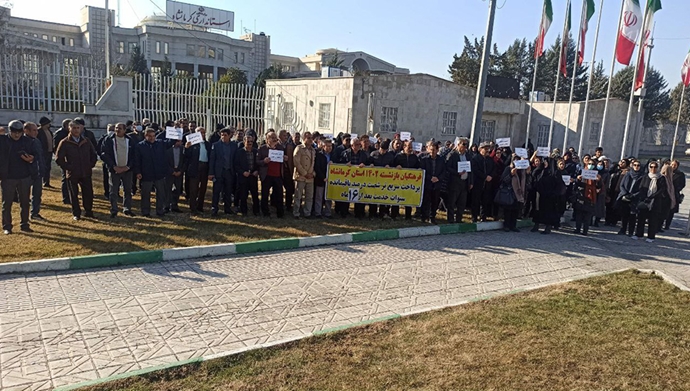

On December 31st, a wave of protests swept across various provinces in Iran, where retired teachers and workers from multiple sectors expressed their dissatisfaction due to delays in payments, reduced pension allowances, and poor working conditions. These gatherings highlighted the deep economic disparities and the Iranian regime’s failure in responding to domestic protests.
In Sari, a city in northern Iran, retired teachers recently gathered in a protest to demand the payment of dues delayed for 16 months. A similar scene occurred in Gorgan, where teachers in front of the Gilan province governorate demanded the payment of overdue dues.
December 31—Sari, northern Iran
Recently retired teachers hold protest rally, demanding the payment of 16-month delayed arrears.#IranProtests pic.twitter.com/RjaXI6n8Ag— People's Mojahedin Organization of Iran (PMOI/MEK) (@Mojahedineng) December 31, 2024
In Kermanshah, there was a significant turnout as retired teachers and educators gathered in front of the governor’s office to demand the rectification of delayed dues and adjustment of their low retirement pensions. The demonstrators chanted “Where is the justice!” highlighting their plight. Meanwhile, workers from the Ministry of Agriculture in Ilam protested in front of the local ministry office, expressing their dissatisfaction with low wages and poor living conditions.
More footage of the protest rally by retired teachers in Kermanshah.
Protesters chanting, "Where is the justice!"#IranProtests pic.twitter.com/myKbNu0cOr— People's Mojahedin Organization of Iran (PMOI/MEK) (@Mojahedineng) December 31, 2024
In Shiraz, southern Iran, retired teachers gathered to protest against the delay in dues, reflecting the dissatisfaction seen in other provinces. In Bushehr, employees of Fajr Jam Gas Refinery and South Fars Gas Company stood against low wages and unfair contract terms, marking a significant escalation in industrial action within the energy sector.
Gachsaran became a focal point for grievances within the oil and gas industry. Workers at the Gachsaran Oil and Gas Company protested against low wages, harsh working conditions, and management policies they considered destructive. Their protest also highlighted the perceived neglect by authorities to address these issues.
December 31—Gachsaran, southwest Iran
Workers of Gachsaran Oil and Gas Company rally to protest low wages and poor working conditions, destructive management policies, and lack of response by authorities.#IranProtestspic.twitter.com/7ZKR1APemF— People's Mojahedin Organization of Iran (PMOI/MEK) (@Mojahedineng) December 31, 2024
In Urmia, northwest Iran, the pattern continued with retired teachers gathering in front of the regional education department. Their protests focused on unpaid dues and low retirement pensions, a recurring theme that has stirred dissatisfaction among retired teachers in Iran.
The widespread geographical spread of protests from north to south and from east to west reflects a pervasive sense of economic dissatisfaction that transcends local issues and points to deeper systemic challenges within the Iranian economy.
December 31—Rasht, northern Iran
Recently retired teachers rally in front of the Gilan province governorate to protest unpaid arrears.#IranProtests pic.twitter.com/toiAuTaP8b— People's Mojahedin Organization of Iran (PMOI/MEK) (@Mojahedineng) December 31, 2024
The Iranian regime faces a critical challenge in addressing these issues as the frequency and intensity of such protests continue to grow. These demonstrations not only reflect the immediate economic difficulties faced by teachers and workers but also indicate entrenched structural problems that require comprehensive political responses.
Due to corruption and inefficiency in the Iranian regime, more people fall below the poverty line daily, with the number of protests increasing day by day. This situation highlights the worsening economic and social conditions that add to the instability in the country. Instead of responding to the protesters, the Iranian regime tends to suppress them, allocating the state budget to military spending and supporting activities considered subversive in the region, including backing terrorist groups. The regime’s regional ambitions also place a heavy burden on the country’s resources, exacerbating the economic and social pressures on the Iranian people.