

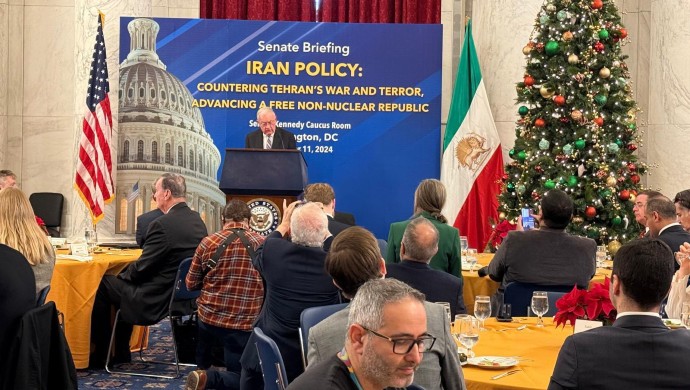

On December 11, a bipartisan conference convened at the U.S. Senate’s Edward M. Kennedy Caucus Room, bringing together prominent lawmakers, diplomats, military leaders, and human rights advocates to champion the cause of a free and democratic Iran. The event, organized amidst transformative developments in the Middle East, underscored the urgency of international solidarity in confronting the oppressive regime in Tehran. Key participants included U.S. Senators from both sides of the aisle, distinguished military figures, and diplomats. A highlight of the gathering was the address by Maryam Rajavi, President-elect of the National Council of Resistance of Iran (NCRI), who outlined her Ten-Point Plan for regime change and democratic reform. Speakers called for stronger efforts to hold Tehran accountable and support Iranian dissidents in this pivotal moment.
Maryam Rajavi’s Vision for a Free and Democratic Iran
For many years, the elected representatives of the United States in both chambers of the Congress have repeatedly supported a correct policy toward the religious fascism ruling #Iran. The validity of their viewpoint is now confirmed by significant developments ongoing inside and… pic.twitter.com/Vp1hR1cfd8
— Maryam Rajavi (@Maryam_Rajavi) December 11, 2024
Maryam Rajavi outlined a clear path for regime change and democratic reform in Iran. She emphasized that the clerical regime, already facing strategic losses, cannot withstand the anger of the Iranian people. “The Revolutionary Guards and all other oppressive forces in Iran will not be able to stand against the nationwide uprising,” Rajavi declared, citing the recent collapse of the Assad dictatorship and setbacks for Hezbollah in Lebanon as signs of Tehran’s weakening influence.
Rajavi highlighted the resilience of Iran’s organized resistance movement, which continues to expand despite severe repression. She called on the international community to recognize the Iranian people’s right to overthrow the regime, stressing, “The correct and viable solution is the overthrow of this regime by the people of Iran and the Iranian Resistance.” Furthermore, Rajavi outlined a roadmap for Iran’s transition to democracy, emphasizing the establishment of a provisional government to hold elections within six months of the regime’s fall. She reaffirmed that for a free Iran, legitimacy must come from the ballot box, advocating for gender equality, religious freedom, and a non-nuclear Iran.
Bipartisan Support for a Free Iran
The conference reflected a bipartisan consensus in U.S. politics, with lawmakers from both parties expressing a unified commitment to supporting the Iranian Resistance and advocating for democratic reforms in Iran. U.S. Senator Ted Cruz, a strong proponent of the “Maximum Pressure” policy, underscored the need for decisive action, stating, “Bullies and tyrants do not respect weakness, but they only respect strength.” U.S. Senator Jeanne Shaheen, reflecting on Iran’s faltering leadership, noted that recent regional shifts, such as the fall of the Assad regime, signal Tehran’s diminishing grip.
Senator Thom Tillis emphasized the importance of cross-party collaboration, declaring, “This is not a time to accommodate Iran. This is a time to step up the pressure.”
The Impact of Regional Developments
A key theme of the conference was the transformative impact of recent regional developments, particularly the fall of the Assad regime in Syria. Former U.S. Ambassador to Morocco Marc Ginsberg described this moment as a rare “inflection point,” signaling a shift in regional power dynamics and weakening Tehran’s influence. Senator Shaheen linked this change to the inherent vulnerabilities in Iran’s regional strategy, arguing that the events in Syria expose Tehran’s weakening capacity to maintain its network of proxies.
Former U.S. Air Force General and Commander of U.S. European Command General Tod D. Wolters emphasized the significance of these shifts, noting that “the nexus of nefarious activity stretching from Iran to the West, through Syria to the Eastern Mediterranean has been broken.” These developments present an opportunity to challenge Tehran’s destabilizing agenda and advance the cause of a free and democratic Iran.
Strengthening International Policies Against Tehran
The conference stressed the necessity of strengthening international policies to counter Tehran’s destabilizing activities and nuclear ambitions. Senator Cruz called for the reinstatement of the “Maximum Pressure” policy, drawing on its success during the Trump administration in reducing Iran’s oil exports from one million barrels per day to 300,000 without raising global oil prices. Cruz vowed, “On January 20th, we will return to a ‘Maximum Pressure’ policy,” focusing on sanctions, dismantling Iran’s nuclear capabilities, and eliminating its oil sales.
Former National Security Advisor to the Vice President of the United States General Keith Kellogg echoed this urgency, emphasizing the need for continued pressure on the regime. “This regime is tottering,” he warned, calling for sustained political, economic, and regional action to exploit Tehran’s vulnerabilities. Former U.S. Senator Sam Brownback framed the moment as critical, asserting, “It’s not only now or never; it’s now or nuclear,” urging the incoming U.S. administration to adopt a “Maximum Pressure 2.0” policy to ensure global stability.
Maryam Rajavi’s Ten-Point Plan
Central to the conference was Maryam Rajavi’s Ten-Point Plan, a comprehensive framework for transitioning Iran to a free, secular, and democratic society. The plan advocates for universal suffrage, gender equality, the separation of religion and state, and the abolition of the death penalty. Ambassador Ginsberg lauded Rajavi’s leadership, stating, “Her commitment, her leadership, her dedication has galvanized a worldwide opposition into a major coalition determined to seize this moment.” Former U.S. National Security Advisor General James Jones described the plan as “Jeffersonian in principle,” proposing its inclusion in a future Iranian constitution.
General Wolters said, “We must prepare to implement her Ten-Point Plan. It provides the architecture for immediate action once the regime falls, ensuring we can move forward swiftly and decisively.”
The speakers agreed that the plan symbolizes hope and unity for the Iranian people in their struggle for freedom.
Empowerment of the Iranian Resistance and Regional Allies
Speakers at the conference emphasized the critical role of empowering the Iranian Resistance and regional allies in countering Tehran’s oppressive regime and its proxies. Senator Cory Booker highlighted the global significance of the Iranian people’s struggle, asserting, “What the Iranian people are suffering under… is not just an Iranian problem; it is an American problem.” He stressed the need to protect dissidents, including those at Ashraf 3 in Albania, and affirmed bipartisan unity in supporting justice for the Iranian people.
General Jones underscored the importance of U.S. resolve in supporting opposition movements, identifying the Iranian regime as “the head of the snake” behind groups like Hezbollah, Hamas, and the Houthis. Senator Brownback drew parallels to U.S. support for Poland’s Solidarity movement, stating, “We need to support the people on the ground in Iran and do so publicly, boldly, and clearly.” This collective effort, speakers agreed, is crucial for achieving peace in the Middle East and a free Iran.