

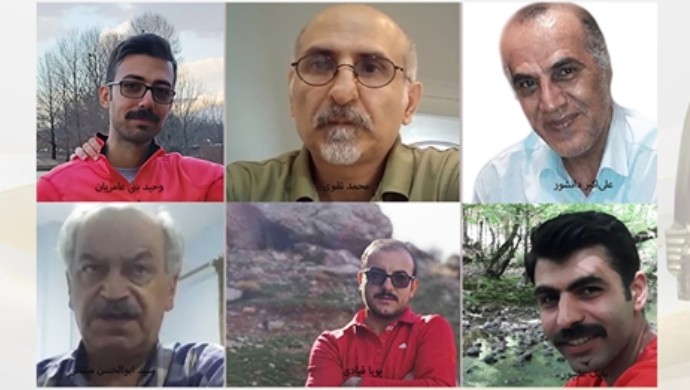

The Iranian regime’s judiciary’s recent sentencing of six political prisoners to death has sparked widespread international outrage. These individuals—Abolhassan Montazer, Pouya Ghobadi, Vahid Bani-Amerian, Babak Alipour, Ali Akbar Daneshvarkar, and Mohammad Taghavi—have been accused of affiliations with the People’s Mojahedin Organization of Iran (PMOI/MEK). These sentences follow months of harsh interrogation and torture in Tehran’s notorious Evin Prison.
Global human rights organizations, lawmakers, and advocacy groups have united to condemn the death sentences. They emphasize the urgent need for international intervention to halt these executions and spotlight the Iranian regime’s systematic human rights abuses.
In a letter to the United Nations High Commissioner for Human Rights, Volker Türk, the Interparliamentary Committee for a Free Iran in Italy called on the United Nations to act immediately. The committee, consisting of senators and parliamentarians, described the executions as a gross violation of international human rights standards. “The international community must publicly condemn these sentences, apply pressure on Iranian authorities, and demand the release of all political prisoners,” the statement reads in part.
The Italian Federation for Human Rights (FIDU) expressed similar concerns in a letter to the UN High Commissioner for Human Rights and the UN Special Rapporteur for Human Rights Situation in Iran. Antonio Stango, President of FIDU, highlighted the blatant political motivation behind the sentences and the lack of fair trials in Iranian courts. The organization urged immediate international action to save the prisoners.
The Friends of a Free Iran and Against Fundamentalism (FOFIAF), led by prominent Nordic politicians, lawmakers, and human rights activists, also issued a plea to the UN High Commissioner for Human Rights. They emphasized the need for a fact-finding mission to visit Iranian prisons, citing the regime’s increasing repression amid political instability. “Immediate action is required to save these lives and prevent further atrocities,” the statement urged.
In Romania, the Parliamentary Committee for a Free Iran issued a strongly worded appeal to the UN Special Rapporteur on Human Rights in Iran. The letter condemned the death sentences as a tool of oppression and called on the international community to demand the unconditional release of all political prisoners in Iran. The signatories underscored Iran’s alarming record of human rights violations and extrajudicial executions.
Australian human rights advocates and lawmakers, represented by the Australian Supporters of Democracy in Iran, sent a letter to Foreign Minister Penny Wong, urging Australia to lead global efforts to hold Iran accountable. They called for diplomatic pressure to halt these executions called on Australia to work closely with the UN and other allies to address these concerns.
In the UK, Member of Parliament Bob Blackman released a statement condemning the sentences and calling on the UK government to take action. Blackman urged a unified international response to save the lives of the six prisoners and hold the Iranian regime accountable for its repression of dissent. “These sentences are clear evidence of the regime’s ongoing disregard for the rights and lives of its citizens,” he said.
The death sentences for these six Iranian political prisoners have galvanized international outrage. Advocacy groups and political entities have called for swift and decisive action, warning that the Iranian regime’s use of capital punishment as a political weapon endangers not only these individuals but the broader struggle for human rights and democracy in Iran. A coordinated global response is seen as essential to saving these lives and ensuring accountability for the regime’s actions.