

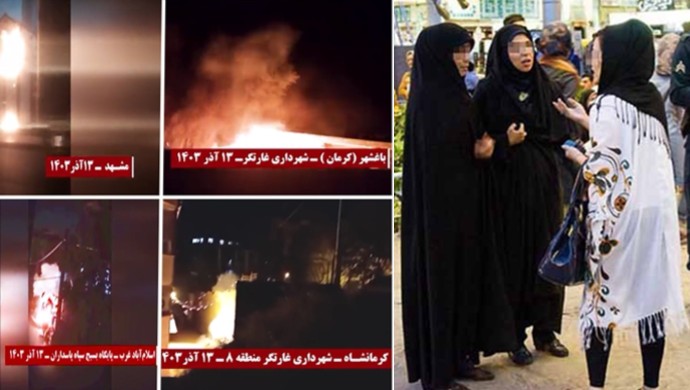

In response to the Iranian regime’s criminal “Chastity and Hijab Law,” which ramps up repression and pressure against women and girls, Iran’s rebellious youth launched attacks on the regime’s repression and corruption centers on December 3, 2024, with slogans like “No to compulsory hijab, no to forced religion, and no to mandatory government.”
In their activities, the rebellious youth targeted symbols of misogyny and “mandatory government” in several cities across the country. These targets included regime building tasked with repression and looting, propaganda banners depicting the regime’s leaders and repression apparatus, and facilities belonging to the IRGC and Basij, the two prominent bodies in charge of suppressing dissidents, especially women:
– Explosion at a regime building in Bagh Shahr in Kerman
– Explosion at a regime building of District 8 in Kermanshah
– Explosion at a Basij Base in Eslamabad-e Gharb
– Burning a Basij Week banner with a picture of Khomeini in Tehran
– Burning a placard of Khamenei in Mashhad
– Burning a Basij Week banner in Homayounshahr, Isfahan
– Burning a Basij Week banner featuring Qassem Soleimani in Kerman
– Burning a Basij Week banner featuring Soleimani in Bushehr
– Burning of the IRGC Basij in Qasr-e Qand
– Burning of the Basij espionage placard in Nikshahr
On the same day, Resistance Units projected symbols of resistance in different cities under the watchful eyes of the IRGC and surveillance cameras of the regime’s security apparatus. In these activities, the slogan “Woman, Resistance, Freedom” was prominently displayed in the cities of Rasht, Karaj, and Mashhad for fellow citizens to see. This slogan symbolizes the leading role of women in the struggle for freedom in Iran and has become especially popular since the 2022 uprising.
The resilient female political prisoners in Evin Prison also raised their voices, protesting against the regime’s criminal executions and specifically the issuance of death sentences for political prisoners. Inside the enemy’s repressive stronghold, behind prison bars, they boldly chanted: “Neither repression nor executions will work anymore.”
On the evening of December 3, they gathered in the women’s ward yard, chanting slogans against the mandatory government and revolting against the regime. The cries of these women, protesting the death sentences issued for six political prisoners, symbolize the vitality and resilience of women and herald the twilight of the misogynistic regime.
While repeating the names of prisoners sentenced to death— Pouya Ghobadi, Vahid Bani-Amerian, Hassan Montazer, Mohammad Taghavi, Akbar Daneshvar, Babak Alipour, Behrooz Ehsani, Mehdi Hassani, Javad Vafaei, Pakhsan Azizi, Varishe Mardi, Mojahed Kourkour, Abbas Deris, and the “Ekbatan youth” — they chanted, among other slogans:
– The women’s ward in Evin Prison, united and determined, stands firm until the death sentences are abolished.
– Neither repression nor executions will work anymore; the executioner regime will have no peaceful sleep.
– The issuance of death sentences is the rulers’ revenge against women and Kurdistan, extending to every corner of Iran.
– We swear by the martyrs; we stand steadfast until the end.
– Heads may roll, lives may be lost, but freedom shall never perish.
– Our response to executions is fire, rage, and uprising.
– Fear us, executioner, for we are the generation of martyrs.
– The executioner regime must be destroyed.
– Political prisoners must be freed; the executioner regime must be destroyed.
– Freedom, freedom, freedom! Say it: Freedom, freedom, freedom!
The so-called “Chastity and Hijab,” published on November 30, 2024, consists of 74 articles across five chapters. Its content flagrantly violates the Universal Declaration of Human Rights, international conventions such as the International Covenant on Civil and Political Rights, and conventions related to women’s rights. For example, it compels ministries, organizations, and municipalities to go beyond morality patrols in cracking down on improper hijab or removing the hijab.
In addition to targeting women, this law imposes severe penalties on government employees, business owners, and others who refuse to cooperate with the regime’s enforced hijab rules. Those who fail to report or act against individuals opposing mandatory hijab, or who refuse to enforce the law, face punishments including five to six years of suspension from public service, fines equivalent to two to six months’ worth of business income, or other significant financial penalties.
While the regime tries to suppress the growing momentum against religious tyranny through mandatory hijab and enforced governance, women, with the slogan “Our response to executions is fire, rage, and uprising,” rose against the misogynistic regime.
In response to the regime’s new crackdown against women under the “Chastity and Hijab Law,” Mrs. Maryam Rajavi, the president-elect of the National Council of Resistance of Iran (NCRI), stated: “The threats to impose mandatory hijab on women in public places, workplaces, offices, and educational centers have intensified. Rise up and let the world hear this cry in unison from all over Iran: No to compulsory hijab, no to forced religion, no to mandatory government. It is both possible and necessary to overthrow the regime of the Supreme Leader.”