

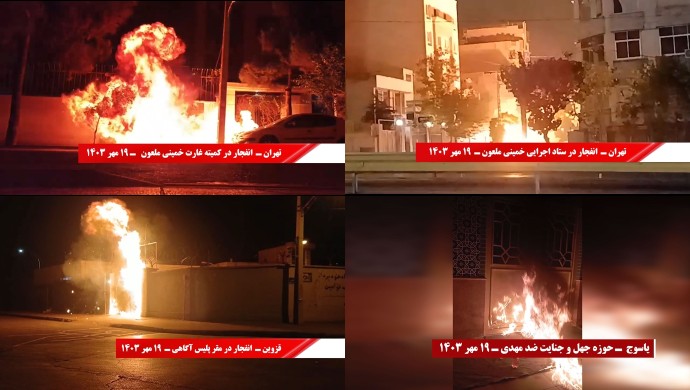

Simultaneously with the global campaign to end executions in Iran, the country’s rebellious youth targeted the regime’s centers of crime and oppression in various cities in response to the recent wave of executions, including 264 executions since the beginning of the presidency of Massoud Pezeshkian.
The fiery response of the rebellious youth took place on October 10, in tandem with the World Day Against the Death Penalty:
Explosions at the judiciary building in Shiraz, the disciplinary office in Arak, the so-called Revolutionary Court in Harsin, the General Directorate of Prisons in Kerman, the intelligence police in Qazvin, the executive headquarters and corrupt Khomeini foundation in Tehran and Kerman, and regime buildings in Yasuj.
The rebellious youth in Fahraj, Kerman, threw Molotov cocktails at an IRGC Basij base tasked with suppressing women, and in Zahedan, they attacked the headquarters of the IRGC’s intelligence and espionage unit as well as a Basij base.
In Tehran, they set fire to a Basij base and torched banners of former regime president Ebrahim Raisi, known as the “Executioner of Tehran. In Yasuj, one of the regime’s centers of fundamentalism was targeted.
In Mashhad, the youth set fire to the regime’s propaganda banners celebrating the Iran-Iraq war, and in Tehran, they torched a banner of Hassan Nasrallah, the now-dead leader of the Tehran-backed Hezbollah. Through these activities, the rebellious youth reflect the sentiment of the Iranian people, who have made it clear that they do not stand behind the regime’s warmongering efforts and its terrorist proxies.
On the occasion of the World Day Against the Death Penalty, a group of political prisoners in Ghezel Hesar Prison wrote in a message: “Under the religious dictatorship ruling Iran, the working class, especially prisoners, endure double suffering. Prisoners who are themselves victims of the regime’s expansionist policies live as if this is the end of the world, deprived of even the most basic legal rights. Yes, in the eyes of the rulers and their jailers, prisoners have no rights. Prisoners’ lives are taken as easily as drinking water, and unjust death sentences are issued in sham trials without the right to defense. Every week, some of our fellow inmates are handed over to the gallows, while others spend the night under the shadow of the noose, haunted by the nightmare of death. These are the most agonizing moments of our lives and those of our families.”
In another part of the statement from prisoners in Ghezel Hesar, it reads: “For more than 37 weeks, prisoners in 22 prisons have launched a broad campaign against executions, staging strikes on Tuesdays to bring the voice of Iranian prisoners to the world. On the eve of the World Day Against the Death Penalty, we call on the people of Iran, the awakened consciences of humanity, Amnesty International, and the UN Human Rights Committee to hear our voices and work to abolish the death penalty, putting pressure on the Iranian rulers to cancel these unjust execution orders.”
Yesterday, in this column, we wrote: “The support of figures, parliaments, human rights organizations, and free Iranians across the globe for the prisoners’ protest in the ‘No to Execution Tuesdays’ campaign has extended the “No to Execution’ movement beyond Iran’s borders, awakening the conscience of the world to stand with the prisoners and their campaign.”
As part of this campaign, 1,500 prominent figures from 78 countries across five continents have supported the global “No to Execution” movement in Iran. Among the signatories are 34 former presidents and prime ministers, 59 former ministers, 93 former UN reporters and ambassadors, 102 international judges and legal experts, 109 leading human rights experts, and 46 Nobel laureates.
In addition, 455 members of parliament, 90 mayors, and 85 city council members have signed this statement.
In part of the statement from the signatories of this campaign, it says: “we endorse and support Maryam Rajavi’s call to end executions in Iran and her steadfast commitment to abolishing the death penalty, as outlined in her Ten-Point Plan for Iran’s future over the past two decades. She reaffirmed this call at the International Jurists’ Conference on August 24, 2024, in Paris.”
The statement continues, noting the political motivations behind the brutal executions in Iran: “Iranian authorities are using these executions for political purposes, seeking to instill fear and terror to prevent the potential outbreak of uprisings by the Iranian people. Thus, any execution carried out under the ruling theocracy should be recognized as political in nature.”
Last week, Mrs. Maryam Rajavi, the president-elect of the National Council of Resistance of Iran (NCRI), attended a conference at the Parliamentary Assembly of the Council of Europe, where she called on the international community to support the Iranian Resistance’s “No to Execution” campaign and demanded accountability from the regime’s leaders for genocide and crimes against humanity.
The Iranian Resistance has been advocating for the abolition of the #DeathPenalty for over two decades
In the Resistance's 10 Point Plan for the Future of #Iran I emphasized the critical importance of abolishing capital punishment On the eve of the #WorldDayAgainsttheDeathPenalty… pic.twitter.com/RxHTHdTVKo— Maryam Rajavi (@Maryam_Rajavi) October 10, 2024