

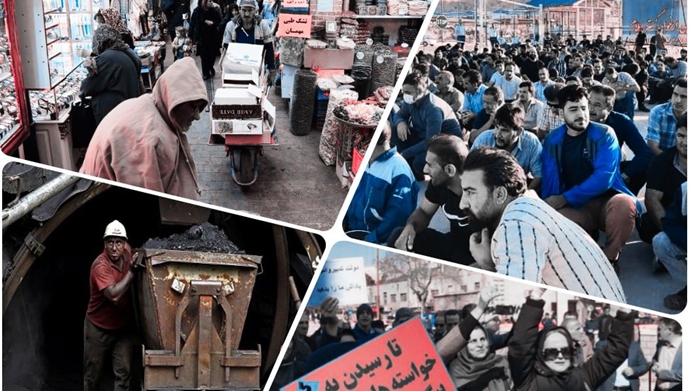

The explosion at the Tabas coal mine was one of the most tragic mining accidents in Iran, resulting in the heartbreaking death of more than 50 hard-working miners at a depth of approximately 500 meters underground.
One of the many reasons for this disaster was the outdated equipment and infrastructure of the mine. In images gradually released showing the conditions (or rather the forced labor) of the workers, in addition to medieval tools such as shovels and pickaxes, and their torn clothing and boots, the terrible state of the tunnels, broken-down wagons, and unsafe scaffolding demonstrated that the mining equipment had been abandoned for years without proper maintenance or repairs.
The Tabas mine explosion sparked renewed discussion on the state of infrastructure and once again brought the issue of decaying foundational systems to the forefront. However, under the rule of the mullahs, it’s not just the mines where time seems to have stopped. Everywhere one looks, the infrastructure is in severe crisis and on the verge of collapse.
A brief review of infrastructure should begin with the most important issue—healthcare, which is directly related to the health and lives of citizens.
Healthcare
The disregard for human life is clear in the regime’s policies and actions. The country’s healthcare infrastructure has become severely outdated and inefficient.
Nearly all parts of the healthcare system are falling apart. An official in the Ministry of Health admitted that “70% of hospitals and healthcare facilities in the country are outdated, with this number reaching 80% in Tehran, and 90% of these buildings cannot be retrofitted.” (Source: The official IRNA news agency, September 9). He also mentioned that some hospitals are over a hundred years old. He further referred to “50,000 outdated beds” that require hundreds of trillions of rials in funding.
On August 21, Bourse News website reported that the “aging and outdated pharmaceutical industry” is in a similar state, with “over 60% of the machinery and production lines in pharmaceutical companies reaching the point of obsolescence.”
The issue of deterioration in the healthcare system extends further, including the Emergency Medical Services (EMS), with “55% of ambulances in Iran no longer operational.”
Education
The decaying infrastructure in Iranian schools is one of the serious problems facing the education system. Many schools have old and unsafe buildings, which, due to the insufficient budget for repairs and renovations, pose serious risks to students.
On October 1, Aftab News referred to the regime’s statistics and wrote, “one-third of the schools in the country are not safe. This means that around 30% of the country’s schools lack the necessary safety for students.” At least 100,000 classrooms are unsafe, putting approximately 3 million students at risk. Yet, the regime, obsessed with warmongering, has other priorities.
In the short time since the schools reopened on September 21, reports have surfaced of collapsed roofs in schools in Isfahan and West Azerbaijan provinces, causing serious injuries and hospitalizing students.
Energy and electricity
One of the current crises in the energy production and distribution system is the imbalance in the power industry, which has become a serious challenge. In addition to the regime’s corruption, such as selling electricity to other countries or allocating major shares to Islamic Republic Guard Corps (IRGC) cryptocurrency mining centers, another reason for this imbalance is the aging power plants and transmission network from production to consumption.
The statistics are alarming in this area as well. A regime official stated that “30% of the country’s power grid is old and outdated and requires 140 trillion rials in investment.” (Source: Rokna News Agency, September 11)
As a result, the theft and plundering by regime leaders, along with widespread and organized corruption at all levels of the State, have not only looted the country’s resources but have also led to the deterioration and collapse of all infrastructure, pushing it into a state of crisis.
The consequence of this destruction is the decline in the quality of life and the growing poverty and misery of all social classes.
Now, when the problem lies in a country’s infrastructure, the solution also lies in changing the political “infrastructure” of the country, which, in political terms, is referred to as the “overthrow of the mullahs’ regime.”